


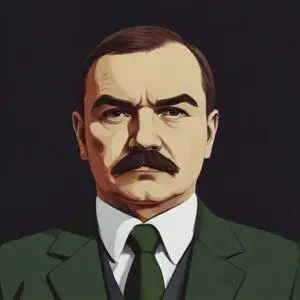
A Scottish-born Irish rebel leader who played a key role in the Easter Rising of 1916, advocating for Irish independence from British rule through socialist and republican ideologies.
James Connolly, a towering figure in Irish history, is best known for his pivotal role in the 1916 Easter Rising against British rule in Ireland. As a charismatic leader, socialist, and trade unionist, he dedicated his life to fighting for Irish independence and workers' rights.
Born on June 5, 1868, in the Cowgate district of Edinburgh, Scotland, Connolly was the third son of Irish parents, Mary McGinn and John Connolly. Growing up in poverty, he dropped out of school at the age of 11 to work as a laborer. This early exposure to hardships fueled his passion for social justice and inspired his later activism.
In 1896, Connolly moved to Ireland, where he founded the Irish Socialist Republican Party (ISRP), the country's first socialist party. The ISRP's manifesto called for an Ireland free from British rule, as well as from the grip of British capitalists, landlords, and financiers.
Connolly's involvement with the Industrial Workers of the World (IWW) in the United States from 1905 to 1910 further solidified his commitment to syndicalism. Upon his return to Ireland, he worked alongside James Larkin, organizing for the Irish Transport and General Workers' Union in Belfast and Dublin.
In 1916, Connolly committed the Irish Citizen Army (ICA), the union's militia, to the plans of the Irish Republican Brotherhood and the Irish Volunteers for a wartime insurrection. As commander of the Dublin garrison, he fought alongside Patrick Pearse, and the two led the rebellion from the General Post Office.
Wounded during the fighting, Connolly was executed by firing squad on May 12, 1916, along with six other signatories to the Proclamation of the Irish Republic. This martyrdom cemented his status as a hero in Irish history.
Connolly's influence on Irish republicanism and the labor movement cannot be overstated. He played a crucial role in shaping the country's struggle for independence and remains an icon for socialists and trade unionists worldwide.
"The worker is the slave of capitalist society, the female worker is the slave of that slave."
"The great appear great because we are on our knees: Let us rise."
These powerful words continue to resonate with people today, inspiring action and solidarity in the pursuit of social justice and equality.
Connolly's life and legacy can be seen as part of a broader global movement for social change and independence in the early 20th century. His commitment to syndicalism and socialism mirrors the contemporaneous efforts of figures like Vladimir Lenin and Rosa Luxemburg.
In the context of Irish history, Connolly's influence can be compared to that of other key figures, such as Patrick Pearse and Éamon de Valera, who also played crucial roles in the fight for independence.
James Connolly's remarkable life serves as a testament to the power of dedication, conviction, and sacrifice. His unwavering commitment to the causes of Irish independence, socialism, and workers' rights has left an indelible mark on history. As we reflect on his legacy, we are reminded of the importance of fighting for a more just and equitable society, where the voices of the marginalized are heard and valued.
Born in 1882
Leader of Ireland's struggle for independence from Britain, serving as both Prime Minister and President, and key figure in shaping the country's modern identity.
Born in 1890
Leader of the Irish independence movement, instrumental in negotiating the Anglo-Irish Treaty, and a key figure in the Irish War of Independence.
Born in 1879
Irish revolutionary leader who sparked the Easter Rising, a pivotal event in Ireland's struggle for independence. He's remembered for his bravery and poetic writings.
Born in 1775
Irish lawyer and politician who championed Catholic emancipation and served as Lord Mayor of Dublin, known for his advocacy for Irish rights and liberties.
Born in 1846
Leader of the Irish Parliamentary Party, advocating for Irish Home Rule and land reform, known for his charismatic leadership and strategic political maneuvering.
Born in 1763
Leader of the 1798 Irish Rebellion, fighting for independence from British rule and advocating for Catholic emancipation. His legacy inspired future Irish independence movements.
Born in 1778
Leader of the 1803 Irish rebellion against British rule, known for his passionate speeches and tragic execution at age 25.
