


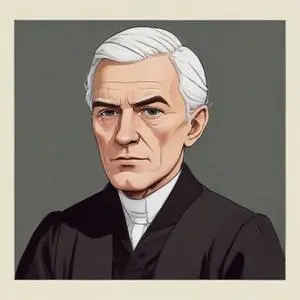
Irish lawyer and politician who championed Catholic emancipation and served as Lord Mayor of Dublin, known for his advocacy for Irish rights and liberties.
Daniel O'Connell, hailed as "The Liberator," is renowned for his unwavering dedication to securing Catholic emancipation in 19th-century Ireland. As the acknowledged political leader of Ireland's Roman Catholic majority, he championed liberal and reform causes, earning him international recognition as a champion of human rights.
O'Connell was born on August 6, 1775, in Carhan, County Kerry, Ireland, to a wealthy Roman Catholic family. His parents, Morgan O'Connell and Catherine O'Mullane, instilled in him a strong sense of faith and social responsibility. O'Connell's early education took place in local hedge schools, where he developed a passion for learning and a keen sense of injustice.
In 1823, O'Connell founded the Catholic Association, a grassroots organization aimed at achieving Catholic emancipation. Through tireless campaigning, public speaking, and strategic lobbying, O'Connell mobilized Catholic Ireland, from the impoverished tenant farmers to the middle class, to demand equal rights. His efforts culminated in the passing of the Catholic Relief Act in 1829, which granted Catholics the right to sit in Parliament.
O'Connell's electoral victories in 1828 and 1830 earned him a seat in the United Kingdom Parliament, where he continued to advocate for liberal and reform causes. As an abolitionist, he vehemently opposed slavery and championed the rights of marginalized communities. Despite his achievements, O'Connell's ultimate goal – the repeal of the 1800 Act of Union and the restoration of the Irish Parliament – remained elusive.
O'Connell faced criticism for his political compromises and patronage system, which some perceived as autocratic. The growing agrarian crisis and the devastating impact of the Great Famine in his final years further strained his leadership. Despite these challenges, O'Connell remained committed to his cause, earning him both admiration and respect from his contemporaries.
Daniel O'Connell's remarkable life and career serve as a testament to his unwavering dedication to social justice and human rights. His legacy extends far beyond his native Ireland, inspiring generations of reformers and abolitionists worldwide. As we reflect on his life and achievements, we are reminded of the power of individual courage and determination in shaping the course of history.
"The altar of freedom is not a pedestal for a statue, but a battleground for the living."
"The justice of our cause must be the anchor of our hope, and the beauty of our endeavor must be the magnet of our hearts."
O'Connell's own words continue to inspire and motivate, reminding us of the importance of perseverance and dedication in the pursuit of justice and equality.
Born in 1846
Leader of the Irish Parliamentary Party, advocating for Irish Home Rule and land reform, known for his charismatic leadership and strategic political maneuvering.
Born in 1882
Leader of Ireland's struggle for independence from Britain, serving as both Prime Minister and President, and key figure in shaping the country's modern identity.
Born in 1890
Leader of the Irish independence movement, instrumental in negotiating the Anglo-Irish Treaty, and a key figure in the Irish War of Independence.
Born in 1902
Irish revolutionary who fought in the Anglo-Irish War and was executed by the British at 18, becoming a martyr for the Irish independence movement.
Born in 1879
Irish revolutionary leader who sparked the Easter Rising, a pivotal event in Ireland's struggle for independence. He's remembered for his bravery and poetic writings.
Born in 1868
A Scottish-born Irish rebel leader who played a key role in the Easter Rising of 1916, advocating for Irish independence from British rule through socialist and republican ideologies.
Born in 1763
Leader of the 1798 Irish Rebellion, fighting for independence from British rule and advocating for Catholic emancipation. His legacy inspired future Irish independence movements.
