


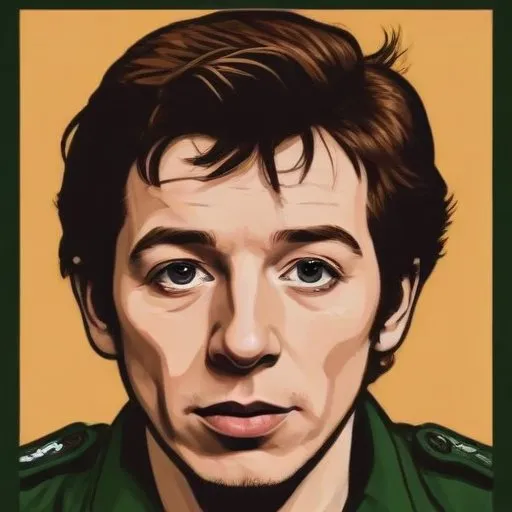
Irish revolutionary who fought in the Anglo-Irish War and was executed by the British at 18, becoming a martyr for the Irish independence movement.
Kevin Barry, a young Irish Republican Army (IRA) soldier, was executed by the British Government on November 1, 1920, for his involvement in an attack on a British Army supply lorry, resulting in the deaths of three British soldiers. His tragic fate, at the tender age of 18, would ignite a fire of nationalistic fervor in Ireland, cementing his status as a martyr for the Irish independence movement.
Born on January 20, 1902, in Dublin, Ireland, Kevin Barry was the fourth of seven children to Thomas and Mary Barry. His father, a successful dairy businessman, passed away when Kevin was just six years old, leaving his mother to manage the family's farm in County Carlow and their townhouse on Fleet Street. Kevin's early education took place at the National School in Rathvilly and later at the O'Connell Schools in Dublin.
In 1916, Barry enrolled in St. Mary's College, Rathmines, where he developed a passion for Irish history and nationalism. As the Irish War of Independence gained momentum, Barry joined the IRA, determined to fight for his country's freedom. On September 20, 1920, Barry was part of an IRA ambush on a British Army supply lorry, which resulted in the deaths of three British soldiers. Barry was captured, and despite international appeals for clemency, he was sentenced to death.
Bloodied and bruised from his interrogation, Barry refused to betray his comrades, earning him the admiration of the Irish people. His execution, just seven days after the death of Terence MacSwiney, the republican Lord Mayor of Cork, sparked widespread outrage and condemnation. The British Government's handling of Barry's case further galvanized public opinion against British rule, paving the way for the escalation of violence in the Irish War of Independence.
Kevin Barry's ultimate sacrifice would inspire generations of Irish nationalists, cementing his place in Irish history alongside other revered figures like Patrick Pearse and Michael Collins. The poem "Kevin Barry," written by Irish poet and writer, Dr. Peadar O'Donnell, eloquently captures the essence of Barry's martyrdom:
"Oh, Kevin Barry, the grey dawn is breaking
In Dublin's fair city, where you were born
The hills of Rathfarnham, where you played and loved
Will echo with your name, until the morn."
Beyond his native Ireland, Barry's story has resonated with struggle for independence and self-determination worldwide, solidifying his status as an enduring symbol of national pride and resistance.
Today, Kevin Barry's legacy lives on through the Kevin Barry Memorial, situated near the site of his execution in Dublin's Mountjoy Prison. The iconic Irish ballad, "Kevin Barry," continues to be sung in pubs and gatherings across Ireland, ensuring that the spirit of this young martyr remains forever etched in the hearts and minds of the Irish people.
In the words of Barry himself, "It is not the dying that is hard, but the leaving of all that is dear."
As we reflect on the life and sacrifice of Kevin Barry, we are reminded of the power of conviction, courage, and selflessness in the face of adversity.
Born in 1879
Irish revolutionary leader who sparked the Easter Rising, a pivotal event in Ireland's struggle for independence. He's remembered for his bravery and poetic writings.
Born in 1868
A Scottish-born Irish rebel leader who played a key role in the Easter Rising of 1916, advocating for Irish independence from British rule through socialist and republican ideologies.
Born in 1882
Leader of Ireland's struggle for independence from Britain, serving as both Prime Minister and President, and key figure in shaping the country's modern identity.
Born in 1890
Leader of the Irish independence movement, instrumental in negotiating the Anglo-Irish Treaty, and a key figure in the Irish War of Independence.
Born in 1904
Irish lawyer and politician who served as Minister for External Affairs and was awarded the Nobel Peace Prize for his humanitarian work, particularly in the area of human rights. He was a key figure in the formation of Amnesty International.
Born in 1879
An Irish republican politician who served as Lord Mayor of Cork and famously died after a 74-day hunger strike in 1920, inspiring widespread international sympathy and support for the Irish independence movement.
