


The Geneva Conference of 1954 marked a pivotal moment in world history, as the international community gathered to determine the fate of Vietnam. The conference's outcome, the partitioning of Vietnam into North Vietnam and South Vietnam, set the stage for a decades-long struggle for control of the region, ultimately culminating in the Vietnam War.
Following World War II, the Allied powers sought to establish a new world order, with the United States and the Soviet Union emerging as superpowers. In Indochina, the French sought to reassert their colonial dominance, but the Viet Minh, led by Ho Chi Minh, had other plans. The Viet Minh, backed by the Soviet Union and China, waged a brutal war against the French, culminating in the First Indochina War.
From May to July 1954, diplomats from 16 nations gathered in Geneva to negotiate an end to the First Indochina War. The conference was marked by intense diplomatic maneuvering, with the United States and the Soviet Union engaging in a high-stakes game of Cold War politics.
The Viet Minh, buoyed by their military successes, held significant leverage in the negotiations. Ho Chi Minh's delegation pushed for a unified, communist Vietnam, while the United States and its allies advocated for a divided Vietnam, with a non-communist South.
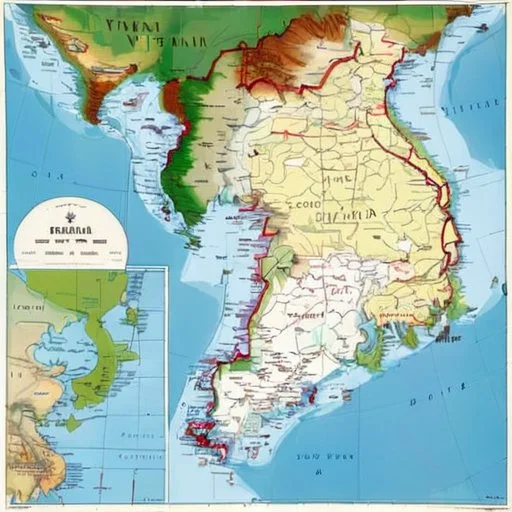
The Geneva Accords, signed on July 20, 1954, effectively partitioned Vietnam into two zones: North Vietnam, led by Ho Chi Minh's communist government, and South Vietnam, backed by the United States and its anticommunist allies.
The 17th parallel, a demilitarized zone (DMZ), separated the two zones, with the understanding that nationwide elections would be held in 1956 to reunify the country. However, these elections never took place, and the division of Vietnam became a de facto permanent arrangement.
The Geneva Conference and the partition of Vietnam had far-reaching consequences, shaping the course of world history and influencing global politics for decades to come. The conference marked a turning point in the Cold War, as the United States and the Soviet Union began to confront each other directly in proxy wars around the world.
Today, the Geneva Conference serves as a cautionary tale about the dangers of imperial ambition and the importance of diplomacy in preventing conflict. As the world continues to grapple with the complexities of international relations, the legacy of the Geneva Conference remains a powerful reminder of the need for cooperation and dialogue in the pursuit of peace.
The Geneva Conference was not the first attempt to negotiate a peaceful resolution to the Indochina conflict. In 1946, Ho Chi Minh's Viet Minh government and the French government had signed the Modus Vivendi, which recognized Vietnamese independence within the French Union. However, the agreement was short-lived, and the First Indochina War broke out in 1947.
The conflict dragged on for seven years, with the Viet Minh waging a guerrilla war against the French colonial forces. The war was marked by brutal atrocities, including the Bao Dai massacre, in which French troops killed hundreds of Vietnamese civilians.
In 1953, the Viet Minh launched a major offensive, capturing the strategic city of Dien Bien Phu. The French, realizing they could not hold on to their colonial empire, agreed to negotiate a peace settlement.

Pham Van Dong, the first Prime Minister of North Vietnam, played a crucial role in the Geneva Conference negotiations. A member of the Viet Minh's central committee, Dong was a skilled diplomat and strategist who worked closely with Ho Chi Minh.
Dong's negotiating skills were instrumental in securing key concessions from the French and American delegations. He was known for his calm and composed demeanor, which helped to diffuse tensions during tense negotiations.
After the Geneva Accords, Dong became a key figure in North Vietnamese politics, serving as Prime Minister from 1955 to 1987. He played a crucial role in shaping North Vietnam's economic and foreign policy, and was a strong advocate for reunification with South Vietnam.
The Geneva Conference marked a significant shift in US policy towards Vietnam. Prior to the conference, the US had supported the French colonial government, providing financial and military aid to prop up their colonial empire.
However, with the French defeat at Dien Bien Phu, the US began to reassess its policy towards Vietnam. The Eisenhower administration, fearful of communist expansion in Southeast Asia, decided to support the creation of an independent, non-communist South Vietnam.
The US delegation, led by Wendell Bedell, advocated for a divided Vietnam, hoping to prevent communist domination of the region. However, the US also recognized the Viet Minh's legitimacy, and agreed to provide humanitarian aid to both North and South Vietnam.
The Geneva Conference was held against the backdrop of the Cold War, with the US and the Soviet Union engaging in a proxy war in Vietnam. The conference marked a significant escalation of Cold War tensions, as the two superpowers began to confront each other directly in proxy wars around the world.
The conference was also influenced by the Bandung Conference, a meeting of Asian and African nations held in Indonesia in 1955. The Bandung Conference promoted Afro-Asian solidarity and called for an end to colonialism, which further galvanized the Viet Minh's demands for independence.
The Geneva Accords ultimately benefited the Soviet Union, which gained a strategic ally in North Vietnam and increased its influence in Southeast Asia.
Historical scholarship has often viewed the Geneva Conference as a failed peace settlement, which ultimately led to the Vietnam War. Critics argue that the Accords created a temporary solution that only delayed the inevitability of conflict.
Others have seen the conference as a missed opportunity for genuine reunification, as the US and the Soviet Union failed to provide sufficient guarantees for nationwide elections in 1956.
Historians have also debated the role of the conference in shaping the trajectory of the Cold War, with some arguing that it marked a significant escalation of tensions between the US and the Soviet Union.