


In a watershed moment that would shake the foundations of the Catholic Church, the First Vatican Council decreed the dogma of papal infallibility, proclaiming the Pope's absolute authority in matters of faith and morals. This fateful decision, ratified on July 18, 1870, would forever alter the hierarchical structure of the Church, cementing the Pope's dominance and sparking intense debate.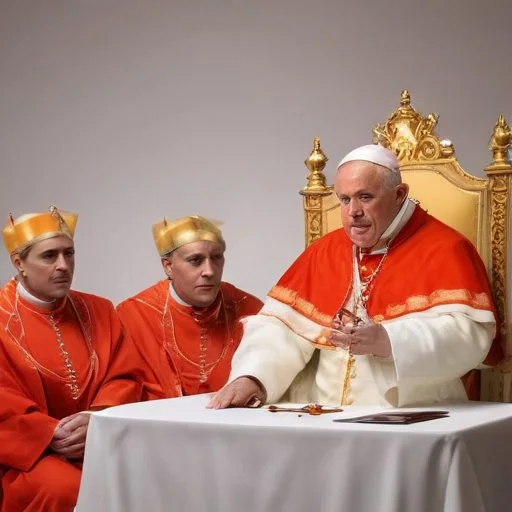
The mid-19th century was a tumultuous period for the Catholic Church. The aftermath of the French Revolution, the rise of liberalism, and the unification of Italy had led to a significant erosion of the Church's temporal power and influence. Amidst this chaos, Pope Pius IX, determined to reassert the Church's authority, called the First Vatican Council in 1869.
This pivotal gathering brought together over 700 bishops from around the world, tasked with addressing the Church's internal struggles and defining its stance on critical issues. The Council's deliberations would ultimately culminate in the promulgation of the doctrine of papal infallibility, a move that would have far-reaching consequences.
The papal decree, titled Pastor Aeternus, declared that "the Roman Pontiff, when he speaks ex cathedra (from the chair), possesses, by the divine assistance promised to him in blessed Peter, that infallibility which the divine Redeemer willed his Church to enjoy in defining doctrine concerning faith and morals."
This sweeping statement effectively established the Pope as the ultimate arbiter of truth, imbuing him with an aura of infallibility that would be revered and feared in equal measure.
The doctrine of papal infallibility had significant repercussions within the Church and beyond. It:
As the Church cemented its position on papal infallibility, it sparked intense debate and controversy. Many critics saw this move as a power grab, an attempt to stifle dissent and consolidate authority.
The First Vatican Council's decree sparked intense reactions from within and outside the Church. Some notable critics included:
Despite these criticisms, the doctrine of papal infallibility stood firm, shaping the Church's trajectory and continuing to influence Catholic thought to this day.
The First Vatican Council's decree on papal infallibility remains a watershed moment in Catholic history, its reverberations still felt today. While some hail it as a triumph of papal authority, others see it as a contentious and problematic doctrine, stifling debate and fostering an unhealthy culture of obedience.
As we reflect on this pivotal event, we are reminded of the enduring power of ideas and the Church's ongoing struggle to balance authority with accountability, dogma with dissent.
In the words of Pope Pius IX himself, "It is not the Pope, but the Pope as the embodiment of the Church, that is infallible." The debate continues, as the Catholic Church grapples with the complexities of its own identity and the fallout of that fateful decree.
Pope Pius IX, born Giovanni Maria Mastai-Ferretti, was a pivotal figure in the Catholic Church's tumultuous 19th century. Elected in 1846, he would go on to become one of the longest-reigning popes in history, leaving an indelible mark on the Church's trajectory.
A strong-willed and conservative leader, Pius IX was determined to reassert the Church's authority in the face of rising liberalism and secularism. His calling of the First Vatican Council in 1869 was a testament to his unwavering commitment to upholding the Church's traditions and combating the perceived threats to its power.

The concept of papal infallibility is unique to the Catholic Church, but it bears some resemblance to similar notions of authority found in other religious traditions.
In Eastern Orthodoxy, for instance, the Patriarch of Constantinople is considered the first among equals, holding a position of high authority but not quite equivalent to papal infallibility. Similarly, in some Protestant denominations, the idea of sola scriptura (scripture alone) serves as a counterweight to papal authority, emphasizing the Bible as the ultimate source of truth.
Historians have long debated the significance and implications of papal infallibility, with some viewing it as a necessary bulwark against the forces of modernity and others seeing it as a retrograde attempt to stifle intellectual freedom.
Ultramontane historians, such as those influenced by the writings of Joseph de Maistre, tend to portray papal infallibility as a necessary assertions of the Church's authority in the face of rising liberalism. In contrast, liberal historians, like Lord Acton, have been more critical, seeing the doctrine as a threat to individual liberty and intellectual inquiry.
The promulgation of papal infallibility in 1870 occurred against the backdrop of significant geopolitical upheaval. The unification of Italy, the rise of nation-states, and the decline of the Ottoman Empire all contributed to a complex web of political and religious tensions.
In this context, the doctrine of papal infallibility can be seen as a strategic move by the Catholic Church to reassert its authority and influence in a rapidly changing world.
The doctrine of papal infallibility draws on a rich philosophical and ideological heritage, influenced by the writings of St. Augustine, St. Thomas Aquinas, and other prominent Catholic thinkers.
The concept of infallibility is grounded in the idea of the Church as a divinely instituted institution, with the Pope serving as the Vicar of Christ on earth. This understanding is rooted in a particular interpretation of scripture, tradition, and the nature of authority within the Church.