


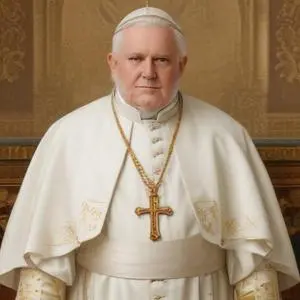
The longest-reigning pope in history, who oversaw the loss of the Papal States and convened the First Vatican Council, which defined papal infallibility.
Pope Pius IX is renowned for being the second-longest reigning pope in history, serving the Catholic Church for an unprecedented 32 years from 1846 to 1878. During his reign, he convoked the First Vatican Council, which would have a profound impact on the Church's doctrine and practices.
Giovanni Maria Mastai Ferretti, later known as Pope Pius IX, was born on May 13, 1792, in Senigallia, Italy. He was ordained as a priest in 1815 and went on to serve as the Archbishop of Spoleto and later as the Archbishop of Imola.
In 1846, Mastai Ferretti was elected as the Pope, taking the name Pius IX. Initially, he was considered liberal, but his views shifted dramatically in the wake of the Revolutions of 1848. Following the assassination of his prime minister, Pellegrino Rossi, Pius fled Rome and excommunicated all participants in the short-lived Roman Republic.
After his return to Rome in 1850, Pius's policies and doctrinal pronouncements became increasingly conservative. One of the most controversial incidents during his reign was the kidnapping of Edgardo Mortara, a six-year-old Jewish boy, who was taken from his family and raised as a Catholic.
Pius IX made significant contributions to Catholic doctrine, including the promulgation of the dogma of the Immaculate Conception in 1854, which declared that Mary, the Mother of God, was conceived without original sin. He also issued the Syllabus of Errors in 1864, condemning liberalism, modernism, and other Enlightenment ideas.
In 1868, Pius IX convoked the First Vatican Council, which would have a profound impact on the Church's doctrine and practices. The Council led to the formation of the dogma of papal infallibility, which declared that the Pope was infallible when speaking ex cathedra.
Pius IX died on February 7, 1878, and was beatified by Pope John Paul II in 2000. Despite his controversial reign, he remains one of the most significant figures in Catholic history, leaving a lasting legacy on the Church's doctrine, practices, and politics.
Born in 1920
Leader of the Catholic Church from 1978 to 2005, known for helping to end communism in Poland and being a charismatic advocate for human rights and social justice.
99 Years Old
The first pope to resign in nearly 600 years, he's known for his conservative views and efforts to strengthen the Catholic Church's traditional teachings. He's also a prolific writer and theologian.
89 Years Old
The leader of the Catholic Church, known for his progressive stance on social issues and efforts to reform the Church, inspiring millions worldwide.
Born in 1810
The first pope to fully embrace modernity, he issued the groundbreaking encyclical Rerum Novarum, which addressed social justice and workers' rights, shaping the Catholic Church's stance on social issues.
Born in 1554
Established the Congregation for the Propagation of the Faith, a missionary organization that aimed to spread Catholicism globally, and standardized the papal conclave process.
Born in 1568
The 17th-century Catholic leader who reigned for 21 years, known for his strong stance against Galileo Galilei and his scientific discoveries, as well as his extensive patronage of the arts.
Born in 1611
Led the Catholic Church during a tumultuous period, reforming the Church's finances and combating corruption, while also opposing the French monarch's attempts to exert control over the Church.
Born in 1652
The 18th-century Pope who banned Freemasonry and reformed the Roman Curia, leaving a lasting impact on the Catholic Church's governance and relations with secret societies.
