


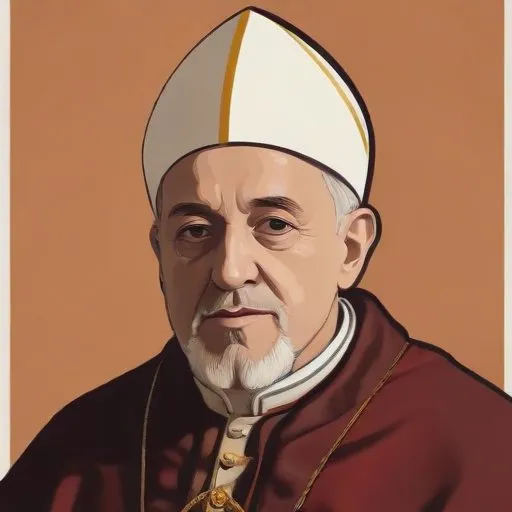
Established the Congregation for the Propagation of the Faith, a missionary organization that aimed to spread Catholicism globally, and standardized the papal conclave process.
Pope Gregory XV is renowned for his pivotal role in founding the Congregation for the Propagation of the Faith, an organization dedicated to spreading Catholicism and overseeing missionary work worldwide. He is also celebrated for canonizing notable saints, including Ignatius of Loyola, Francis Xavier, Teresa of Ávila, and Philip Neri, solidifying his commitment to the Counter-Reformation.
Alessandro Ludovisi, later known as Pope Gregory XV, was born on January 9, 1554, in Bologna, Italy, to Pompeo Ludovisi, Count of Samoggia, and Camilla Bianchini. He was the third of seven children and received his education at the Roman College, run by the Society of Jesus in Rome, and the German College in Rome.
Gregory XV's career flourished in Rome, where he held various positions:
In 1612, Pope Paul V appointed him as the Archbishop of Bologna, where he was consecrated a bishop on May 1, 1612, in the church of Sant'Andrea al Quirinale in Rome.
In August 1616, Pope Paul V sent Gregory XV as Apostolic Nuncio to the Duchy of Savoy to mediate between Charles Emmanuel I, Duke of Savoy, and Philip III of Spain in their dispute concerning the Gonzaga Duchy of Montferrat. This diplomatic effort showcased his exceptional communication and conflict-resolution skills.
On September 19, 1616, Pope Paul V elevated Gregory XV to the rank of cardinal, recognizing his dedication to the Catholic Church.
Pope Gregory XV's establishment of the Congregation for the Propagation of the Faith has had a lasting impact on the spread of Catholicism globally. His commitment to the Counter-Reformation solidified his place in Catholic history, and his canonization of notable saints has inspired generations of Catholics.
Through his diplomatic efforts and unwavering dedication to the Catholic Church, Pope Gregory XV left an enduring legacy that continues to shape the Catholic faith today.
Born in 1568
The 17th-century Catholic leader who reigned for 21 years, known for his strong stance against Galileo Galilei and his scientific discoveries, as well as his extensive patronage of the arts.
Born in 1611
Led the Catholic Church during a tumultuous period, reforming the Church's finances and combating corruption, while also opposing the French monarch's attempts to exert control over the Church.
Born in 1590
The 254th Pope, a strong advocate for the Catholic Church's authority, known for his papal bull condemning the doctrine of probabilism.
Born in 1535
The second shortest-reigning pope in history, serving for just 27 days in 1605, he is most known for his brief but tumultuous papacy marked by power struggles and controversy.
Born in 1476
A fierce defender of Catholic orthodoxy, he implemented strict reforms and established the Roman Inquisition to root out heresy. His papacy was marked by controversy and conflict.
Born in 1568
The 17th-century Catholic leader who reigned for 21 years, known for his strong stance against Galileo Galilei and his scientific discoveries, as well as his extensive patronage of the arts.
Born in 1431
Ruthless and cunning, this Pope was infamous for his corrupt and immoral ways, using his power to further his family's interests.
Born in 1590
The 254th Pope, a strong advocate for the Catholic Church's authority, known for his papal bull condemning the doctrine of probabilism.
