


The first Victory Day Parade, held on Red Square in Moscow, Soviet Union, is renowned for marking the monumental triumph of the Soviet Union over Nazi Germany, culminating in a grand spectacle of military prowess and national pride. This historic event, which took place on June 24, 1945, showcased the Soviet Union's unwavering strength and solidarity, cementing its position as a dominant global superpower.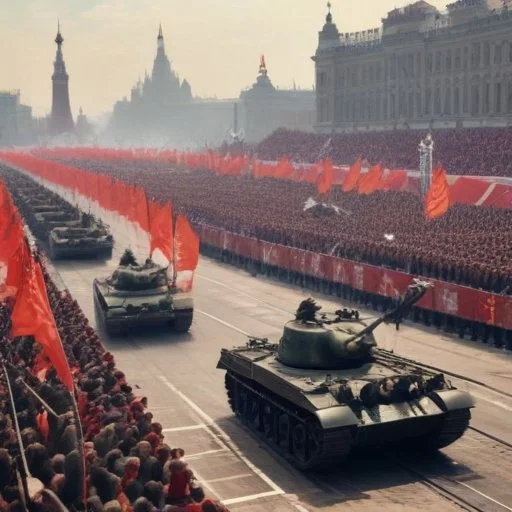
The Soviet Union's victory over Nazi Germany was a culmination of years of intense struggle and sacrifice. The Nazi invasion of the Soviet Union in 1941, codenamed Operation Barbarossa, had caught the Soviet military off guard, resulting in significant losses and territorial concessions. However, under the leadership of Joseph Stalin, the Soviet Union rallied and launched a series of counterattacks, eventually pushing the Nazi forces back and reclaiming lost territory.
The success of the Soviet Union's war effort was largely attributed to the strategic leadership of key figures such as General Georgy Zhukov, who played a crucial role in planning and executing the Soviet counterattacks, and Marshal Konstantin Rokossovsky, who led the Soviet troops to victory in the Battle of Berlin.
The first Victory Day Parade was a grand affair, featuring thousands of troops, tanks, artillery, and aircraft rumbling through Red Square, accompanied by the thunderous applause and cheers of Soviet citizens. The parade was a testament to the Soviet Union's military prowess, showcasing its latest weaponry and technology, including the iconic T-34 tank and the IL-2 Sturmovik aircraft.
The Victory Day Parade had a profound impact on Soviet society, fostering a sense of national pride and unity. The event brought together people from all walks of life, transcending social and cultural boundaries, and created a shared sense of purpose and belonging.
The Soviet Union's victory over Nazi Germany marked a significant shift in the global balance of power, cementing the Soviet Union's position as a superpower and paving the way for the emergence of the Cold War. The event also had far-reaching implications for the world order, influencing the formation of the United Nations and the post-war settlement.
Personal accounts from participants and eyewitnesses provide a poignant glimpse into the human experience during the Victory Day Parade. One soldier recalled the immense sense of pride and relief as he marched through Red Square, knowing that the war was finally over and that he would soon be reunited with his family.
The first Victory Day Parade set a precedent for future Victory Day celebrations, which have continued to be an important part of Russian and Soviet tradition. The event has also inspired similar celebrations around the world, serving as a testament to the enduring legacy of the Soviet Union's resilience and strength.
The first Victory Day Parade serves as a testament to the bravery and resilience of the Soviet people, inspiring future generations to persevere in the face of adversity. The event reminds us of the importance of national pride, unity, and determination, and continues to be a powerful symbol of the human spirit.
The road to the first Victory Day Parade was paved with the sacrifices of millions of Soviet citizens. The war had exacted a heavy toll, with over 20 million lives lost and millions more displaced. The Soviet economy was in shambles, and the infrastructure lay in ruins. Yet, despite the devastation, the Soviet people remained resolute, driven by their determination to emerge victorious.
In the months leading up to the parade, the Soviet government worked tirelessly to rebuild and restore the city of Moscow. The streets were cleaned, the buildings were repaired, and the city was adorned with banners and flags. The atmosphere was electric, with excitement and anticipation building up to the grand event.
The night before the parade, thousands of troops and performers rehearsed their roles, perfecting their drills and routines. The sounds of music and laughter filled the air, mingling with the scent of blooming flowers and freshly cut grass. It was a moment of pure joy, a fleeting glimpse of peace in a world torn apart by war.
General Georgy Zhukov: The Mastermind Behind the Soviet Victory
General Georgy Zhukov was the architect of the Soviet Union's victory over Nazi Germany. A brilliant military strategist, Zhukov played a crucial role in planning and executing the Soviet counterattacks that ultimately led to the defeat of the Nazi forces.
Zhukov's leadership was instrumental in the Battle of Stalingrad, where the Soviet forces trapped and defeated the German Sixth Army. He then went on to plan and execute the Battle of Kursk, the largest tank battle in history, which marked a decisive turning point in the war.
Throughout the war, Zhukov remained a stoic figure, beloved by his troops and respected by his enemies. He was a true hero of the Soviet Union, and his legacy continues to inspire generations of military leaders.
The first Victory Day Parade had a profound impact on Soviet culture, fostering a sense of national pride and unity. The event brought together people from all walks of life, transcending social and cultural boundaries.
The parade was a celebration of the Soviet people's resilience and strength, a testament to their ability to persevere in the face of adversity. It was a moment of pure joy, a fleeting glimpse of peace in a world torn apart by war.
The parade also marked a shift in Soviet cultural identity, as the country began to assert its dominance on the global stage. The event was a declaration of the Soviet Union's emergence as a superpower, and it set the tone for the country's post-war cultural and artistic expression.
The Technology Behind the Victory Day Parade
The first Victory Day Parade showcased the Soviet Union's impressive technological prowess, featuring the latest in military hardware and equipment. The iconic T-34 tank, which played a crucial role in the Soviet victory, was prominently displayed, along with the IL-2 Sturmovik aircraft and other advanced weaponry.
The parade also highlighted the Soviet Union's advancements in communication and transportation technology, with state-of-the-art radio equipment and vehicles on display.
The technology on display at the parade was a testament to the Soviet Union's commitment to innovation and scientific progress, and it set the tone for the country's future technological advancements.
The Geopolitical Context of the First Victory Day Parade
The first Victory Day Parade took place at a critical moment in world history, marking the end of World War II and the beginning of the Cold War. The event was a declaration of the Soviet Union's emergence as a superpower, and it set the tone for the country's post-war foreign policy.
The parade was a symbol of the Soviet Union's growing influence on the global stage, and it marked a significant shift in the balance of power in Europe and beyond.
The event was closely watched by the international community, with leaders from around the world paying close attention to the Soviet Union's display of military might and economic strength.