


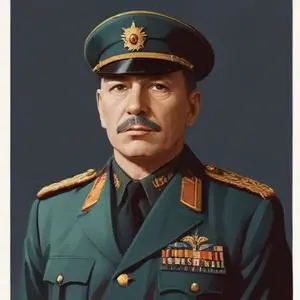
A Soviet military leader who played a crucial role in several key battles, including the Battle of Stalingrad and the capture of Berlin, earning him the highest military honors. He was a skilled strategist and tactician who helped turn the tide of the war in favor of the Allies.
Konstantin Rokossovsky was a Soviet and Polish officer who left an indelible mark on the annals of World War II, earning the esteemed title of Marshal of the Soviet Union and Marshal of Poland. This decorated commander played a pivotal role in some of the war's most decisive battles, including the defense of Moscow, Stalingrad, and Kursk, cementing his reputation as a master strategist and fearless leader.
Rokossovsky was born on December 21, 1896, in Warsaw, which was then part of the Russian Empire. Little is known about his early life, as he was a private individual who kept his personal life shrouded in mystery. However, it is known that he served in the Imperial Russian Army during World War I, and in 1917, he joined the Red Guards, followed by the Red Army in 1918.
Rokossovsky's military prowess was evident early on, as he fought with distinction during the Russian Civil War of 1917-1922. He held senior commands until 1937, when he fell victim to the Great Purge. Branded a traitor, imprisoned, and tortured, Rokossovsky's future looked bleak. However, the urgent need for experienced officers during the Winter War of 1939-1940 led to his reinstatement.
Following Germany's invasion of the Soviet Union in June 1941, Rokossovsky's military acumen was put to the ultimate test. He played key roles in the defense of Moscow, the counteroffensives at Stalingrad, and the Battle of Kursk. His strategic genius was instrumental in planning and executing part of Operation Bagration in 1944, one of the most decisive Red Army successes of the war. This achievement earned him the prestigious title of Marshal of the Soviet Union.
In the aftermath of World War II, Rokossovsky became Defence Minister and deputy chairman of the Council of Ministers in the newly established Polish People's Republic. He served in this capacity from 1949 until his removal in 1956 during the Polish October.
Rokossovsky's legacy extends far beyond his military accomplishments. He was a strong advocate for Polish-Russian cooperation and played a crucial role in shaping Poland's post-war government. Despite his later years being marked by controversy and persecution, Rokossovsky's contribution to the Allied victory in World War II remains unwavering.
Rokossovsky's personal life was marked by simplicity and humility. He was known for his quiet confidence and unwavering commitment to his country. One of his most memorable quotes, "I was born in a czarist police state, I lived under communism, and I'll die in a socialist Poland," is a testament to his complex and multifaceted life.
Konstantin Rokossovsky's influence on modern society is profound. He played a significant role in shaping the course of World War II and the subsequent formation of the Eastern European political landscape. His military strategies and leadership continue to inspire and educate generations of military historians and enthusiasts.
Rokossovsky's legacy extends beyond the military sphere, as he remains an important cultural icon in both Poland and Russia. His commitment to Polish-Russian cooperation and his advocacy for socialism continue to inspire and influence contemporary politics.
A decorated hero, strategist, and leader, Konstantin Rokossovsky's life is a testament to the power of determination, courage, and conviction. His unwavering commitment to his country and his people has left an indelible mark on the annals of history, ensuring his legacy as one of the most revered and respected military leaders of the 20th century.
Born in 1896
A Soviet military leader who played a crucial role in defeating Nazi Germany in World War II, and later became a key figure in Soviet politics.
Born in 1878
The Soviet Union's ruthless leader who ruled with an iron fist, implementing policies that led to widespread famine and purges, while also playing a crucial role in defeating Nazi Germany in World War II.
Born in 1870
Founder of the world's first socialist state, leading the Bolshevik Revolution and establishing the Soviet Union, known for his radical Marxist ideology and authoritarian rule.
Born in 1879
Founded the Red Army and played a crucial role in the Russian Revolution, shaping the course of modern communism. A key figure in 20th-century politics and ideology.
Born in 1888
A prominent figure in the Russian Revolution, he was a key architect of the Soviet economy and a vocal critic of Stalin's regime, ultimately falling victim to his purges.
Born in 1899
Soviet Union's ruthless secret police chief, responsible for millions of deaths and brutal suppressions during Stalin's regime, known for his cunning and feared reputation.
Born in 1909
Soviet Minister of Foreign Affairs who played a crucial role in shaping the country's foreign policy during the Cold War, known for his diplomatic skills and ability to navigate complex international relations.
Born in 1902
A Soviet politician and economist who played a key role in shaping the country's economic and political policies during the Cold War era, known for his pragmatic approach and influence on Soviet leadership.
