


The Battle of Mars-la-Tour, fought on August 16, 1870, was a pivotal moment in the Franco-Prussian War, marking a decisive Prussian victory that would alter the course of the conflict. This crucial confrontation, also known as the Battle of Vionville or the Battle of Mars-la-Tour-Vionville, sealed the fate of the war, paving the way for the Prussians to besiege the city of Metz and trapping the French army inside.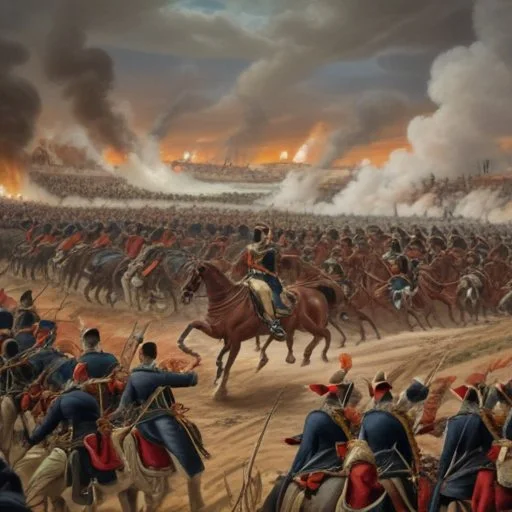
The Franco-Prussian War, sparked by a series of diplomatic crises and militaristic posturing, had been brewing for years. The Prussian Kingdom, under the leadership of Otto von Bismarck, sought to unite the German states under a single, powerful entity. France, fearing encirclement and eager to maintain its dominance in Europe, responded with a declaration of war on July 19, 1870.
As the war raged on, the French Army of the Rhine, led by Marshal François Achille Bazaine, clashed with the Prussian army, commanded by General Konstantin von Alvensleben, near the town of Mars-la-Tour. The Prussians, boasting superior artillery and cavalry, outmaneuvered the French, exploiting their weaknesses and forcing them to retreat. The Battle of Mars-la-Tour was a masterclass in Prussian military strategy, showcasing their ability to adapt and improvise on the battlefield.
The Battle of Mars-la-Tour unfolded over several hours on August 16, 1870:
The Battle of Mars-la-Tour had far-reaching consequences, including:
The Franco-Prussian War and the Battle of Mars-la-Tour had significant cultural and social impacts, including:
The Battle of Mars-la-Tour remains an important chapter in the Franco-Prussian War, a testament to the Prussian army's martial prowess and the French army's bravery in the face of defeat. As a pivotal moment in European history, it continues to fascinate and educate, offering valuable lessons for military strategists and historians alike.
The Franco-Prussian War was sparked by a series of diplomatic crises, including the Ems Dispatch, which Prussian Chancellor Otto von Bismarck edited to make it seem like the French were threatening the Prussian king. This manufactured outrage led to a declaration of war by France on July 19, 1870.
As the war began, the French Army of the Rhine, led by Marshal François Achille Bazaine, marched into the Saar region, where they clashed with Prussian forces. The Prussians, under the command of General Konstantin von Alvensleben, had been preparing for war and were well-equipped and well-trained.
The stage was set for the Battle of Mars-la-Tour, a pivotal moment in the war that would have far-reaching consequences for both France and Prussia.
Marshal François Achille Bazaine was a highly respected military leader who played a crucial role in the Franco-Prussian War. Born in 1811, Bazaine rose through the ranks of the French army, distinguishing himself in several conflicts, including the Crimean War and the Italian War of Independence.
Despite his military prowess, Bazaine was also known for his caution and hesitation, traits that would ultimately prove costly during the Battle of Mars-la-Tour. His decision to delay engaging the Prussians allowed them to gain a strategic advantage, which they would exploit to devastating effect.
Bazaine's legacy is still debated among historians, with some viewing him as a hero who fought valiantly against overwhelming odds, while others see him as a flawed leader who made critical mistakes at a pivotal moment in French history.
The French and Prussian armies that clashed at Mars-la-Tour were vastly different in terms of their organization, training, and tactics. The French army was still mired in the Napoleonic traditions of the past, with a focus on grandeur and spectacle, whereas the Prussian army was a modern, efficient machine, designed for speed and adaptability.
The Prussians also had a significant advantage in terms of artillery, with their Krupp guns outclassing the French cannons. Additionally, the Prussian cavalry was more mobile and better equipped than their French counterparts.
These differences in military doctrine and technology would have a profound impact on the outcome of the battle, as the Prussians were able to outmaneuver and outgun the French at every turn.
The Franco-Prussian War had a profound impact on French culture, leading to a sense of national shame and humiliation. The war marked the end of the Second French Empire and the establishment of the Third Republic, which would struggle to come to terms with the defeat.
The war also led to a flourishing of artistic and literary creativity, as writers and artists sought to process the trauma of the conflict. Works such as Émile Zola's La Débâcle and Claude Monet's The Siege of Paris captured the mood of a nation in crisis.
Furthermore, the war led to a renewed focus on patriotism and national identity, as the French people sought to rebuild and recover from the devastating defeat.
The Franco-Prussian War took place against a backdrop of shifting alliances and rising nationalism in Europe. The Prussian kingdom, under the leadership of Otto von Bismarck, was determined to unify the German states and challenge French dominance.
The war marked a significant shift in the balance of power in Europe, as Prussia emerged as a major player and France's influence began to wane. The war also had far-reaching consequences for the European system, as it led to the rise of a powerful and centralized German state.
The war's outcome would have a profound impact on European politics for generations to come, setting the stage for the complex web of alliances that would lead to World War I.