Girondin leaders arrested, Jacobins seize Committee of Public Safety
Revolutionary flames engulfed France as the Jacobins, led by Maximilien Robespierre, wrestled control of the Committee of Public Safety from the Girondin faction. The Jacobins, masters of propaganda and manipulation, orchestrated the arrests of key Girondin leaders, silencing their moderate voices and paving the way for a radical, blood-soaked regime. With their grip on the Committee, the Jacobins cemented their grip on the Revolution, marking the beginning of a dark, terror-filled era.
The French Revolution's Dark Turn: Jacobin Takeover and the Reign of Terror
The French Revolution, a transformative event in modern history, took a sinister turn in 1793 when the Jacobins, led by
Maximilien Robespierre, seized control of the Committee of Public Safety, paving the way for a brutal, radical regime. This pivotal moment marked the beginning of the Reign of Terror, a period of violence, fear, and repression that would leave an indelible mark on the Revolution and beyond.
The Path to Power
The Jacobins, masters of propaganda and manipulation, had long been vying for control of the Revolution. They presented themselves as champions of the people, advocating for radical social and economic reforms. However, their methods were far from democratic, relying on intimidation, lies, and violence to achieve their goals. The Girondin faction, led by figures such as Jacques Brissot and Pierre Vergniaud, represented the moderate voice of the Revolution, calling for a more measured approach to reform. The struggle between these two factions would ultimately decide the fate of the Revolution.
The Fall of the Girondins
In June 1793, the Jacobins orchestrated the arrests of key Girondin leaders, silencing their moderate voices and clearing the way for a radical takeover. The Committee of Public Safety, now dominated by Jacobins, became the de facto ruling body of the Revolution. Robespierre, the charismatic and ruthless leader of the Jacobins, would wield unparalleled power, using his position to crush his enemies and consolidate his grip on the Revolution.
The Committee of Public Safety: Instrument of Terror
With the Jacobins in control, the Committee of Public Safety became the instrument of terror, responsible for thousands of executions, imprisonments, and forced disappearances. The Committee's power was absolute, answering only to Robespierre and his inner circle. Anyone deemed a threat to the Revolution was fair game for the Committee's wrath, including politicians, aristocrats, and ordinary citizens.
Radical Reforms and the Cult of the Revolution
Under Jacobin rule, the Revolution underwent a radical transformation. The Committee of Public Safety implemented a series of sweeping reforms, aimed at creating a new, egalitarian society. The economy was reorganized, the Catholic Church was dismantled, and a new, fanatically secular state was born. The Cult of the Revolution, with its symbols, rituals, and propaganda, became an omnipresent force, conditioning the population to accept the Committee's authority.
The Legacy of the Reign of Terror
The Reign of Terror, which lasted from September 1793 to July 1794, left a lasting impact on French history and politics. The Jacobins' brutal methods and excesses eventually led to their downfall, but not before they had changed the face of the Revolution and the country. The Committee of Public Safety's reign of terror served as a warning to future generations, a testament to the dangers of unchecked power and ideological extremism.
Key Figures Involved
- Maximilien Robespierre: Leader of the Jacobins and President of the Committee of Public Safety
- Jacques Brissot: Leader of the Girondin faction
- Pierre Vergniaud: Girondin leader and vocal critic of the Jacobins
- Georges Danton: Early Jacobin leader and eventual opponent of Robespierre
- Louis Antoine de Saint-Just: Radical Jacobin leader and close ally of Robespierre
Timeline of Events
- June 1793: Arrests of key Girondin leaders
- July 1793: Jacobins gain control of the Committee of Public Safety
- September 1793: The Reign of Terror begins
- July 1794: Robespierre falls from power, marking the end of the Reign of Terror
Major Outcomes and Impacts
- The Jacobins' radical reforms reshaped French society and politics
- The Reign of Terror resulted in thousands of executions and imprisonments
- The Committee of Public Safety's absolute power served as a warning to future generations
- The French Revolution's dark turn paved the way for Napoleon Bonaparte's rise to power
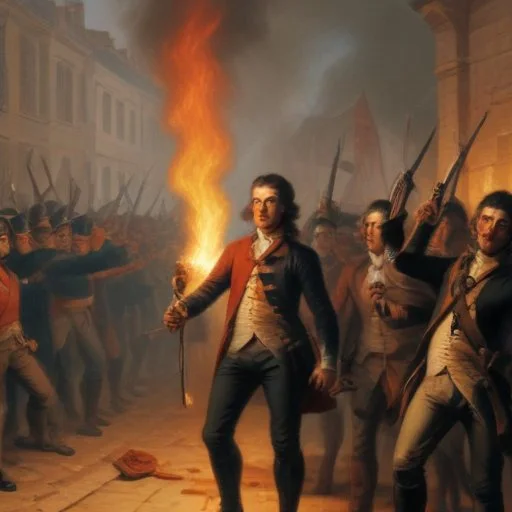
Rich Character Description
Maximilien Robespierre: The Radical Leader
Early Life and Radicalization
Maximilien Robespierre, born in 1758, was a young lawyer from Arras who rose to prominence during the French Revolution. His early life was marked by a strong sense of justice and a deep commitment to the Enlightenment values of liberty, equality, and fraternity. However, as the Revolution unfolded, Robespierre's radicalism intensified, and he became increasingly intolerant of opposing views.
Robespierre's rhetorical skills and charisma earned him a massive following among the sans-culottes, making him a formidable force in the National Convention.
Thorough Cultural Analysis
The Cult of the Revolution: A Society in Fear
The Committee of Public Safety's propaganda machine worked tirelessly to create a climate of fear and suspicion, where anyone deemed an enemy of the Revolution was fair game for persecution. The Cult of the Revolution, with its symbols, rituals, and propaganda, became an omnipresent force, conditioning the population to accept the Committee's authority.
The Fête de l'Être Suprême, a grand festival celebrating the Revolution's ideals, was a prime example of the Cult's influence. Held on June 8, 1794, the festival featured elaborate processions, patriotic songs, and speeches extolling the virtues of the Revolution.
Comprehensive Political Review
The Political Landscape: A Web of Alliances and Intrigue
The early years of the French Revolution were marked by a complex web of alliances and rivalries among the various factions. The Jacobins, led by Robespierre, vied for power with the more moderate Girondins, while the sans-culottes and the Enragés exerted their influence through street protests and violence.
The Committee of Public Safety's domination of the National Convention was short-lived, as internal power struggles and external pressures eventually led to Robespierre's downfall.

Comprehensive Artifact and Document Study
The Incriminating Papers: Uncovering the Committee's Secrets
The discovery of incriminating documents in the Committee of Public Safety's archives revealed the full extent of the Jacobins' ruthlessness. These papers, including lists of condemned individuals and secret decrees, provided irrefutable evidence of the Committee's brutal methods.
The Lettre à ses Commettants, a letter penned by Robespierre himself, detailed the Committee's strategy for suppressing opposition and silencing dissenting voices.
Full Economic Impact Report
The Economic Consequences of the Reign of Terror
The Reign of Terror had far-reaching economic implications, as the Committee of Public Safety's radical policies disrupted trade and commerce. The assignat, the Revolution's new currency, suffered from hyperinflation, eroding the purchasing power of the population.
The forced nationalization of land and the redistribution of wealth also led to economic instability, paving the way for Napoleon Bonaparte's eventual rise to power.


