


Few events in history have marked a more dramatic turn of fortunes than the execution of Maximilien Robespierre and Louis Antoine de Saint-Just, the masterminds behind the Reign of Terror during the French Revolution. On a sweltering July 28, 1794, these two leaders, who had sent thousands to their deaths, were guillotined in the same square where they had orchestrated the demise of so many others.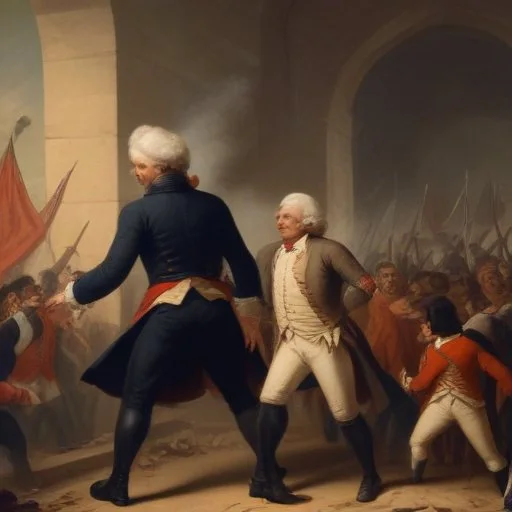
For over a year, Robespierre and Saint-Just had held France in an iron grip, using fear, intimidation, and violence to maintain their grip on power. As leaders of the Committee of Public Safety, they had presided over a period of unprecedented bloodshed, sending anyone deemed an enemy of the revolution to the guillotine.
Robespierre, a charismatic and cunning orator, had risen to prominence through his impassioned speeches and radical ideas. Saint-Just, his protégé and ally, was equally ruthless and efficient in carrying out the Committee's brutal policies. Together, they had built a regime of terror, where neighbor turned against neighbor and dissent was met with death.
But as the Reign of Terror continued to claim more lives, a growing number of French citizens began to question the morality and logic of the Committee's actions. The economy was in shambles, the war effort was faltering, and the people were tired of living in fear.
A fissure had opened within the Committee itself, as moderates like Georges Danton and Camille Desmoulins began to push back against Robespierre's increasingly autocratic rule. The writing was on the wall – the once-indestructible Committee of Public Safety was showing signs of cracks.
On July 27, 1794, Robespierre and Saint-Just were arrested by their former allies, who had turned against them in a stunning coup. The following day, they were put on trial, where they faced a barrage of accusations and condemnations from their former colleagues.
The trial was a farce, with the outcome predetermined. Robespierre, who had once wielded such immense power, was now forced to beg for mercy. Saint-Just, cold and calculating to the end, refused to speak in his own defense.
In the end, it was the guillotine that silenced the demagogues, as they were led to the same scaffold where they had sent so many others to their deaths. The Reign of Terror was finally over, and France could begin the long journey towards rebuilding and recovery.
The execution of Robespierre and Saint-Just marked a significant turning point in the French Revolution, but it did not erase the scars of the Reign of Terror. The trauma and fear inflicted on the French people would take generations to heal.
Yet, in the midst of destruction and chaos, the events of July 28, 1794, also offered a glimmer of hope. For the first time, the French people saw that those who wielded power could also be held accountable. It was a lesson that would shape the course of French politics and democracy for centuries to come.
As the dust settled on the execution of Robespierre and Saint-Just, France began to rebuild and redefine itself. The Directory, a new governing body, took the reins of power, promising a more moderate and inclusive approach to governance.
Though the Reign of Terror was finally over, its impact would be felt for generations to come. The execution of Robespierre and Saint-Just served as a potent reminder of the dangers of unchecked power and the importance of accountability.
In the end, the fall of the demagogues marked not only the end of a brutal chapter in French history but also the beginning of a new era of hope, freedom, and democracy.
Robespierre's early life was marked by tragedy and hardship. Orphaned at a young age, he was raised by his older sister and struggled to make ends meet. Despite these challenges, he was an exceptional student and went on to study law in Paris. It was during this time that he developed his passion for radical politics and became acquainted with key figures of the French Revolution.
Saint-Just, on the other hand, came from a more affluent background. His family was part of the minor nobility, and he received a good education. However, he was known for his cold and calculating demeanor, earning him the nickname "The Angel of Death."
The Committee of Public Safety, led by Robespierre and Saint-Just, was a product of the radicalization of the French Revolution. It was formed in response to the crisis of 1793, when the country was threatened by internal and external enemies. The Committee's initial purpose was to defend the revolution, but it soon became an instrument of terror and repression.
Under Robespierre's leadership, the Committee implemented a series of draconian policies, including the Law of Suspects, which allowed for the arrest and execution of anyone deemed an enemy of the revolution. This led to a wave of terror, with thousands of people being guillotined or imprisoned.
The Reign of Terror had a profound impact on French culture, leading to a period of intense fear and paranoia. The constant threat of arrest and execution created a sense of uncertainty and mistrust, which permeated all aspects of life.
Artists and writers, in particular, were affected by the Terror, as many were forced to flee or go into hiding. Those who remained had to be careful not to offend the authorities, leading to a period of cultural stagnation.

Historians have long debated the significance of the Fall of the Demagogues, with some viewing it as a necessary evil and others condemning it as a brutal suppression of dissent.
Revisionist historians, such as Georges Lefebvre, have argued that Robespierre and Saint-Just were not the monsters they were portrayed to be, but rather idealists who were driven to extremes by the circumstances of the revolution.
The French Revolution was a European phenomenon, with far-reaching consequences for the continent. The Reign of Terror, in particular, sent shockwaves throughout Europe, leading to a wave of repression and counter-revolution.
The execution of Robespierre and Saint-Just marked a turning point in this process, as European powers began to reassert their dominance over France. The Treaty of Vienna, signed in 1795, would go on to shape European politics for generations to come.