


The French Revolution, a maelstrom of violence and upheaval, reached its crescendo on August 10, 1792, as a frenzied mob stormed the Tuileries Palace, leaving in its wake a trail of bloodshed, destruction, and shattered dreams. This fateful day would forever be etched in history as the moment when King Louis XVI, the monarch who had ruled France for nearly two decades, was arrested and taken into custody, his authority and power crumbling beneath the weight of the people's fury.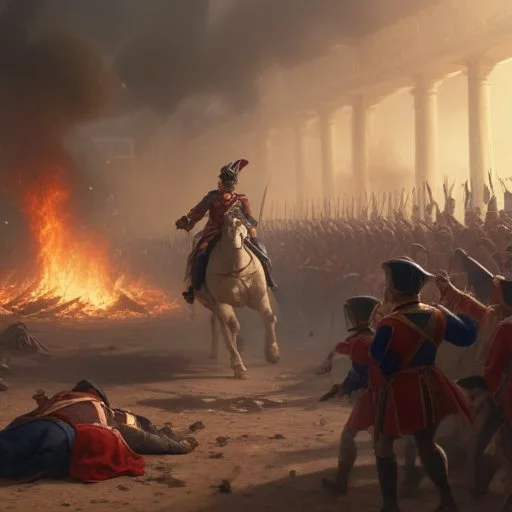
As the sun rose over Paris, tensions simmered like a pot about to boil over. The National Assembly, the governing body of the Revolution, had grown increasingly divided, with radical factions calling for the overthrow of the monarchy and the establishment of a republic. Meanwhile, the king, still clinging to his authority, remained obstinate in his refusal to relinquish power.
The flashpoint came when a group of prominent revolutionaries, including Maximilien Robespierre and Georges Danton, rallied the masses outside the palace, urging them to take action against the monarch. The crowd, fueled by months of economic hardship, political discontent, and inflammatory rhetoric, was primed to explode.
As the mob surged forward, the Swiss Guards, tasked with protecting the palace, found themselves vastly outnumbered and outmatched. Despite their bravery, they were brutally cut down, their bodies mutilated and left to rot in the streets. Estimates vary, but it is thought that between 600 and 1,000 Swiss Guards lost their lives that day, their sacrifice a testament to the ferocity of the revolutionary spirit.
The carnage was not limited to the palace walls. The mob, driven by a frenzy of violence, targeted anyone perceived as loyal to the monarchy, leaving a trail of destruction and chaos in its wake. The once-majestic halls of the Tuileries Palace, where kings and queens had once held court, were now reduced to a scene of utter devastation.
In the aftermath of the storming, King Louis XVI was arrested and taken into custody, his authority and power finally broken. The National Assembly, now dominated by radical factions, voted to abolition the monarchy, marking the end of an era and the beginning of the Reign of Terror.
The consequences of the storming of the Tuileries Palace were far-reaching and profound. The French Revolution, already a cauldron of turmoil, would now descend into an abyss of violence and bloodshed, with the Committee of Public Safety, led by Robespierre, wielding arbitrary power and meting out summary justice to perceived enemies of the state.
The storming of the Tuileries Palace marked a turning point in the French Revolution, signaling the final collapse of the monarchy and the rise of the radical Jacobin faction. It would also have far-reaching consequences for European history, inspiring a wave of revolutionary fervor that would sweep across the continent and shape the course of modern politics.
In the end, the Tuileries Palace, once a symbol of royal power and grandeur, would be destroyed, its stones used to build a monument to the Revolution. The storming of the palace on that fateful day in August 1792 would forever be etched in the collective memory of the French people, a testament to the power of popular uprising and the unyielding desire for liberty, equality, and fraternity.
Georges Danton, a key player in the storming of the Tuileries Palace, was a radical Jacobin who played a crucial role in the French Revolution. Born in 1759, Danton was a lawyer by training and quickly rose to prominence in the early years of the Revolution. He was known for his fiery oratory skills and his ability to whip up crowds into a frenzy.
Danton's radical views and his willingness to take bold action made him a natural ally for Maximilien Robespierre, and together they formed a powerful partnership that would shape the course of the Revolution. Despite his later fall from grace, Danton's role in the storming of the Tuileries Palace remains a testament to his unwavering commitment to the revolutionary cause.

The Tuileries Palace, once a symbol of royal power and grandeur, had become a symbol of the monarchy's declining authority in the years leading up to the Revolution. The king's obstinate refusal to relinquish power had created a toxic atmosphere, with radical factions calling for his overthrow and the establishment of a republic.
The National Assembly, the governing body of the Revolution, was divided and weakened, unable to effectively respond to the growing crisis. Meanwhile, the royal family was increasingly isolated, with many of its supporters either fleeing the country or turning against the monarchy.
In the months leading up to the storming of the Tuileries Palace, King Louis XVI issued a series of proclamations in an attempt to quell the growing unrest. One such proclamation, issued on June 20, 1792, ordered the National Assembly to dissolve and called for new elections.
This proclamation, seen as a desperate attempt to cling to power, only served to further inflame the situation. The people of Paris, already distrustful of the monarchy, saw the proclamation as a thinly veiled attempt to undermine the Revolution and restore royal authority.
The Tuileries Palace, once the epicenter of French power and culture, had long been a symbol of the monarchy's grandeur and prestige. The palace, with its beautiful gardens and stunning architecture, had played host to countless royal ceremonies and receptions.
The storming of the palace, and its subsequent destruction, marked a turning point in French cultural history. The Revolution's rejection of the monarchy and its symbols of power marked a shift towards a more egalitarian society, where power was no longer concentrated in the hands of a few elite individuals.
Historians have long debated the significance of the storming of the Tuileries Palace, with some viewing it as a necessary step towards the establishment of a republic, while others see it as a brutal and senseless act of violence.
Some historians, such as Albert Soboul, have argued that the storming of the palace was a spontaneous uprising, driven by the people's desire for freedom and equality. Others, such as François Furet, have seen it as a carefully orchestrated event, driven by the radical Jacobins' desire for power.