


The Paris Commune, a fleeting yet fiery experiment in radical socialism, came to a brutal end in May 1871, as French troops stormed the city, unleashing a week of intense street fighting that would claim the lives of approximately 20,000 communards and result in the arrest of 38,000 others.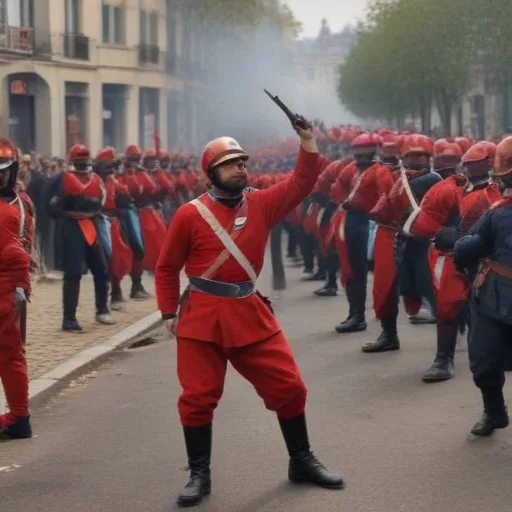
In the aftermath of the Franco-Prussian War, Paris was awash with social and political upheaval. The defeat of France and the abdication of Napoleon III had created a power vacuum, which was swiftly filled by the radical socialist movement. The Paris Commune, established in March 1871, sought to create a decentralized, democratic society, free from the shackles of capitalism and monarchy.
As the Commune's radical ideals began to take hold, the French government, led by Adolphe Thiers, grew increasingly uneasy. Determined to crush the rebellion, Thiers ordered French troops to march on Paris, sparking a week of brutal fighting that would become known as Bloody Week.

The fighting was intense and merciless, with both sides engaging in acts of brutality and terror. The French army, determined to quash the rebellion, employed heavy artillery and massacre tactics, while the communards, fighting for their lives, responded with guerrilla warfare and makeshift barricades.
The city was ravaged, with entire neighborhoods reduced to rubble. The smell of smoke and blood hung heavy in the air, as the sounds of gunfire and screams echoed through the streets.
By the close of Bloody Week, the Paris Commune lay in ruins, its residents either dead or imprisoned. The survivors, many of whom had lost loved ones and livelihoods, were left to pick up the pieces of their shattered lives.
The Paris Commune's brutal suppression marked a turning point in French politics, with the event's impact felt for generations to come. The Commune's radical ideals, though ultimately failed, inspired future generations of socialists and anarchists, shaping the course of modern French history.
The Commune's legacy extends beyond France, with its influence felt in social and political movements around the world. The event's bloody suppression serves as a stark reminder of the dangers of unchecked government power and the importance of protecting human rights.

"What is the Commune, that spark of hope in the darkness? It is the people, it is the workers, it is the women, it is the children, it is the future." - Louise Michel
"The Commune is the only government that has ever existed in the history of the world, where the people, and the people alone, have been the masters of their own destiny." - Gustave Courbet

This event, though marked by violence and bloodshed, serves as a testament to the power of human resistance and the unwavering pursuit of freedom and equality. The Paris Commune's legacy continues to inspire and educate, serving as a reminder of the importance of protecting human rights and promoting social justice.
Louise Michel: The Anarchist and Educator
Louise Michel, a key figure in the Paris Commune, was a French anarchist and educator who played a crucial role in the Commune's leadership. Born in 1830, Michel was a passionate advocate for social justice and women's rights. She was known for her fiery speeches and her determination to create a more equal society.
Michel's involvement in the Commune began when she helped establish a network of women's committees, which aimed to provide aid to the poor and promote education. Her leadership and charisma quickly earned her a prominent position within the Commune's government.
Despite her eventual arrest and imprisonment, Michel's legacy as a champion of social justice and women's rights continued to inspire generations of activists and revolutionaries.

The Siege of the Hôtel de Ville
The Siege of the Hôtel de Ville was a pivotal moment in the Paris Commune's bloody downfall. On May 24, 1871, French troops, led by General Joseph Vinoy, launched a fierce assault on the Hôtel de Ville, the seat of the Commune's government.
The communards, led by Louise Michel and other key leaders, put up a fierce resistance, but they were vastly outnumbered and outgunned. After hours of intense fighting, the troops breached the building, and many of the Commune's leaders were captured or killed.
The fall of the Hôtel de Ville marked the beginning of the end for the Paris Commune, as French troops continued their brutal suppression of the rebellion.
The Cultural Legacy of the Paris Commune
The Paris Commune's impact on French culture was profound and far-reaching. The Commune's emphasis on art, literature, and music helped to foster a vibrant cultural scene, which continued to thrive long after the Commune's suppression.
Many of France's most prominent artists, writers, and intellectuals, including Gustave Courbet, Eugène Pottier, and Émile Zola, were inspired by the Commune's ideals and participated in the rebellion.
Today, the Paris Commune is remembered as a pioneering moment in the history of social and cultural revolution, and its influence can be seen in art, literature, and music around the world.

The Political Repercussions of the Paris Commune
The Paris Commune's brutal suppression had significant political repercussions in France and beyond. The event marked a turning point in French politics, as the country shifted towards a more conservative, authoritarian government.
The Commune's experiment in radical socialism also inspired a new wave of social and political movements, including anarchism, socialism, and communism, which would shape the course of modern politics.
The Commune's legacy continues to influence political thought and action, serving as a powerful symbol of resistance and a reminder of the importance of protecting human rights and promoting social justice.
The Economic Consequences of the Paris Commune
The Paris Commune's suppression had significant economic consequences for the city and the country as a whole. The destruction of property, infrastructure, and businesses during Bloody Week led to widespread economic devastation.
The French government's efforts to rebuild and restore order were hampered by the massive debt incurred during the Franco-Prussian War, leading to a prolonged period of economic stagnation.
However, the Commune's emphasis on social welfare and workers' rights also helped to inspire new economic policies, including the development of social security and labor laws, which would shape the course of modern French economic policy.