Galileo banned by Church for Sun-centered theory
In the heart of the Catholic Church's stronghold, Rome, a trailblazer's revolutionary ideas clashed with dogma. Galileo Galilei, a pioneering astronomer, had the audacity to propose that the earth orbited the sun, contradicting the geocentric model. The Church, unwilling to relinquish its grip on ancient wisdom, declared Galileo's teachings heretical, effectively silencing his provocative voice. This 17th-century showdown between science and faith would have far-reaching consequences, shaping the course of human understanding.
The Cosmic Standoff: Galileo's Clash with the Catholic Church
In 1616, the Roman Catholic Church officially condemned Galileo Galilei's revolutionary idea that the Earth orbits the Sun, silencing his voice and sparking a centuries-long debate between science and faith. This pivotal event, known as the Galileo Affair, marked a turning point in the history of science and the Catholic Church's relationship with modernity.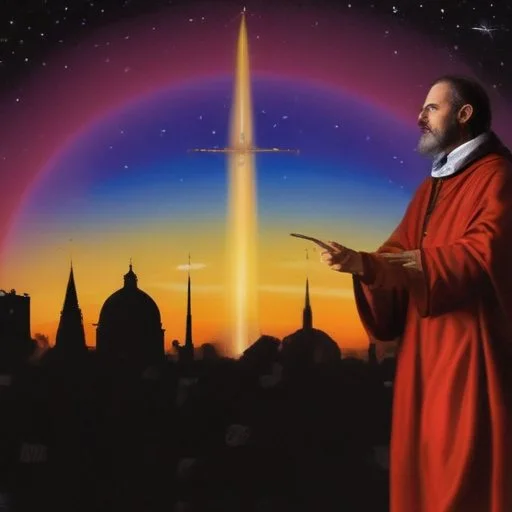
The Geocentric Model vs. the Copernican Revolution
The Church had long subscribed to the geocentric model, which placed Earth at the center of the universe. Galileo, inspired by Nicolaus Copernicus' groundbreaking work, dared to challenge this notion by proposing a heliocentric model, where the Sun takes center stage. This radical idea not only threatened to upend the Church's authority but also the very fabric of Aristotelian philosophy.
The Church's Verdict: Heresy and Suppression
Gathering evidence from his observations of the heavens, Galileo wrote a pointed letter to the Grand Duchess of Tuscany, defending the Copernican theory. The Church, sensing heresy, labeled Galileo's work "vehemently suspect" and forbade him from teaching or promoting the heliocentric model. The Inquisition would later condemn Galileo's book, Dialogue Concerning the Two Chief World Systems, and condemn him to lifelong house arrest.
The Players: Galileo, the Church, and the Patrons
- Galileo Galilei: The pioneering astronomer and mathematician whose observations and writings sparked the controversy.
- The Roman Catholic Church: The institution that saw Galileo's ideas as a threat to its authority and dogma.
- Pope Urban VIII: The supportive patron who initially encouraged Galileo's work, only to later turn against him.
- The Medici Family: Powerful patrons who backed Galileo's research and shielded him from initial Church scrutiny.
The Legacy: Science, Faith, and the Quest for Truth
The Galileo Affair set a precedence for the Church's relations with science, marking a nascent divide between faith and reason. The episode also sparked a scientific revolution, as Galileo's work paved the way for pioneers like Isaac Newton and Johannes Kepler. Today, the Galileo Affair serves as a testament to the power of human inquiry and the importance of intellectual freedom.
Timeline of Events
- 1610: Galileo discovers four moons of Jupiter, providing evidence for the Copernican theory.
- 1615: Galileo writes a letter to the Grand Duchess of Tuscany, defending the Copernican theory.
- 1616: The Church declares Galileo's teachings "vehemently suspect" and forbids him from promoting the heliocentric model.
- 1632: Galileo publishes Dialogue Concerning the Two Chief World Systems, sparking widespread controversy.
- 1633: Galileo is condemned to lifelong house arrest, where he continues to write and study until his death in 1642.
Impact on Future Events
The Galileo Affair's ripple effects can be seen in:
- The rise of modern science and the Scientific Revolution.
- The emergence of Enlightenment thinkers, who challenged Church authority and advocated for reason and individualism.
- The ongoing debate between science and faith, as the Church continues to grapple with the implications of Galileo's work.
Galileo's Parting Words
"Eppur si muove" ("And yet it moves") – Galileo's supposed utterance, which captures the essence of his defiance and dedication to the pursuit of truth.


