


In a historic moment that marked the end of an era of oppression and the dawn of a new era of freedom, Jean-Bertrand Aristide, a Catholic priest-turned-politician, was sworn in as Haiti's first democratically elected president. This momentous occasion, which took place on February 7, 1991, was a testament to the power of the human spirit and the unrelenting quest for democracy in a nation long plagued by tyranny.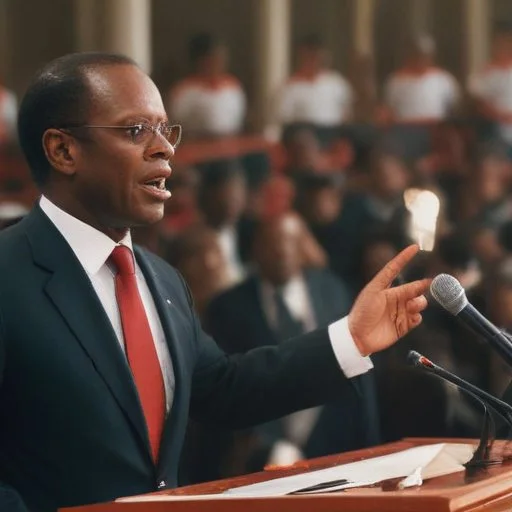
Haiti's journey to democracy was marked by decades of brutal dictatorship, including the notorious Duvalier regime, which ruled with an iron fist from 1957 to 1986. The Duvaliers' reign was characterized by brutal suppression of dissent, widespread human rights abuses, and rampant corruption. After the fall of the Duvalier regime, Haiti was plunged into a period of political instability, with the military junta seizing power and ruling the country until 1990.
Enter Jean-Bertrand Aristide, a charismatic and courageous Catholic priest who became a beacon of hope for the Haitian people. Aristide's rise to prominence began in the 1980s, when he became a vocal critic of the Duvalier regime and its human rights abuses. As a priest, Aristide worked tirelessly to empower the poor and marginalized, establishing a network of community organizations and advocacy groups that became the backbone of the democratic movement.
In 1990, Aristide decided to run for president, riding a wave of popular support and promising to bring an end to the cycle of violence and oppression that had plagued Haiti for decades. His campaign was marked by massive rallies, impassioned speeches, and a message of hope and unity that resonated with the Haitian people. On December 16, 1990, Aristide won a landslide victory, capturing over 67% of the vote and becoming Haiti's first democratically elected president.
On February 7, 1991, Aristide was sworn in as president, surrounded by a sea of jubilant Haitians and international dignitaries. The ceremony was a symbol of Haiti's transition from dictatorship to democracy, and Aristide's inaugural address was a call to action, urging the Haitian people to work together to rebuild their nation and forge a brighter future.
Aristide's presidency marked a significant shift in Haiti's political landscape, as he implemented reforms aimed at promoting democratization, human rights, and economic development. His government established a new constitution, created an independent electoral council, and launched programs aimed at reducing poverty and inequality.
Aristide's presidency was not without controversy, however, and he faced criticism for his handling of the economy and his relations with the Haitian military. Despite these challenges, Aristide's legacy as a champion of democracy and human rights remains unshakeable, and his presidency is widely regarded as a pivotal moment in Haiti's transition to democracy.
As Haiti continues to face the challenges of poverty, inequality, and political instability, the swearing-in of Jean-Bertrand Aristide as president remains a powerful symbol of the power of the human spirit and the unrelenting quest for freedom and democracy.
The geopolitical context of Aristide's inauguration was marked by a significant shift in the international community's approach to Haiti. After decades of supporting brutal dictatorships, the US and other Western powers began to promote democracy and human rights in the Caribbean nation. This change in policy was driven in part by the end of the Cold War, which allowed for a re-evaluation of priorities in the region.
This new era of cooperation was evident in the presence of international dignitaries at Aristide's inauguration, including US President George H.W. Bush's representative, General Colin Powell. The event marked a turning point in Haiti's relations with the global community, as the country began to transition from a pariah state to a fledgling democracy.

Before entering politics, Aristide was a charismatic and outspoken Catholic priest known for his advocacy on behalf of the poor. Born in 1953 in the southern town of Port-Salut, Aristide was drawn to the priesthood at a young age and went on to study in Haiti, Canada, and Israel.
Aristide's faith was deeply intertwined with his politics, and he often drew on biblical themes in his speeches and writings. As a priest, he worked tirelessly to empower the poor and marginalized, establishing a network of community organizations and advocacy groups that became the backbone of the democratic movement.
The social dynamics of Haiti's transition to democracy were complex and multifaceted. Aristide's election marked a significant shift in the balance of power, as the poor and marginalized began to assert their rights and challenge the dominance of the wealthy elite.
This newfound empowerment was evident in the massive street protests and rallies that accompanied Aristide's campaign and inauguration. The sense of hope and possibility that characterized this period was palpable, as Haitians from all walks of life came together to demand change and reject the tyranny of the past.

Historians have long debated the significance of Aristide's presidency, with some viewing it as a key moment in Haiti's transition to democracy and others seeing it as a flawed experiment that ultimately ended in failure.
Regardless, Aristide's legacy as a champion of human rights and democracy remains unshakeable. His presidency marked a crucial turning point in Haiti's history, as the country began to confront its painful past and forge a new path forward.
Aristide's presidency had a profound impact on Haitian culture, as the country began to reclaim its heritage and reject the imposed values of colonialism and dictatorship.
The era was marked by a resurgence of traditional Haitian music, art, and literature, as artists and intellectuals began to explore new themes and forms of expression. This cultural renaissance was fueled in part by Aristide's own love of Haitian culture, which he celebrated in his speeches and writings.