


On September 3, 1944, Anne Frank, her family, and hundreds of others were forcibly herded onto the last transport train from the Westerbork transit camp in the Netherlands, bound for the Auschwitz concentration camp in Poland. This brutal journey would mark the beginning of the end for the Frank family, as they were thrust into the heart of the Nazi's genocidal machinery.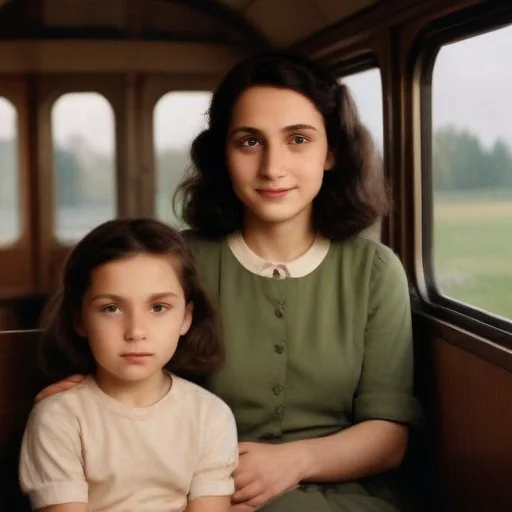
Westerbork, a former refugee camp turned transit camp, had already served as a temporary holding facility for the Frank family and other Jewish prisoners. The harsh conditions, overcrowding, and lack of basic necessities had taken a toll on the family's spirits, but they held onto hope, unaware of the horrors that awaited them at Auschwitz.
Auschwitz, the largest and most notorious concentration camp in the Nazi empire, was a place of unspeakable cruelty and terror. The camp's sheer scale and efficiency in processing and exterminating its prisoners was unparalleled. The gas chambers, starvation, and brutal treatment of prisoners were just a few of the horrors that awaited the Frank family upon their arrival.
Upon arrival at Auschwitz, the Frank family was separated, and Anne, her mother Edith, and sister Margot were sent to the women's camp, Bergen-Belsen. The harsh conditions, lack of food, and rampant disease took a terrible toll on the family. Edith Frank died of starvation and exhaustion in January 1945, while Margot died of typhus in February 1945. Anne, who had grown weak and ill, died in March 1945, just two months before the camp was liberated by the Allies.
Despite the unimaginable tragedy that befell the Frank family, Anne's diary, which she kept while hiding with her family in Amsterdam, has become a beacon of hope and resilience. Her writing, which spans two years, catalogues the daily struggles and fears of a young girl living in hiding, but also reveals her hopes and dreams for a better future. Her diary has inspired countless readers around the world, serving as a testament to the power of human spirit and the importance of standing against hatred and oppression.
"In spite of everything, I still believe that people are truly good at heart."
— Anne Frank, The Diary of a Young Girl
Anne Frank's diary has become a powerful educational tool, teaching generations about the horrors of the Holocaust and the importance of tolerance, empathy, and understanding. Her story has inspired numerous adaptations, including plays, films, and stage productions, ensuring that her message of hope and resilience continues to inspire people around the world.
One of the key figures involved in the fateful journey of Anne Frank was Otto Frank, the father of Anne and Margot. Born on May 12, 1889, in Frankfurt, Germany, Otto was a successful businessman who had moved his family to Amsterdam in 1933 to escape the growing anti-Semitism in Germany.
Otto's decision to go into hiding with his family in 1942 was a desperate attempt to protect them from the Nazi occupation. During their time in hiding, Otto remained a pillar of strength for his family, trying to maintain a sense of normalcy and hope despite the dire circumstances.
After the war, Otto was the only member of the Frank family to survive the concentration camps. He dedicated his life to spreading his daughter's message of hope and peace, working tirelessly to publish Anne's diary and share her story with the world.

The Diary of Anne Frank is not only a poignant and powerful literary work but also an important historical artifact. The diary, which contains over 300 pages of handwritten notes, provides a unique glimpse into the life of a young girl living in hiding during World War II.
The diary was written in a series of notebooks, which Anne kept hidden in a secret annex above her father's office building. The notebooks were later recovered by Miep Gies, one of the people who had helped the Frank family while they were in hiding.
The diary has become an important symbol of the Holocaust, serving as a testament to the horrors of the Nazi regime and the resilience of the human spirit. Today, the original diary is housed at the Anne Frank House museum in Amsterdam, where it is seen by millions of visitors each year.
Anne Frank's diary has had a profound cultural impact, inspiring countless adaptations, including plays, films, and stage productions. The diary has been translated into over 60 languages and has sold more than 30 million copies worldwide.
The diary's cultural significance extends beyond its literary importance, serving as a powerful symbol of hope and resilience in the face of oppression. Anne's story has inspired people from all over the world, transcending cultural and linguistic boundaries.
The diary has also been the subject of numerous educational initiatives, with many schools incorporating it into their curriculum as a way to teach students about the Holocaust and the importance of tolerance and empathy.

The Nazi occupation of the Netherlands during World War II was a critical factor in the Frank family's fateful journey. The Netherlands, which had declared neutrality at the start of the war, was invaded by Germany in May 1940.
The occupation had a devastating impact on the Jewish population of the Netherlands, with many Jews being rounded up and deported to concentration camps. The Nazis established a network of transit camps, including Westerbork, where the Frank family was eventually sent.
The geopolitical context of the time was marked by a complex web of alliances and rivalries between nations, which ultimately contributed to the failure of the international community to prevent the atrocities of the Holocaust.