


In the scorching desert heat of Egypt's Valley of the Kings, two men stood on the cusp of history, poised to unravel a mystery that had captivated the imagination of the world for millennia. On November 26, 1922, British archaeologist Howard Carter and his patron, George Herbert, the 5th Earl of Carnarvon, became the first people to enter the tomb of Pharaoh Tutankhamun in over 3,000 years, uncovering a treasure trove of golden relics and ancient secrets.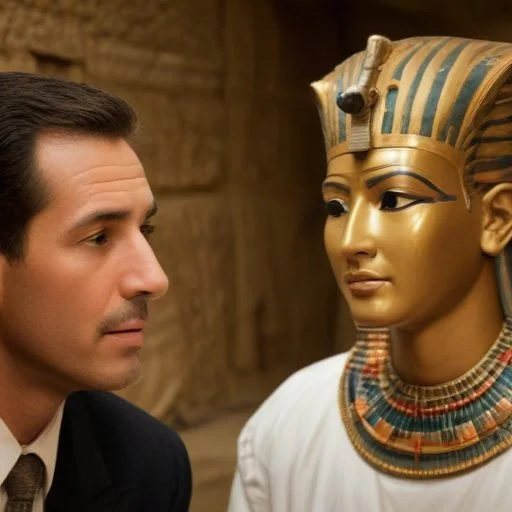
The discovery was the culmination of years of tireless excavation and exploration, driven by Carter's unwavering passion for ancient Egyptian history. With the backing of Lord Carnarvon, a wealthy aristocrat and amateur Egyptologist, Carter had scoured the Valley of the Kings, searching for the elusive tomb of the enigmatic Pharaoh Tutankhamun.
Tutankhamun, the boy king who ruled Egypt from approximately 1332 to 1323 BCE, had been all but forgotten in the annals of history. His tomb, believed to be hidden deep within the Valley of the Kings, was shrouded in mystery, sparking the imagination of archaeologists and treasure hunters alike.
On that fateful day in November, Carter and Carnarvon stood before a seemingly ordinary tomb entrance, marked only by a series of ancient workmen's huts. As they cleared the rubble and debris, a glimmer of gold caught Carter's eye – the unmistakable sign of a long-abandoned tomb.
With trembling hands, Carter made a small breach in the doorway, and a warm, golden light spilled out, illuminating the faces of the two men. As they stepped inside, the air was thick with the scent of incense and myrrh, and the whispers of the past seemed to reverberate through the chamber.
The tomb was a treasure trove of golden relics, precious jewels, and remarkably preserved artifacts. The pharaoh's magnificent golden mask, adorned with lapis lazuli and carnelian, gazed out at the two men, its piercing gaze seeming to transcend the centuries.
The discovery sent shockwaves around the world, captivating the imagination of the public and igniting a renewed interest in ancient Egyptian culture. Carter and Carnarvon's find was hailed as one of the most significant archaeological discoveries of the 20th century, shedding new light on the life and reign of Pharaoh Tutankhamun.
The discovery of Tutankhamun's tomb has inspired generations of archaeologists, historians, and enthusiasts, fueling a deeper understanding of ancient Egyptian civilization and its enduring legacy.
As we gaze upon the treasures of the Valley of the Kings, we are reminded of the power of human curiosity and the thrill of discovery, beckoning us to continue exploring the secrets of the past.
Lord George Herbert, the 5th Earl of Carnarvon, was a British aristocrat and amateur Egyptologist who played a crucial role in the discovery of Tutankhamun's tomb. Born on June 26, 1866, Carnarvon was a member of the wealthy and influential Herbert family. Despite his privileged upbringing, Carnarvon was drawn to Egyptology, and his passion for the subject led him to sponsor several archaeological excavations in Egypt.
Howard Carter, on the other hand, was a British archaeologist and Egyptologist who had spent years searching for the lost tomb of Tutankhamun. Born on May 9, 1874, Carter was a skilled excavator and artist who had previously worked with the famous archaeologist Flinders Petrie. His expertise and dedication were instrumental in the discovery of the tomb.
The partnership between Carter and Carnarvon was a perfect blend of passion and resources. While Carnarvon provided the financial backing, Carter brought his expertise and knowledge to the excavation. Together, they achieved what many had deemed impossible – uncovering the secrets of the Valley of the Kings.
The discovery of Tutankhamun's tomb had a profound impact on popular culture, inspiring a wave of Egyptomania that swept across the globe. The tomb's treasures, particularly the golden mask of Tutankhamun, became an instant sensation, captivating the imagination of people from all walks of life.
The discovery also led to a renewed interest in ancient Egyptian culture, with books, films, and exhibitions dedicated to the subject. The tomb's treasures were exhibited worldwide, attracting millions of visitors and generating widespread media attention.
The cultural impact of the discovery extended beyond Egyptology, influencing art, fashion, and architecture. Egyptian motifs and symbols became popular design elements, and the tomb's treasures inspired a new generation of artists, designers, and architects.
The search for Tutankhamun's tomb was not a new endeavor, even in the 1920s. For centuries, archaeologists and treasure hunters had been searching for the lost tomb of the boy king. One of the earliest recorded searches was by the Greek historian Herodotus, who wrote about the tomb's existence in the 5th century BCE.
In the 19th century, the search for Tutankhamun's tomb gained momentum, with several archaeologists and explorers attempting to find it. The British archaeologist Flinders Petrie, who had worked with Howard Carter, was one of the first to suggest that the tomb might be located in the Valley of the Kings.
Despite these early efforts, the search for Tutankhamun's tomb remained elusive until Carter and Carnarvon's discovery in 1922. The discovery was a testament to the perseverance and dedication of these two men, who against all odds, uncovered one of the most significant archaeological finds in history.
The discovery of Tutankhamun's tomb provided an unprecedented wealth of artifacts and relics that shed new light on ancient Egyptian funerary practices. One of the most significant discoveries was the golden mask of Tutankhamun, which was intricately crafted with lapis lazuli and carnelian.
The tomb's treasury was filled with an array of precious jewels and ornaments, including golden collars, pendants, and rings. These artifacts provided valuable insights into the craftsmanship and artistic skills of ancient Egyptian artisans.
The discovery of the sarcophagus, adorned with images of the goddess Nut and the gods of the afterlife, offered a unique glimpse into ancient Egyptian beliefs about the afterlife. The tomb's artifacts, including the chariots, furniture, and other relics, have helped historians and archaeologists reconstruct the life and reign of Pharaoh Tutankhamun.
The discovery of Tutankhamun's tomb has had a lasting impact on the field of Egyptology, shaping our understanding of ancient Egyptian history and culture. The tomb's treasures have provided a unique window into the life and reign of Pharaoh Tutankhamun, offering insights into the politics, religion, and society of ancient Egypt.
The discovery has also contributed significantly to the development of archaeological methods and techniques. Carter's meticulous excavation and documentation of the tomb's contents have set new standards for archaeological excavation and preservation.
In addition, the discovery has sparked a renewed interest in the study of ancient Egyptian language, literature, and art, inspiring a new generation of scholars and researchers to explore the complexities of ancient Egyptian culture.