


On November 4, 1922, British archaeologist Howard Carter's painstaking excavations in Egypt's Valley of the Kings culminated in a momentous discovery – the unsealing of Pharaoh Tutankhamun's burial chamber, a treasure trove that had lain undisturbed for over 3,200 years. As the dust of centuries settled, the world caught its first glimpse of the golden treasures and the enigmatic mask of the boy-king, sparking an archaeological frenzy that would captivate the world.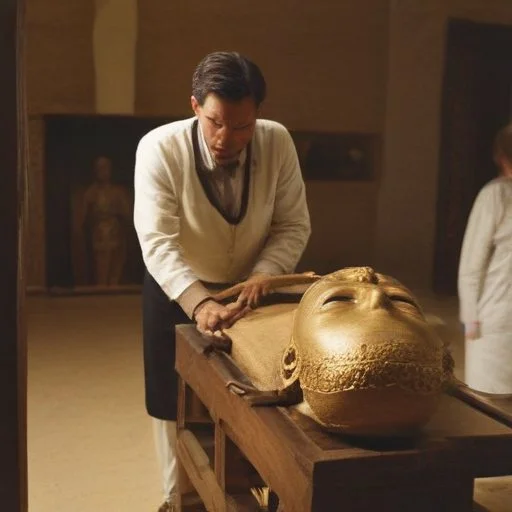
Howard Carter's fascination with ancient Egypt began at a young age, nurturing a passion that would drive him to dedicate his life to unearthing the secrets of the pharaohs. With a background in art and archaeology, Carter honed his skills under the tutelage of renowned Egyptologist Percy Newberry, eventually partnering with George Herbert, the 5th Earl of Carnarvon, to excavate the Valley of the Kings.
The fateful day of November 4, 1922, marked the culmination of Carter's years of meticulous excavation. As he carefully breached the door of the antechamber, the air was thick with anticipation. With each delicate brushstroke, the dust of centuries slowly receded, revealing the first hints of the tomb's treasures – golden chariots, precious jewels, and the majestic golden mask of Tutankhamun.
Tutankhamun, the Egyptian pharaoh who ruled from 1332 to 1323 BCE, remained an enigma, shrouded in mystery. His life and reign were a mere whisper in the annals of history, overshadowed by the more prominent figures of Akhenaten and Ramses II. The discovery of his tomb would unravel the secrets of his life and reign, casting a spotlight on the intrigue and drama that surrounded this young pharaoh.
The discovery of Tutankhamun's tomb catapulted Carter to international fame, earning him the coveted title of Knight Bachelor in 1923. The Royal Geographical Society honored him with the Founder's Medal in 1924, solidifying his reputation as a leading archaeologist of his time.
The unsealing of Tutankhamun's burial chamber not only shed light on a previously unknown pharaoh but also sparked a renewed interest in ancient Egyptian culture and archaeology. Carter's discovery paved the way for subsequent excavations, inspiring generations of archaeologists and scholars to continue unearthing the secrets of the ancient world.
"At first, I see nothing, and then, suddenly, I see treasure beyond my wildest dreams!" – Howard Carter, on discovering Tutankhamun's tomb
The unsealing of Tutankhamun's burial chamber remains one of the most significant archaeological discoveries of the 20th century, a testament to Howard Carter's unwavering dedication to uncovering the secrets of the ancient world. As the world continues to marvel at the treasures of the tomb, Carter's legacy serves as a beacon, inspiring future generations to pursue the thrill of discovery and the preservation of our cultural heritage.
Howard Carter was born on May 9, 1874, in Kensington, London, to Samuel John Carter and Martha Joyce Carter. His early life was marked by a curiosity for the ancient world, sparked by his father's love for drawing and art. Carter's parents encouraged his creative pursuits, and he eventually honed his skills as an artist, which would later serve him well in his archaeological endeavors.
Carter's family moved to Swaffham, Norfolk, when he was eight years old, where he developed a passion for nature and the outdoors. This early connection with the natural world would instill in him a sense of wonder and awe that would drive his later explorations of ancient Egypt.
The golden mask of Tutankhamun, one of the most iconic artifacts discovered in the tomb, has become an cultural icon, symbolizing the mystique and grandeur of ancient Egypt. The mask's discovery sparked a global fascination with ancient Egyptian culture, inspiring countless works of art, literature, and film.
The mask's cultural significance extends beyond its aesthetic appeal, as it has come to represent the enigmatic and mysterious nature of the pharaohs. It has inspired generations of artists, designers, and historians, cementing its place as a cultural touchstone.
The walls of Tutankhamun's tomb are adorned with intricate paintings, depicting the pharaoh's life and reign. These vivid images provide valuable insights into the daily life and rituals of ancient Egyptians, offering a unique window into the past.
The paintings also hold secrets about the tomb's construction and the burial rituals of the time. By analyzing the pigments and techniques used, archaeologists have been able to reconstruct the sequence of events surrounding the pharaoh's burial, shedding new light on the mysteries of the tomb.
The discovery of Tutankhamun's tomb marked a turning point in the field of Egyptology, as it provided a wealth of new information about ancient Egyptian history and culture. The tomb's excavation and subsequent analysis have contributed significantly to our understanding of the Amarna period and the reign of Tutankhamun.
The discovery has also had a profound impact on the development of archaeological methods and practices, influencing generations of archaeologists and historians. Carter's meticulous excavation and documentation of the tomb have set a new standard for archaeological excavations, shaping the course of the field.
The discovery of Tutankhamun's tomb has had a lasting impact on education, inspiring generations of students to explore the wonders of ancient Egypt. The tomb's treasures have become an integral part of history curricula, providing a tangible connection to the past.
The tomb's discovery has also led to the development of innovative educational resources, such as museum exhibits, documentaries, and online resources. By making the ancient world accessible and engaging, educators have been able to spark a love of learning and a fascination with history in students of all ages.