


The invasion of Iraq, launched in 2003, will forever be remembered for the infamous "Mission Accomplished" speech delivered by President George W. Bush on board the USS Abraham Lincoln off the coast of California. As Bush stood triumphantly before a giant banner bearing the same phrase, he boldly declared that major combat operations in Iraq had ended, marking a symbolic conclusion to the war.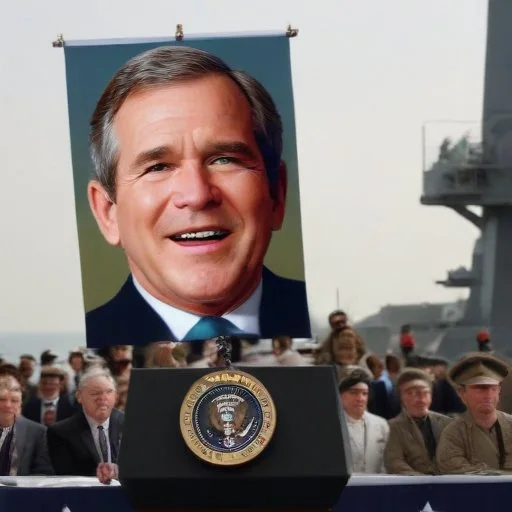
The invasion of Iraq was a culmination of the post-9/11 war on terror, with the US and its allies aiming to remove Saddam Hussein's regime from power. The war was sparked by allegations of Iraq's possession of weapons of mass destruction (WMDs), which were later proven to be unfounded.
On May 1, 2003, President Bush donned a flight suit and landed on the USS Abraham Lincoln in a Navy S-3B Viking jet, symbolizing a victorious return for the troops. The event was meticulously staged, with the "Mission Accomplished" banner serving as the backdrop for Bush's speech. In his address, Bush praised the bravery and sacrifice of the US military, proclaiming that "major combat operations in Iraq have ended."
The invasion of Iraq and the Mission Accomplished speech had far-reaching consequences, including:
The Mission Accomplished speech and the invasion of Iraq had a profound impact on American culture and society:
The invasion of Iraq and the Mission Accomplished speech remain highly controversial, with many regarding the event as a symbol of hubris and miscalculation:
In his 2010 memoir, Decision Points, President Bush acknowledged that the "Mission Accomplished" speech was a mistake, stating that "it sent a signal that the war was over, when it wasn't."
The invasion of Iraq and the Mission Accomplished speech have had a lasting impact on US foreign policy and military strategy:
The Mission Accomplished speech, though initially designed to boost morale and demonstrate US military prowess, has become a symbol of the complexities and challenges of modern warfare. As the US reflects on its involvement in Iraq, the event serves as a poignant reminder of the importance of humility, careful planning, and responsible leadership in the pursuit of national security and global stability.
The invasion of Iraq and the subsequent Mission Accomplished speech must be understood within the broader context of the post-Cold War world order. The collapse of the Soviet Union had left the United States as the sole superpower, leading to a unipolar world order.
In this context, the US invasion of Iraq can be seen as an attempt to assert American dominance and establish a new world order, with the US as the primary arbiter of global security.
The idea of a unipolar world order was heavily influenced by the neoconservative ideology, which emphasized the need for the US to take a more active role in shaping global affairs.
Tony Blair, the former Prime Minister of the United Kingdom, played a crucial role in supporting the US invasion of Iraq.
Blair's decision to join the US-led coalition was motivated by his belief in the importance of maintaining the transatlantic alliance and his commitment to the principles of liberal interventionism.
Despite facing criticism and opposition from within his own party, Blair remained a steadfast supporter of the war effort, and his partnership with Bush was instrumental in shaping the course of the invasion.
The Mission Accomplished speech and the invasion of Iraq had a profound impact on American culture, particularly in the realm of popular music.
Artists such as Eminem, Bruce Springsteen, and Green Day responded to the war with protest songs that critiqued the Bush administration's policies and questioned the rationale behind the invasion.
The war also inspired a new wave of documentary filmmaking, with films like "Fahrenheit 9/11" and "Control Room" offering critical perspectives on the war and its consequences.
The political fallout from the Mission Accomplished speech and the invasion of Iraq was severe, with the Bush administration facing intense criticism from both domestic and international audiences.
The Democratic Party, led by figures such as Senators John Kerry and Ted Kennedy, launched a series of scathing attacks on the administration's handling of the war.
The controversy surrounding the war also led to a surge in anti-war activism, with organizations such as MoveOn.org and Code Pink playing key roles in mobilizing opposition to the war.
Historiographically, the Mission Accomplished speech represents a turning point in the way historians approach the study of modern warfare.
The speech, with its premature declaration of victory, highlights the importance of nuanced and contextualized understandings of military conflicts.
Furthermore, the controversy surrounding the speech has led historians to re-examine the role of rhetoric and propaganda in shaping public perceptions of war.