


On a fateful day in October 1922, Italian fascists, clad in their distinctive black shirts, marched on Rome, marking a watershed moment in Italian history. This audacious coup, orchestrated by the charismatic Benito Mussolini, would propel the National Fascist Party to power, heralding a dark era of authoritarian rule that would last for two decades.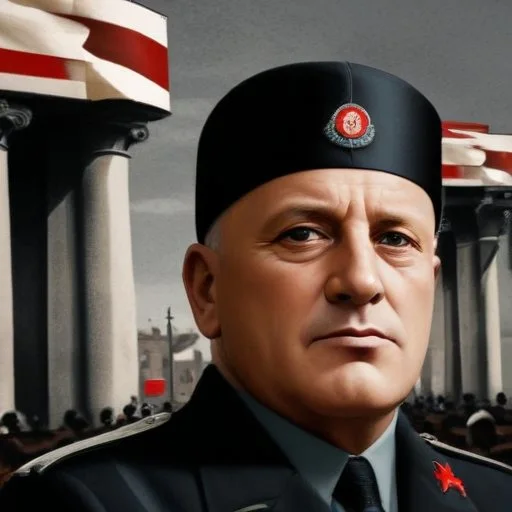
Post-World War I Italy was a country in disarray. Economic woes, political instability, and social unrest had created a powder keg of discontent. The ruling Liberal Party, led by Prime Minister Luigi Facta, was increasingly ineffective in addressing the nation's problems, creating a power vacuum that Mussolini's National Fascist Party was more than happy to fill.
Mussolini, a former socialist and editor of Avanti!, had founded the National Fascist Party in 1919. Initially, the party attracted disaffected war veterans and nationalists, who were drawn to Mussolini's promise of national renewal and his bombastic rhetoric. As the party's popularity grew, so did its paramilitary wing, the Blackshirts (squadristi), who used violence and intimidation to quash political opponents.
On October 27, 1922, approximately 30,000 Blackshirts, led by Mussolini, converged on Rome, occupying key government buildings, communication networks, and strategic locations. The government, caught off guard, was paralyzed, and King Victor Emmanuel III, faced with the prospect of civil war, reluctantly appointed Mussolini as Prime Minister.
Mussolini's appointment marked the beginning of a dark era in Italian history. The new Prime Minister quickly consolidated power, suppressing political opposition, restricting civil liberties, and establishing a cult of personality. The National Fascist Party's grip on power would remain unchallenged for the next two decades, until Mussolini's downfall in 1943.
The March on Rome had far-reaching cultural and social implications. The fascist regime's emphasis on nationalism, militarism, and authoritarianism resonated with many Italians, who had grown disillusioned with the ineffective Liberal government. The regime's architectural and artistic projects, such as the construction of the Via della Conciliazione in Rome, reflected a grandiose, monumental style that reflected Mussolini's megalomania.
The March on Rome was widely condemned by international leaders, who viewed Mussolini's coup as a brazen seizure of power. Domestically, the event was met with a mix of fear and awe, as many Italians were torn between admiration for Mussolini's bold action and concern about the erosion of democratic norms.
The March on Rome cemented Mussolini's position as the dominant figure in Italian politics, paving the way for the fascist regime's authoritarian rule. The event also had significant implications for international relations, as Italy's fascist government began to forge alliances with other authoritarian regimes, including Nazi Germany.
One eyewitness account from a journalist present during the March on Rome described the Blackshirts as "a tidal wave of steel helmets, guns, and black shirts, pouring into the city like a dark, menacing flood."
The March on Rome served as a blueprint for future authoritarian takeovers, influencing the rise of fascist and nationalist movements across Europe. The event also galvanized anti-fascist resistance, inspiring movements like the Italian Resistance and paving the way for post-World War II Italy's transition to democracy.
| 1922 | Mussolini's March on Rome |
| 1923 | Mussolini consolidates power, suppressing political opposition |
| 1930s | Fascist regime's architectural and artistic projects, including the construction of the Via della Conciliazione |
Did you know that Mussolini was initially a pacifist and opposed Italy's entry into World War I? It was only later that he adopted a more nationalist and militaristic stance, eventually leading the National Fascist Party.
The March on Rome was not an isolated event, but rather the culmination of years of growing fascist sentiment in Italy. The country's post-World War I economic and political instability created a fertile ground for extremist ideologies to take root. The fascist movement, with its emphasis on nationalism, authoritarianism, and militarism, resonated with many Italians who felt disillusioned with the ineffective Liberal government.
The fascist ideology was also influenced by the country's cultural and intellectual traditions. Italian thinkers like Giovanni Gentile and Julius Evola developed a philosophical framework that emphasized the importance of the state and the subordination of individual rights to the collective good.
Fascism's appeal was not limited to Italy. The ideology spread across Europe, influencing movements in Germany, Austria, and Spain, among others. The March on Rome marked a watershed moment in this process, inspiring similar authoritarian takeovers across the continent.
As Prime Minister of Italy, Luigi Facta was tasked with stabilizing the country in the aftermath of World War I. However, his ineffective leadership and inability to address Italy's economic and political woes created a power vacuum that Mussolini's National Fascist Party was eager to fill.
Facta's government was marked by inaction and indecision, allowing the fascist movement to gain strength and eventually orchestrate the March on Rome. Despite his efforts to resist Mussolini's coup, Facta was ultimately forced to relinquish power, marking the end of his political career.
The March on Rome was not an isolated event, but rather part of a broader trend of fascist movements rising across Europe. Germany's Nazi Party, led by Adolf Hitler, would soon follow in Mussolini's footsteps, using a combination of propaganda, intimidation, and violence to seize power.
While both movements shared similarities in their ideology and tactics, they also had significant differences. Mussolini's fascism was more bureaucratic and authoritarian, whereas Hitler's Nazism was more radical and racist. Nonetheless, both movements would go on to have devastating consequences for Europe and the world.

The fascist regime's emphasis on grandiosity and monumentality is reflected in its architectural and artistic projects. The construction of the Via della Conciliazione in Rome, a grand boulevard leading to St. Peter's Basilica, is a prime example of this style.
Fascist art often featured grandiose and neoclassical elements, reflecting the regime's emphasis on national pride and imperial ambition. Artists like Ardengo Soffici and Giorgio de Chirico created works that celebrated the fascist ideology, often using classical motifs to convey a sense of grandeur and power.
Fascism's ideology was deeply rooted in philosophical traditions that emphasized the importance of the state and the subordination of individual rights to the collective good. Thinkers like Friedrich Nietzsche and Vilfredo Pareto influenced fascist thought, providing a philosophical framework for the movement's emphasis on nationalism, authoritarianism, and militarism.
Fascism also drew on the ideas of Italian thinkers like Giovanni Gentile, who developed a philosophy of "actual idealism" that emphasized the importance of the state and the role of the individual in serving the collective good. These ideas would go on to shape fascist ideology and inform the regime's policies and actions.