


On August 30, 1945, the city of Hong Kong finally breathed a collective sigh of relief as the Japanese occupation, marked by brutal suppression, famine, and disease, came to an end. This day marked the liberation of the city from the Imperial Japanese forces, which had invaded the British colony in December 1941, bringing with them a reign of terror that lasted for three years and eight months.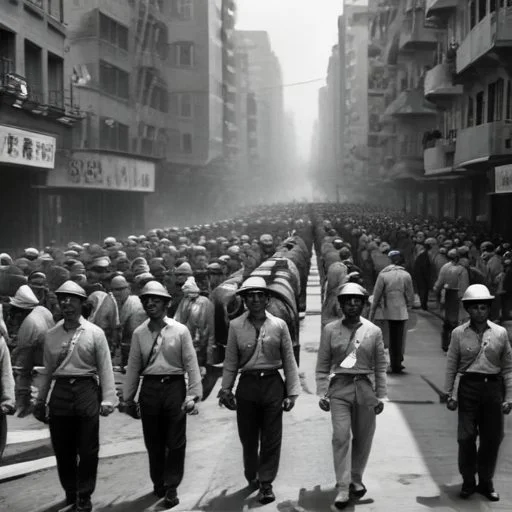
In the early 1940s, Hong Kong was a British colony, a strategic port city and commercial hub in Southeast Asia. With the outbreak of World War II, the British government, anticipating a Japanese invasion, had fortified the colony's defenses. However, despite their efforts, the city fell to the Japanese on Christmas Day, 1941, after a brutal 18-day battle.
The Japanese occupation of Hong Kong was led by Lieutenant General Takashi Sakai, who would later face trial and execution for war crimes. Meanwhile, on the British side, Governor Sir Mark Young and Commander-in-Chief Lieutenant General Christopher Maltby played crucial roles in the defense of the colony and its eventual liberation.
The Japanese occupation of Hong Kong had a profound impact on the city and its people. The occupation resulted in an estimated 10,000 to 20,000 deaths, widespread destruction of infrastructure, and a significant decline in the city's economy. However, the end of the occupation also marked the beginning of Hong Kong's post-war reconstruction and growth into the cosmopolitan city it is today.
The Japanese occupation had a profound impact on Hong Kong's cultural and social fabric. The occupation led to the suppression of Western cultural influences, and the forced adoption of Japanese customs and language. However, the occupation also sparked a growing sense of nationalism and identity among the Hong Kong people, laying the foundations for the city's future growth and development.
One notable account of the occupation is that of Dr. Selwyn Clarke, a British doctor who remained in Hong Kong during the occupation and provided medical care to prisoners of war and civilians. His bravery and selflessness have been recognized as a testament to the human spirit during times of war.
The Japanese occupation of Hong Kong played a significant role in shaping the city's future. The occupation led to a re-evaluation of the city's defenses and its relationship with the British government, ultimately contributing to Hong Kong's transition from a British colony to a Special Administrative Region of China in 1997.
The liberation of Hong Kong marked the end of a dark chapter in the city's history, but it also paved the way for a new era of growth, development, and cooperation between East and West. As we reflect on this significant event, we are reminded of the bravery and resilience of the Hong Kong people, who have emerged stronger and more united than ever before.
The Japanese occupation of Hong Kong was a brutal and devastating period in the city's history. One of the most significant aspects of this occupation was the forced labor camps established by the Japanese authorities. Thousands of Hong Kong residents, including men, women, and children, were forced to work in these camps, often under harsh conditions and with minimal food and water.
The labor camps were used to support the Japanese war effort, with prisoners being forced to work on infrastructure projects, such as roads, bridges, and tunnels. Many prisoners died due to the harsh conditions, malnutrition, and disease. The forced labor camps were a stark reminder of the Japanese occupation's brutality and disregard for human life.
The experience of the forced labor camps had a profound impact on the people of Hong Kong, leaving deep emotional scars that would take decades to heal.
Lieutenant General Takashi Sakai, the Japanese commander who led the invasion of Hong Kong, was a complex and controversial figure. Born in 1887, Sakai was a career military officer who rose through the ranks of the Imperial Japanese Army. He was known for his tactical brilliance and his ability to inspire loyalty among his troops.
However, Sakai's leadership of the Japanese occupation of Hong Kong was marked by brutality and ruthlessness. He was responsible for numerous atrocities, including the forced labor camps, mass executions, and the torture of prisoners. After the war, Sakai was tried and executed for war crimes, a fate that many saw as fitting punishment for his crimes.
Sakai's legacy is a reminder of the dangers of unchecked military power and the importance of holding leaders accountable for their actions.
The Japanese occupation of Hong Kong had a profound impact on the city's cultural fabric. The occupation led to a suppression of Western cultural influences, as the Japanese authorities sought to impose their own culture and values on the city. This led to the closure of Western-style schools, the banning of Western music and literature, and the forced adoption of Japanese customs and language.
However, despite the oppression, the occupation also sparked a growing sense of nationalism and identity among the Hong Kong people. The city's residents began to re-evaluate their cultural heritage and to reject the imposed Japanese culture. This growing sense of national identity laid the foundations for Hong Kong's future growth and development.
The cultural impact of the occupation was a complex and multifaceted phenomenon, with both positive and negative consequences for the city and its people.
The Japanese occupation of Hong Kong had a devastating impact on the city's economy. The occupation led to a decline in trade and commerce, as the city's ports were closed and its infrastructure was damaged. The city's economy was further weakened by the forced labor camps, which drained the city's workforce and disrupted production.
After the war, the British government invested heavily in rebuilding Hong Kong's economy, investing in infrastructure, education, and industry. This led to a period of rapid growth and development, as Hong Kong emerged as a major commercial hub in Southeast Asia.
The economic impact of the occupation was a significant factor in shaping Hong Kong's post-war reconstruction and growth.
The Japanese occupation of Hong Kong was part of a broader strategy to expand Japanese influence in Southeast Asia. The occupation was driven by Japan's need for resources, including oil and raw materials, and its desire to secure strategic locations and territories.
The occupation of Hong Kong was also seen as a way to counter Western influence in the region, particularly that of the British Empire. The Japanese authorities saw the occupation as a way to challenge Western dominance and to establish Japan as a major power in Asia.
The geopolitical context of the occupation highlights the complex and interconnected nature of global politics during World War II.