


The Kellogg-Briand Pact, signed on August 27, 1928, by fifteen nations, was a groundbreaking agreement that outlawed war as an instrument of national policy, marking a significant milestone in the pursuit of international peace. This unprecedented treaty, named after its chief architects, US Secretary of State Frank Kellogg and French Foreign Minister Aristide Briand, would eventually garner the support of sixty-one nations, becoming a testament to the collective desire for alternatives to armed conflict.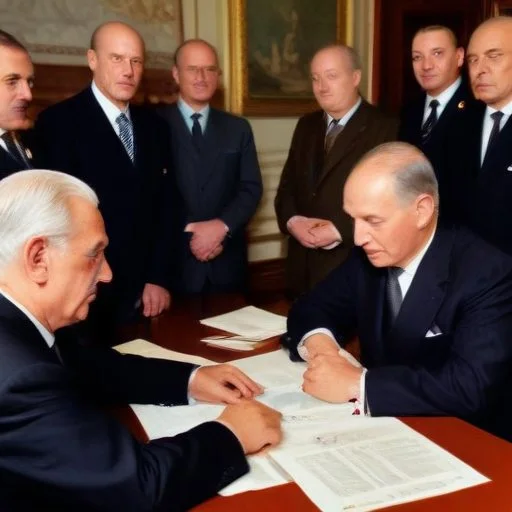
The aftermath of World War I left the world reeling from the devastating consequences of global conflict. As nations struggled to rebuild and recover, the need for a new era of international cooperation became increasingly apparent. The Kellogg-Briand Pact was born out of this desire, with its proponents seeking to establish a framework for resolving disputes peacefully and preventing future wars.
The pact's core principle was the renunciation of war as an instrument of national policy, with signatory nations pledging to settle disputes through peaceful means. The agreement also recognized the inherent right of nations to defend themselves, while emphasizing the importance of collective security and cooperation in maintaining international peace.
The Kellogg-Briand Pact's significance extended beyond its immediate impact, shaping the trajectory of international relations and inspiring subsequent peace initiatives. Although it failed to prevent the outbreak of World War II, the pact's ideals continue to influence diplomacy and global governance to this day.
The pact's emphasis on collective security and peaceful conflict resolution resonated with a war-weary public, contributing to a growing cultural movement that emphasized the importance of international cooperation and diplomacy.
While the pact was hailed as a landmark achievement by many, critics argued that its provisions were too vague and lacked effective enforcement mechanisms, rendering it toothless in the face of aggressive nationalism.
"The greatest enemy of peace is the passion of nations, which, like the passion of individuals, is sometimes excessive and sometimes unjust." – Aristide Briand
The Kellogg-Briand Pact shares parallels with other landmark peace initiatives, such as the Hague Conventions and the League of Nations, all of which sought to establish norms and institutions for promoting international peace and security.
Frank Kellogg's memoirs offer a unique insight into the pact's negotiation process, revealing the diplomatic intricacies and personal relationships that underpinned this historic agreement.
The Kellogg-Briand Pact's legacy can be seen in the development of subsequent international treaties and organizations, including the United Nations Charter and the Geneva Conventions, which have further codified the principles of international law and humanitarian norms.
The pact's emphasis on peace and international cooperation has inspired generations of scholars, diplomats, and policymakers, shaping the contours of modern international relations and informing the development of new peace initiatives and conflict resolution mechanisms.
The Kellogg-Briand Pact was originally signed in the French Foreign Ministry's Salon de l'Horloge, a storied venue that had hosted numerous historic diplomatic occasions.

Frank Kellogg, the 45th US Secretary of State, was an unlikely champion of international cooperation. Born in 1856 in New York, Kellogg's early life was marked by humble beginnings, working as a farmhand and later as a newspaper editor. His entry into politics was equally unassuming, starting as a county attorney in Minnesota.
However, Kellogg's ascension to national prominence was swift, serving as a senator from 1917 to 1923. His dedication to international cooperation and peaceful resolution of conflicts earned him the respect of his peers, ultimately leading to his appointment as Secretary of State in 1925.
Kellogg's critical role in shaping the Kellogg-Briand Pact highlights his transformation from a small-town lawyer to a visionary statesman. His unwavering commitment to peace and international cooperation continues to inspire generations of diplomats and policymakers.

The Kellogg-Briand Pact's impact extended far beyond the realm of international diplomacy, resonating with a war-weary public and inspiring a cultural movement that emphasized the importance of collective security and peaceful conflict resolution.
In the aftermath of World War I, pacifist literature and art flourished, with writers like Ernest Hemingway and poets like Wilfred Owen capturing the horrors of war. The pact's ideals also influenced the development of international organizations, such as the International Committee of the Red Cross, which sought to promote humanitarian law and protect civilians in armed conflicts.
The pact's emphasis on collective security also paved the way for the development of new forms of international cooperation, including the establishment of the United Nations in 1945.
The Kellogg-Briand Pact shares parallels with other landmark peace initiatives, including the Hague Conventions of 1899 and 1907. While the pact outlawed war as an instrument of national policy, the Hague Conventions established norms for the humane treatment of prisoners of war, the protection of civilians, and the prohibition of certain weapons.
Both agreements demonstrate a growing international recognition of the need for collective action to prevent war and promote humanitarian norms. However, the Hague Conventions were more focused on regulating the conduct of war, whereas the Kellogg-Briand Pact sought to abolish war altogether.
Despite their differences, both agreements have contributed significantly to the development of modern international humanitarian law, influencing the Geneva Conventions and shaping the contours of modern conflict resolution.

The Kellogg-Briand Pact's significance extends beyond its historical context, offering valuable lessons for educators and students alike. By incorporating the pact into history and political science curricula, educators can encourage critical thinking about international relations, diplomacy, and conflict resolution.
Moreover, the pact's emphasis on collective security and peaceful conflict resolution provides a framework for exploring contemporary global challenges, such as climate change, nuclear disarmament, and human rights.
By engaging with the pact's ideals and legacy, students can develop a deeper understanding of the complexities of international relations and the importance of cooperation in promoting global peace and security.
Historians have long debated the significance of the Kellogg-Briand Pact, with some viewing it as a naive attempt to outlaw war and others seeing it as a groundbreaking milestone in international cooperation.
More recent scholarship has highlighted the pact's role in shaping the development of international humanitarian law and its influence on subsequent peace initiatives, such as the United Nations Charter.
By reexamining the pact's history and legacy, historians can gain a deeper understanding of the complex interplay between international relations, diplomacy, and conflict resolution, informing our approaches to promoting global peace and security in the 21st century.