


In a move that would forever alter the course of history, Prince Paul, the regent of Yugoslavia, signed the Tripartite Pact, aligning his nation with the Axis powers of Nazi Germany, Fascist Italy, and Imperial Japan. This fateful decision, made on March 25, 1941, would cast a dark shadow over the Balkans, leaving a legacy of controversy and outrage in its wake.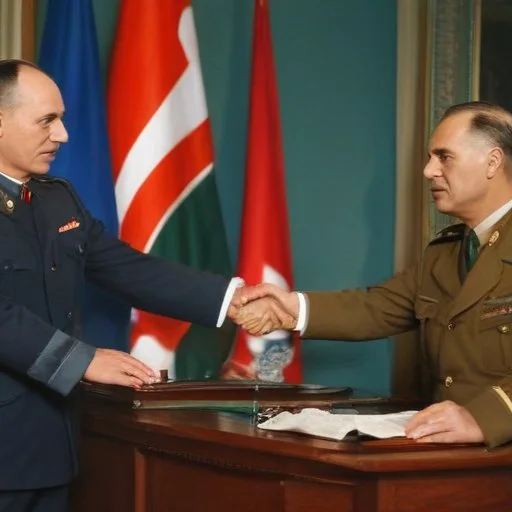
The Kingdom of Yugoslavia, born in 1918 from the ashes of World War I, had long walked a precarious tightrope of neutrality. However, as the winds of war began to howl across Europe, Prince Paul, backed by a council of advisors, crumbled under the pressure of German demands. The Tripartite Pact, seen as a necessary evil by some, was viewed by many Yugoslavians as a betrayal of the nation's sovereignty.
Born in 1893, Prince Paul was a member of the Karađorđević dynasty, which had ruled Serbia since the 19th century. Following the death of King Alexander I in 1934, Paul became regent for his cousin, the young King Peter II. Initially popular for his efforts to modernize and stabilize the Yugoslavian economy, Paul's leadership was soon marred by authoritarianism and a growing distance from his people.
The Tripartite Pact had far-reaching consequences for Yugoslavia and the world at large. The nation was subsequently invaded by Axis powers, and the Yugoslavian army was quickly defeated. The country was carved up into territories controlled by Germany, Italy, and Hungary, paving the way for a brutal occupation.
Despite the government's betrayal, the Yugoslavian people refused to surrender. A fierce resistance movement, led by Josip Broz Tito, emerged, determined to fight against the Axis occupation. This brave struggle would ultimately play a significant role in the Allied victory, earning Yugoslavia a place among the founding members of the United Nations.
"We have been betrayed by those who should have protected us." - A Yugoslavian citizen, upon learning of the Tripartite Pact
"I will not be intimidated by the threats of others. I will make the decisions that I believe are best for my country." - Prince Paul, in a statement following the signing of the pact
The Kingdom of Yugoslavia's fateful decision to join the Axis powers serves as a cautionary tale about the dangers of appeasement and the importance of standing up against tyranny. Though the country would never fully recover from the wounds of war, its brave people would go on to forge a new, independent path, one that would ultimately lead to a brighter future.
Before the outbreak of World War II, Yugoslavia was an agrarian country with a growing industrial sector. The country was rich in natural resources, including iron, copper, and chromium, which made it an attractive target for the Axis powers. The Yugoslavian government had invested heavily in modernizing its infrastructure, including the construction of roads, railways, and ports.
The country's economy was also heavily dependent on agriculture, with crops such as wheat, corn, and tobacco being major exports. The industrial sector was smaller, but growing, with a focus on textiles, machinery, and chemicals. Despite these efforts, Yugoslavia remained one of the poorest countries in Europe, with a GDP per capita of around $300 in 1939.
The country's economic situation was further complicated by its location, bordering both Germany and Italy, which made it vulnerable to economic pressure from its powerful neighbors. This vulnerability would eventually contribute to Prince Paul's decision to sign the Tripartite Pact.

General Dušan Simović was a Yugoslavian military officer who played a crucial role in the coup that overthrew Prince Paul's government on March 27, 1941. Born in 1882, Simović was a veteran of both World War I and the Balkan Wars, and had risen through the ranks to become the Chief of the General Staff of the Yugoslavian Army.
Simović was a strong opponent of Prince Paul's government and its pro-Axis policies. He was deeply concerned about the implications of the Tripartite Pact and the potential consequences for Yugoslavia's sovereignty and independence. Along with a group of like-minded officers, Simović planned and executed the coup, which temporarily brought an end to Prince Paul's rule.
The Balkan region has long been a complex and volatile geopolitical hotspot, with various empires and nations vying for control and influence. In the years leading up to World War II, the region was characterized by a delicate balance of power, with Yugoslavia, Greece, and Turkey forming a loose alliance to counter the influence of Italy and Germany.
The Molotov-Ribbentrop Pact, signed in 1939, further complicated the situation, as it created a temporary alliance between Germany and the Soviet Union, allowing Germany to focus its attention on Western Europe and the Balkans. This led to increased pressure on Yugoslavia, as Germany sought to expand its influence in the region.
The country's unique position, bordering both Germany and Italy, made it a crucial strategic location, and its eventual alignment with the Axis powers was seen as a vital component of Germany's plans for expansion.

The Tripartite Pact, signed on March 25, 1941, was a formal agreement between Germany, Italy, and Yugoslavia, solidifying Yugoslavia's entry into the Axis alliance. The document, signed by Prince Paul and the German and Italian ambassadors, committed Yugoslavia to providing military, economic, and political support to the Axis powers.
The pact was the culmination of months of pressure and negotiation between Germany and Yugoslavia, and marked a significant shift in Yugoslavia's foreign policy. The document itself has become a symbol of Yugoslavia's betrayal and its subsequent occupation by the Axis powers.
The war had a profound impact on Yugoslavian culture, as the country was torn apart by occupation, resistance, and civil war. The war led to the destruction of many cultural institutions, including museums, libraries, and historical monuments.
The occupation also led to a cultural blackout, as the Axis powers sought to suppress any expression of Yugoslavian identity and culture. Despite this, the war also saw the emergence of a strong resistance movement, which used cultural expression as a form of resistance against the occupiers.
The war had a lasting impact on Yugoslavian culture, shaping the country's identity and informing its cultural expression in the decades that followed.