


In a seismic shift of power, President Harry S. Truman relieved General Douglas MacArthur of his command of American forces in Korea and Japan on April 11, 1951, marking a critical turning point in the Korean War. This unprecedented move sent shockwaves through the military and beyond, sparking a nation-wide debate on the limits of military power and the role of civilian leadership in wartime.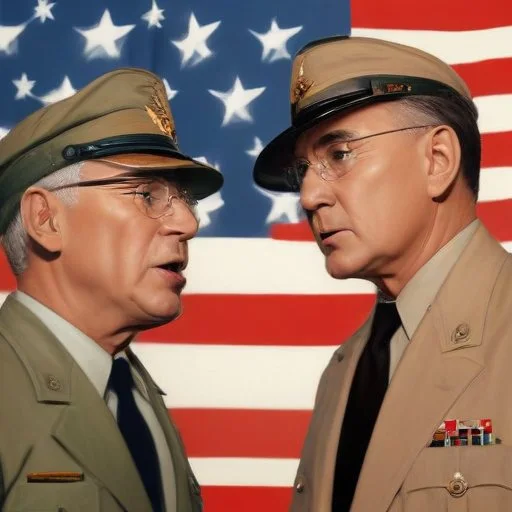
The events leading up to MacArthur's dismissal were a culmination of a long-standing power struggle between the two strong-willed leaders. MacArthur, a decorated war hero and iconic figure, had been pushing for a more aggressive approach to the war, while Truman's administration advocated for a more cautious and diplomatic approach.
MacArthur's public disagreements with Truman's administration had been escalating throughout 1950, culminating in a series of inflammatory statements that implied the President was hindering the war effort. The final straw came when MacArthur wrote a letter to Congress, openly criticizing Truman's policies and advocating for a more aggressive approach to the war.
The aftermath of MacArthur's dismissal saw widespread shock and outrage, with many Americans protesting the decision and calling for Truman's impeachment. However, the move also had significant long-term effects on the military and the presidency.
The event established a precedent for civilian control over the military, solidifying the principle that elected officials have the ultimate authority in matters of war and foreign policy. It also led to a re-evaluation of the role of the military in American society, sparking debates on the limits of military power and the importance of accountability.
The fallout from MacArthur's dismissal sparked a heated national debate, with many Americans divided on the issue. The decision was seen as either a bold assertion of presidential authority or a reckless attack on the military.
Quote: "I didn't fire him because he was a dumb son of a bitch, although he was, but that's not against the law for generals. If he'd been a lieutenant, I'd have fired him, but I didn't fire him because he was a dumb son of a bitch, I fired him because he wouldn't respect the authority of the President." - Harry S. Truman
The Truman-MacArthur controversy draws parallels with other instances of civilian-military conflict, such as the Lincoln-McClellan dispute during the American Civil War. Both cases highlight the delicate balance of power between elected officials and military leaders, and the importance of establishing clear lines of authority in times of war.
In his memoirs, Truman recalled the pressure and anxiety he faced in the days leading up to MacArthur's dismissal, saying "I was under great pressure, but I never felt more certain of my position."
The Truman-MacArthur controversy had far-reaching consequences, influencing the development of civilian-military relations and the role of the presidency in modern American history. It also served as a precursor to future conflicts, such as the Vietnam War, where the limits of military power and civilian control would be repeatedly tested.
The event's significance extends beyond the realm of politics, serving as a powerful symbol of the democratic values of accountability and civilian control. As a testament to these principles, the controversy continues to resonate with Americans today, providing a timely reminder of the importance of checks and balances in our system of government.
General Douglas MacArthur was born on January 26, 1880, in Little Rock, Arkansas. Throughout his military career, he was known for his bravery, strategic thinking, and strong leadership. MacArthur's early life was marked by a strong sense of discipline and duty, instilled by his parents, Arthur MacArthur Jr. and Mary Pinkney Hardy MacArthur. He graduated from the United States Military Academy at West Point in 1903 and went on to serve in various conflicts, including World War I and World War II.
MacArthur's personality was a complex mix of confidence, charisma, and ego, which often led him to clash with his superiors and colleagues. Despite this, he was widely respected for his military prowess and was awarded numerous honors, including the Medal of Honor.
The Truman-MacArthur controversy took place against the backdrop of the Cold War, a period of intense political and ideological rivalry between the United States and the Soviet Union. The Korean War, in which MacArthur was commander, was seen as a crucial front in the battle against communism.
In this context, the conflict between Truman and MacArthur was not just a personality clash, but a reflection of deeper divisions within the US government and society. The debate over military strategy and civilian control of the military was closely tied to larger questions about American foreign policy and national security.
The Truman-MacArthur controversy had significant implications for the development of civilian-military relations in the United States. It established a clear precedent for presidential authority over the military, and paved the way for a more robust system of civilian control.
The controversy also highlighted the importance of clear communication and coordination between civilian leaders and military commanders. In the aftermath of the crisis, the US government implemented reforms aimed at improving the relationship between the two, including the creation of the National Security Council.
The Truman-MacArthur controversy had a profound impact on American popular culture, reflecting and shaping public attitudes towards the military, politics, and authority.
In the years following the crisis, the controversy was the subject of numerous books, films, and plays, including the 1953 film "The Longest Day", which featured a scene depicting MacArthur's dismissal. The controversy also spawned a range of popular songs and jokes, cementing its place in the public imagination.
The Truman-MacArthur controversy has been the subject of sustained historical debate and analysis, with scholars interpreting the event from a range of perspectives.
Some historians have seen the controversy as a triumph of democratic values, with Truman's assertion of civilian control over the military representing a key moment in the development of American democracy. Others have viewed the controversy as a reflection of deeper structural flaws in the US system of government, highlighting the tensions between military power and civilian authority.