


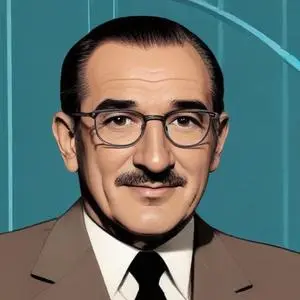
The 51st United States Secretary of State played a crucial role in shaping post-World War II foreign policy, particularly in the formation of the Marshall Plan and the creation of NATO. He was a key figure in the Cold War era.
As the 51st U.S. Secretary of State, Dean Acheson played a pivotal role in shaping the foreign policy of the Harry S. Truman administration from 1949 to 1953. He is best known for his instrumental contributions to the Truman Doctrine and the Marshall Plan, two landmark initiatives that reshaped the post-war world order and cemented America's position as a global superpower.
Born on April 11, 1893, in Middletown, Connecticut, Acheson was the son of Edward Campion Acheson, a Church of England priest, and Eleanor Gertrude Gooderham, a Canadian-born descendant of William Gooderham, Sr., the founder of the Gooderham and Worts Distillery of Toronto. Acheson's family moved to the United States when he was young, and he went on to attend Groton School and Yale College, where he developed a reputation as a partier and prankster.
Acheson's entry into politics began in 1941, when he joined the U.S. Department of State as an assistant secretary. During World War II, he played a key role in shaping American foreign policy, particularly in relation to the Soviet Union. In 1945, he became Truman's main foreign policy advisor, a position he held until 1947. His expertise and vision earned him a seat at the negotiating table, where he helped design the Truman Doctrine and the Marshall Plan.
The Truman Doctrine, unveiled in 1947, was a bold initiative aimed at containing Soviet expansion in Europe. The doctrine committed the United States to supporting free peoples and nations resisting communist aggression, marking a significant shift in American foreign policy. Acheson played a crucial role in shaping this doctrine, which would go on to shape the course of the Cold War.
The Marshall Plan, launched in 1948, was a landmark economic recovery program designed to rebuild war-torn Europe. Acheson was instrumental in convincing Truman to support the plan, which would pour billions of dollars into European reconstruction and help secure America's position as a global leader.
In 1949, Acheson became the 51st U.S. Secretary of State, a position he held until 1953. During his tenure, he continued to play a key role in shaping American foreign policy, particularly in relation to the Soviet Union. He was a strong advocate for the creation of the North Atlantic Treaty Organization (NATO), which was established in 1949.
After leaving government service, Acheson returned to private law practice, but he remained a prominent figure in American politics. In 1962, he was called upon by President John F. Kennedy to provide advice during the Cuban Missile Crisis, and in 1968, he counseled President Lyndon B. Johnson to negotiate for peace with North Vietnam.
Acheson faced fierce criticism from Republicans, led by Senator Joseph McCarthy, who accused him of being soft on communism. Acheson's perceived arrogance and aloofness also earned him detractors, but his supporters saw these traits as evidence of his unwavering commitment to his principles.
Acheson was married to Alice Stanley Acheson, and the couple had three children together. He was a member of the Scroll and Key Society and the Delta Kappa Epsilon fraternity, and he maintained close relationships with his Yale classmates throughout his life.
Acheson was known for his wit and candor, and he left behind a treasure trove of memorable quotes. One of his most famous remarks came in 1949, when he said, "The greatest mistake I made was in underestimating the mentality of the Republicans." Another notable quote is, "The most important thing about a policy is its intellectual basis."
Dean Acheson's legacy is complex and multifaceted. He was a visionary statesman who played a crucial role in shaping America's response to the Soviet Union during the early years of the Cold War. While his policies were not without controversy, they helped establish the United States as a global leader and paved the way for decades of American dominance.
In the end, Acheson's commitment to his principles and his unwavering dedication to American democracy earned him a place among the pantheon of great American statesmen. As he once said, "The only thing necessary for the triumph of evil is for good men to do nothing." Dean Acheson's life's work was a testament to the power of courage and conviction in the face of overwhelming adversity.
Born in 1884
The 33rd President of the United States, a strong leader who made tough decisions, including dropping atomic bombs on Japan and establishing the Marshall Plan to rebuild Europe after WWII.
Born in 1890
Led the Allied forces to victory in World War II and later served as President, maintaining peace and prosperity during the Cold War era. He's known for his strategic leadership and diplomatic skills.
Born in 1888
A prominent Cold War diplomat who served as Secretary of State under President Dwight D. Eisenhower, known for his anti-communist foreign policy and role in shaping the United States' response to the Soviet Union.
Born in 1880
A highly decorated military leader and statesman who played a crucial role in shaping post-WWII foreign policy and was awarded the Nobel Peace Prize for his efforts. He's most known for authoring the Marshall Plan, a massive economic aid program that helped rebuild war-torn Europe.
Born in 1923
A renowned diplomat and strategist who played a pivotal role in shaping global politics during the Cold War era, known for his Realpolitik approach and brokering peace agreements .
98 Years Old
A Polish-born American strategist and policymaker who served as National Security Advisor, shaping US foreign policy and advising presidents on global affairs. Known for his realist approach and expertise on geopolitics.
89 Years Old
The first female US Secretary of State, serving from 1997 to 2001, who played a key role in shaping American foreign policy during the Clinton administration. She's known for her strong diplomatic efforts and advocacy for democracy and human rights.
89 Years Old
The first African American to serve as Secretary of State, he played a crucial role in shaping US foreign policy during the Gulf War and War on Terror. He's also known for his diplomatic efforts and leadership in the military.
