


Kublai Khan's rise to power in the Mongol Empire marked a pivotal moment in history, as the cunning and ambitious grandson of Genghis Khan seized the throne, ushering in a new era of Mongol rule and paving the way for the creation of the Yuan Dynasty in China. This momentous event, which took place in the midst of a tumultuous empire, would have far-reaching consequences, forever changing the trajectory of the Mongol Empire.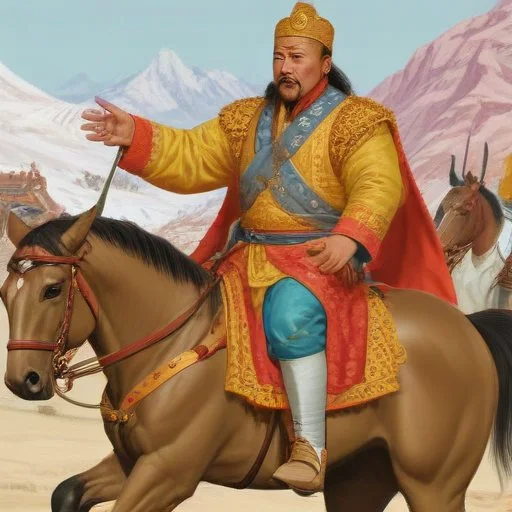
Kublai Khan's journey to the throne was not without its challenges. As the grandson of Genghis Khan, he was well-positioned to take advantage of the power vacuum created by the sudden death of his brother, Mongke Khan, during a military campaign in China. However, Kublai faced opposition from his own family members, who were wary of his intentions and questioned his legitimacy to rule.
With his position solidified, Kublai set about reshaping the Mongol Empire in his image. He established a new capital in Dadu (modern-day Beijing), signaling a shift in the empire's focus towards China and the East. This move marked a significant departure from the traditional Mongol nomadic lifestyle, as Kublai embraced a more sedentary, administratively focused approach to governance.
Kublai's reign would be characterized by a mix of military campaigns, administrative reforms, and cultural exchange. He encouraged trade and diplomacy with neighboring nations, fostering a period of relative peace and stability that facilitated the exchange of ideas, goods, and cultures.
Kublai's rule witnessed a flourishing of cultural and artistic expression, as the Mongol Empire became a melting pot of influences from across the ancient world. The establishment of the Yuan Dynasty in China saw the fusion of Mongolian, Chinese, and Tibetan cultures, giving rise to a unique and vibrant cultural landscape.
Kublai Khan's reign had a profound impact on the Mongol Empire and beyond. His legacy would be felt for centuries to come, shaping the course of Chinese history, influencing the development of Tibetan Buddhism, and leaving an indelible mark on the cultural heritage of the region.
"The Mongol Empire was like a great tempest, and I was the storm's eye, quiet and calm in the center of the whirlwind."
- Kublai Khan
Kublai's ascension to power marked the beginning of a new era, one characterized by cultural exchange, administrative innovation, and military prowess. As the Mongol Empire continued to evolve and expand, Kublai's vision for a unified, cosmopolitan empire would remain a guiding force, shaping the destiny of the nation for generations to come.
Kublai Khan was born in 1215, the fourth son of Tolui, a close advisor to Genghis Khan, and Sorghaghtani, a noblewoman from the Kerait tribe. His early life was marked by exposure to the complexities of Mongol politics and the influence of his mother, who played a significant role in shaping his worldview.
Kublai's education was diverse, with training in Mongolian military tactics, Chinese literature, and Tibetan Buddhism. This eclectic upbringing would later inform his governance style, as he drew upon these disparate influences to forge a unique approach to statecraft.
The Mongol court under Kublai Khan became a cultural epicenter, attracting scholars, artists, and merchants from across the ancient world. The Khan's patronage of the arts and his fascination with foreign cultures led to a flourishing of creative expression, as seen in the development of new forms of Buddhist art, literature, and architecture.
The fusion of Mongolian, Chinese, and Tibetan cultural elements gave rise to a distinct Yuan Dynasty aesthetic, characterized by intricate carvings, vibrant textiles, and ornate ceramics.
The 13th century was a time of great upheaval in Asia, with the Mongol Empire expanding its dominion over vast swaths of territory. The Song Dynasty in southern China, the Jin Dynasty in northern China, and the Tibetan Empire to the west all posed significant challenges to Mongol expansion.
Kublai Khan's decision to establish a new capital in Dadu (modern-day Beijing) marked a strategic shift in the empire's focus, as the Khan sought to consolidate power and expand his influence over the East Asian region.
Among the most significant artifacts from the reign of Kublai Khan are the imperial seals, which served as symbols of the Khan's authority and legitimacy. The seals, often made of precious materials like gold, silver, and jade, featured intricate designs and inscriptions that reflected the Khan's titles, such as " Emperor of the Great Yuan" and "King of Kings."
These seals have provided historians with valuable insights into the administrative structures and ceremonial practices of the Yuan Dynasty.
Kublai Khan's reign was marked by significant economic innovations, including the establishment of a centralized monetary system, the development of a network of trade routes, and the encouragement of foreign trade and investment.
The Khan's policies fostered a period of economic growth, as the Mongol Empire became a hub for mercantile activity, with merchants from across the ancient world drawn to its markets and trade centers.