


The PanAmerican Exposition, a premier event showcasing American innovation and progress, was marred by tragedy on September 6, 1901, when Leon Czolgosz, an unemployed anarchist, shot and fatally wounded President William McKinley. This brazen attack, which occurred in front of thousands of spectators, sent shockwaves throughout the nation, plunging the country into a state of crisis and ultimately claiming the life of the 25th President of the United States.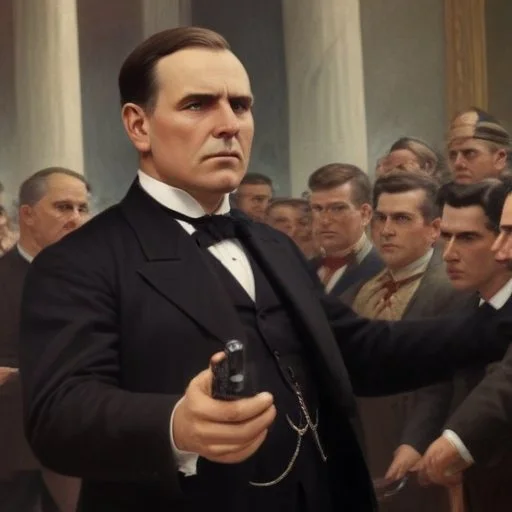
Leon Czolgosz, a Polish-American anarchist, was born on May 5, 1873, in Michigan to a family of modest means. Growing up in a tumultuous household, Czolgosz was drawn to the ideologies of anarchism, which emphasized the abolition of government and the establishment of a stateless society. His radical beliefs were shaped by the writings of Emma Goldman, a prominent anarchist author and speaker, whom he idolized. Goldman's influence, coupled with the death of his father and the economic hardships faced by his family, contributed to Czolgosz's deep-seated resentment towards the wealthy elite and the government.
In the summer of 1901, Czolgosz arrived in Buffalo, New York, determined to carry out a dramatic act of political violence. He had been following President McKinley's schedule, waiting for the perfect moment to strike. The PanAmerican Exposition, with its grandiose displays of American progress and innovation, presented the ideal setting for Czolgosz to exact his revenge against the system he despised.
On September 6, 1901, Czolgosz blended into the crowd gathered at the Temple of Music, awaiting the arrival of President McKinley. Concealing a concealed revolver in his hand, wrapped in a handkerchief, Czolgosz patiently waited in line to shake hands with the President. As McKinley approached, Czolgosz seized the opportunity, firing two shots at close range. The President stumbled backward, mortally wounded, while Czolgosz was tackled to the ground by bystanders.
The assassination attempt on President McKinley sent shockwaves throughout the nation, sparking widespread panic and outrage. The President's condition was grave, and his death on September 14, 1901, plunged the country into a period of national mourning. The event marked a turning point in American history, as the nation struggled to come to terms with the senseless act of violence.
In the aftermath of the assassination, Czolgosz was hailed as a martyr by some in the anarchist community, who saw his actions as a courageous stand against the oppressive government. However, this sentiment was not universally shared, and Czolgosz's actions were widely condemned by the public and the media. His trial, in which he was found guilty of murder and sentenced to death, was widely publicized, and his execution by electric chair on October 29, 1901, brought a sense of closure to the nation.
The assassination of President McKinley had far-reaching consequences, contributing to a significant shift in American politics and society. The event led to increased security measures for public figures, as well as a crackdown on anarchist and radical movements. The assassination also paved the way for the rise of Theodore Roosevelt, who succeeded McKinley as President and went on to shape the course of American history.
The assassination of President William McKinley by Leon Czolgosz on September 6, 1901, remains one of the most significant events in American history. The tragedy, which occurred at the PanAmerican Exposition in Buffalo, New York, was a stark reminder of the dangers of political extremism and the importance of protecting public figures. As the nation looks back on this pivotal moment, it is clear that the legacy of the assassination continues to resonate, shaping the course of American politics and society to this day.
The Pan-American Exposition, held in Buffalo, New York, was a symbol of American progress and innovation, showcasing the country's achievements in science, technology, and culture. The event was a culmination of American exceptionalism, with the country flexing its muscles on the world stage. The assassination of President McKinley at the exposition served as a stark contrast to the ideals of peace and prosperity that the event embodied.
Historians have often debated the role of the Pan-American Exposition in shaping American identity and its influence on the country's foreign policy. The event marked a significant moment in American history, reflecting the nation's growing confidence and ambition on the global stage.
Emma Goldman, a prominent anarchist author and speaker, played a significant role in shaping Leon Czolgosz's radical beliefs. Her influence extended beyond Czolgosz, inspiring a generation of anarchists and radicals. Goldman's writings and lectures emphasized the need for direct action and the abolition of government, resonating with disillusioned individuals like Czolgosz.
Goldman's radical ideology was shaped by her experiences as a Russian immigrant and her involvement in the labor movement. Her activism and writings made her a household name, earning her both admiration and scorn from the public and authorities alike.
The Pan-American Exposition, touted as a celebration of American progress, had a significant environmental impact on the city of Buffalo and its surroundings. The construction of the exposition's infrastructure, including the Temple of Music, resulted in the destruction of natural habitats and the displacement of local wildlife.
The exposition's focus on industrial and technological advancements overshadowed concerns about environmental sustainability, highlighting the tension between progress and preservation that would become a hallmark of the 20th century.
The assassination of President McKinley had far-reaching political consequences, contributing to a significant shift in American politics. The event marked a turning point in the country's approach to anarchists and radicals, leading to increased surveillance and repression of dissenting voices.
The assassination also paved the way for Theodore Roosevelt's rise to power, as he succeeded McKinley as President and implemented his own brand of progressive politics, which would shape the course of American history for years to come.
The assassination of President McKinley occurred against the backdrop of rising tensions between the United States and European powers. The event sparked concerns about American vulnerability and the need for increased security measures, which would have significant implications for the country's foreign policy and national security.
The assassination also highlighted the growing divide between the United States and Europe, as anarchist movements and radical ideologies began to take hold across the Atlantic, threatening the established order and paving the way for the tumultuous years ahead.