


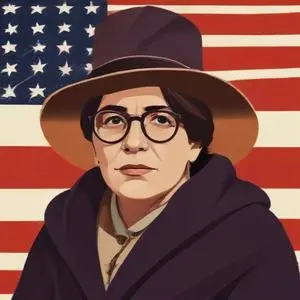
A Lithuanian-Canadian philosopher and activist who advocated for anarchism, free speech, and women's rights, playing a pivotal role in shaping modern feminist and political thought.
Emma Goldman was a Lithuanian-born anarchist revolutionary, political activist, and writer who played a pivotal role in the development of anarchist political philosophy in North America and Europe in the first half of the 20th century. Known for her fiery speeches, controversial writings, and unwavering commitment to social justice, Goldman was a leading figure in the anarchist movement, advocating for women's rights, free speech, and labor rights.
Born on June 27, 1869, in Kaunas, Lithuania, then part of the Russian Empire, Goldman grew up in an Orthodox Jewish family. She immigrated to the United States in 1885, settling in Rochester, New York, where she worked in a factory and became involved in the labor movement.
The Chicago Haymarket affair in 1886, in which a labor protest turned violent, sparked Goldman's interest in anarchism. She soon became a prominent figure in the anarchist movement, writing for anarchist publications and delivering speeches that drew crowds of thousands.
In 1892, Goldman and her lover, Alexander Berkman, planned to assassinate industrialist and financier Henry Clay Frick, an act that Berkman attempted but failed to carry out. Berkman was sentenced to 22 years in prison, while Goldman was imprisoned several times for inciting to riot and illegally distributing information about birth control.
In 1906, Goldman founded the anarchist journal Mother Earth, which became a platform for her writings on anarchism, women's rights, and social issues. Her autobiography, Living My Life, published in two volumes in 1931 and 1935, chronicles her life and activism.
In 1917, Goldman and Berkman were sentenced to two years in jail for conspiring to induce persons not to register for the newly instated draft. After their release, they were arrested and deported to Russia in 1919. Initially supportive of the October Revolution, Goldman eventually became disillusioned with the Soviet Union's violent repression of independent voices, as documented in her book My Disillusionment in Russia (1923).
Goldman spent the remainder of her life in exile, living in England, Canada, and France. She continued to write and speak out against injustice, including against the rise of fascism in Europe. Goldman died on May 14, 1940, in Toronto, Canada, leaving behind a legacy as a pioneering figure in the anarchist movement and a champion of social justice.
Goldman's ideas and activism have inspired generations of social justice advocates, from labor organizers to feminist activists. Her emphasis on direct action, free speech, and individual freedom continues to influence contemporary social movements.
Born in 1870
A Lithuanian-American anarchist and writer who advocated for labor rights and prison reform through his writings and activism, including a 14-year prison sentence for attempting to assassinate a businessman.
Born in 1873
A prominent anarchist writer and historian, known for his influential works on anarcho-syndicalism and his role in the development of modern anarchist thought.
Born in 1866
An American anarchist writer and feminist who advocated for individual freedom and challenged traditional social norms, known for her powerful essays and poetry.
Born in 1809
A 19th-century French economist and politician who advocated for anarchism, socialism, and mutualism, and is known for coining the phrase "Property is Theft."
Born in 1814
A Russian philosopher and theorist who advocated for anarchism and the abolition of the state, and is known for his influence on the development of anarchist thought. His ideas emphasized individual freedom and the rejection of authority.
Born in 1817
A 19th-century thinker who advocated for simple living, civil disobedience, and individualism, inspiring generations to reevaluate their relationship with nature and society.
Born in 1759
A pioneering advocate for women's rights and education, this 18th-century thinker wrote influential works that shaped feminist philosophy and literature.
