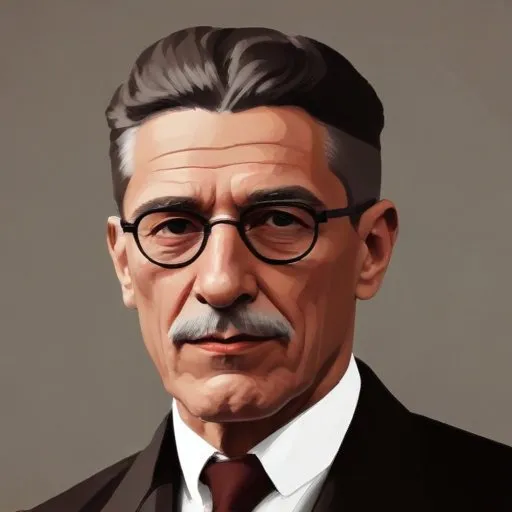
Rudolf Rocker

Rudolf Rocker

Rudolf Rocker was born on March 25th, 1873

Full Name: Rudolf Rocker
Nationality: German-American
Occupation: Author and Activist
Born: 1873
Died: 1958
Notable Work: Nationalism and Culture
Field of Study: Politics
Philosophy: Anarchism

A prominent anarchist writer and historian, known for his influential works on anarcho-syndicalism and his role in the development of modern anarchist thought.

Written by: Sofia Garcia Sofia Garcia

Rudolf Rocker: The Anarchist Visionary

A Life of Defiance and Conviction

Rudolf Rocker, a German anarchist writer and activist, left an indelible mark on the world of politics and philosophy. Known for his scathing critiques of nationalism and his unwavering commitment to anarchist ideals, Rocker's life was a testament to the power of conviction and principle.

Early Life and Formative Years

Born on March 25, 1873, in Mainz, Germany, Rocker's early life was marked by hardship and loss. Orphaned at a young age, he was forced to fend for himself, working as a cabin boy on river boats and later as a typographer. It was during this period that he became involved in trade unionism and joined the Social Democratic Party of Germany (SPD).

The Journey to Anarchism

Rocker's early involvement with the SPD was short-lived, as he soon came under the influence of anarchist thinkers such as Mikhail Bakunin and Peter Kropotkin. His growing radicalism led to his expulsion from the SPD, and he was forced to flee Germany for Paris, where he immersed himself in syndicalist and Jewish anarchist ideas and practices.

London and the Yiddish Anarchist Scene

In 1895, Rocker moved to London, where he became a key figure in the Yiddish-language anarchist scene. He edited the Arbeter Fraynd periodical, published the works of prominent anarchist thinkers, and organized strikes in the garment industry. During this period, he formed a life-long partnership with Milly Witkop, a Ukrainian-born anarchist from a Jewish background.

The War Years and Deportation

During World War I, Rocker was interned as an enemy alien and later deported to the Netherlands. This tumultuous period only strengthened his resolve, and he continued to write and agitate for anarchist causes.

The Rise of Nationalism and the Birth of a Magnum Opus

In the 1920s, Rocker became increasingly concerned with the rise of nationalism and fascism. It was during this period that he began work on his masterwork, Nationalism and Culture, a scathing critique of nationalist ideology. As the Nazi party rose to power, Rocker was forced to flee Germany once more, this time for the United States.

A Life of Activism in Exile

In the United States, Rocker remained active in anarchist circles, working with the Yiddish Freie Arbeiter Stimme group and supporting the Spanish Revolution against fascist and Stalinist forces. He continued to write and publish, leaving behind a legacy of ideas and ideals that continue to inspire and challenge.

Philosophical Contributions and Beliefs

Rocker's philosophical contributions were marked by a deep-seated distrust of authority and a commitment to individual freedom and autonomy. He believed that the state was a coercive institution that stifled human creativity and potential, and that only through the abolition of capitalism and the state could humanity truly flourish.

Influence on Modern Society

Rocker's ideas and ideals have had a profound impact on modern society, influencing thinkers and activists across the globe. His critiques of nationalism and fascism continue to resonate today, and his commitment to anarchist principles remains an inspiration to many.

Quotes and Memorable Sayings

Legacy and Impact

Rudolf Rocker's life was a testament to the power of conviction and principle. His ideas and ideals continue to inspire and challenge, and his legacy serves as a reminder of the importance of individual freedom and autonomy. As a thinker, writer, and activist, Rocker left behind a rich inheritance of ideas and ideals that will continue to shape and inspire generations to come.
Timeline
1873
Birth in Germany
Rudolf Rocker was born on March 25, 1873, in Mainz, Germany. He would go on to become a prominent anarchist writer and activist.
1891
Expulsion from Germany
Rocker was expelled from Germany due to his anarchist activities, prompting him to move to Paris and later London.
1907
Founding of the Ferrer Colony
Rocker helped establish the Ferrer Colony, a libertarian community in Stelton, New Jersey, which offered an alternative to traditional education.
1933
Escape from Nazi Germany
As the Nazi Party rose to power, Rocker fled Germany and eventually settled in the United States, where he continued to write and advocate for anarchist causes.
1958
Death in the USA
Rudolf Rocker passed away on September 19, 1958, in Crompond, New York, leaving behind a legacy as a prominent anarchist thinker and writer.
Rudolf Rocker

Rudolf Rocker Quiz

Rudolf Rocker's most significant contribution to anarchist thought is in the area of

Score: 0/5
FAQ
What was Rudolf Rockers most notable contribution to anarchism?
Rudolf Rocker was a German-American anarchist who wrote extensively on anarchist theory and history. His most famous work is Anarcho-Syndicalism: Theory and Practice, which remains a classic of anarchist literature.
What was Rudolf Rockers role in the Spanish Revolution?
Rudolf Rocker supported the Spanish Revolution and wrote about the anarchist movement in Spain during the 1930s.
How did Rudolf Rockers ideas influence the development of anarchism?
Rudolf Rockers ideas on anarcho-syndicalism and libertarian socialism influenced the development of anarchism in Europe and the United States.
What was Rudolf Rockers relationship with Emma Goldman?
Rudolf Rocker was a close friend and collaborator of Emma Goldman, the famous American anarchist. The two were united in their commitment to anarchist principles and their criticism of capitalism and the state.
What legacy did Rudolf Rocker leave behind?
Rudolf Rocker left behind a legacy as one of the most important anarchist theorists and historians of the 20th century, and his work continues to inspire anarchists and socialists today.

Related People:

Emma Goldman

Born in 1869

A Lithuanian-Canadian philosopher and activist who advocated for anarchism, free speech, and women's rights, playing a pivotal role in shaping modern feminist and political thought.

Alexander Berkman

Born in 1870

A Lithuanian-American anarchist and writer who advocated for labor rights and prison reform through his writings and activism, including a 14-year prison sentence for attempting to assassinate a businessman.

Pierre-Joseph Proudhon

Born in 1809

A 19th-century French economist and politician who advocated for anarchism, socialism, and mutualism, and is known for coining the phrase "Property is Theft."

Mikhail Bakunin

Born in 1814

A Russian philosopher and theorist who advocated for anarchism and the abolition of the state, and is known for his influence on the development of anarchist thought. His ideas emphasized individual freedom and the rejection of authority.

Voltairine de Cleyre

Born in 1866

An American anarchist writer and feminist who advocated for individual freedom and challenged traditional social norms, known for her powerful essays and poetry.

Henry David Thoreau

Born in 1817

A 19th-century thinker who advocated for simple living, civil disobedience, and individualism, inspiring generations to reevaluate their relationship with nature and society.

Leo Tolstoy

Born in 1828

A Russian literary giant who penned sweeping novels like "War and Peace" and "Anna Karenina", exploring the human condition with profound insight and masterful storytelling.

Noam Chomsky

97 Years Old

Developed groundbreaking theories on language acquisition and universal grammar, and is a prominent critic of power and propaganda in modern society.