


October 1964 marked a pivotal moment in Soviet history as Leonid Brezhnev assumed the role of General Secretary of the Soviet Communist Party, while Alexei Kosygin took the reins as Chairman of the Council of Ministers. This unexpected change in leadership sent ripples across the globe, as the world watched with bated breath to see how these two new leaders would shape the Soviet Union's trajectory.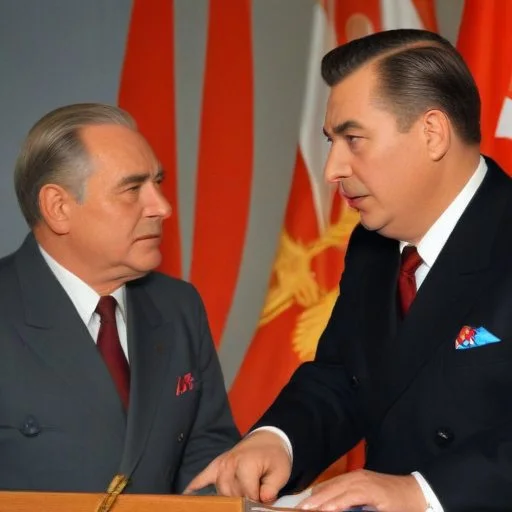
In the early 1960s, the Soviet Union was facing a period of uncertainty. Khrushchev's attempts at reform had been met with resistance from hardline communists, and his removal from power was seen as a necessary step to maintain stability. The question on everyone's lips was: who would take the reins next?
Leonid Brezhnev, a seasoned politician and Party apparatchik, emerged as the new General Secretary. His cautious approach to reform and willingness to listen to the Party's old guard made him an attractive choice for the role. Meanwhile, Alexei Kosygin, a skilled economist and former Premier, took on the Chairmanship of the Council of Ministers, overseeing the country's economic development.
The Brezhnev-Kosygin duo brought a sense of stability to the Soviet Union, calming the nerves of domestic and international stakeholders alike. Brezhnev's dominance in the Party apparatus allowed him to consolidate power, while Kosygin's expertise in economics enabled him to implement reforms aimed at revitalizing the Soviet economy.
Despite the initial sense of unity, tensions began to emerge between Brezhnev and Kosygin. Brezhnev's grip on power tightened, while Kosygin's economic reforms faced stiff resistance from Party hardliners. This power struggle would come to define the next decade of Soviet politics.
The rise of Brezhnev and Kosygin sent shockwaves across the globe. The Western world watched with trepidation as the Soviet Union's new leaders charted a course that would shape international relations, Cold War dynamics, and the global balance of power.
The Brezhnev-Kosygin era, marked by a mix of repression and reform, had far-reaching consequences for the Soviet Union. While it brought a degree of stability, it also paved the way for stagnation and eventually, the collapse of the Soviet empire.
The Brezhnev-Kosygin era may have come to an end, but its legacy continues to influence Soviet and Russian politics to this day. As we look back on this pivotal moment in history, we are reminded of the complex dance of power and the enduring quest for stability in the face of uncertainty.
Alexei Kosygin, born in 1904, was a skilled economist and politician who rose through the ranks of the Soviet government. He served as Premier of the Soviet Union from 1960 to 1964 and was known for his progressive economic reforms. Kosygin's expertise in economics and his experience in government made him an attractive choice for the Chairmanship of the Council of Ministers.
Kosygin's leadership style was characterized by his pragmatic approach to economic development. He believed in the importance of decentralization and giving more autonomy to local governments. This approach was reflected in his economic reforms, which aimed to increase efficiency and productivity in various sectors of the Soviet economy.

The rise of Brezhnev and Kosygin marked a significant shift in the Soviet Union's political landscape. The power struggle between the two leaders would define the next decade of Soviet politics. Brezhnev's consolidation of power and Kosygin's economic reforms would have far-reaching consequences for the Soviet economy and its relations with the Western world.
The Brezhnev-Kosygin era was characterized by a mix of repression and reform. Brezhnev's dominance in the Party apparatus allowed him to maintain control, while Kosygin's economic reforms aimed to revitalize the Soviet economy. This delicate balance of power would shape the course of Soviet politics for years to come.
The economic reforms implemented by Kosygin during the Brezhnev-Kosygin era had a significant impact on the Soviet economy. One of the key reforms was the introduction of the "Kosygin Reforms," which aimed to decentralize the economy and give more autonomy to local governments. This led to an increase in efficiency and productivity in various sectors of the economy.
The reforms also led to an increase in consumer goods and a rise in the standard of living for Soviet citizens. However, the reforms were not without their challenges, and the Soviet economy continued to face difficulties in the following years.

The rise of Brezhnev and Kosygin occurred at a critical time in the Cold War. The Western world was watching with bated breath as the Soviet Union's new leaders charted a course that would shape international relations and the global balance of power.
The Brezhnev-Kosygin era marked a period of détente between the Soviet Union and the United States. The two superpowers engaged in a series of diplomatic negotiations, including the Strategic Arms Limitation Talks (SALT), which aimed to reduce the number of nuclear weapons and ease tensions between the two nations.
Historians have debated the significance of the Brezhnev-Kosygin era in Soviet history. Some have argued that the era marked a period of stagnation, where the Soviet Union failed to reform its economy and politics. Others have seen it as a period of stability, where the Soviet Union maintained its global influence and prestige.
Regardless of interpretation, the Brezhnev-Kosygin era remains an important chapter in Soviet history, shaping the course of the Soviet Union's development and its relations with the world.