


The fateful decision made by Major General Eugene Reybold, Chief of the U.S. Army Corps of Engineers, on June 17, 1942, marked the inception of the most ambitious and clandestine scientific endeavor of the twentieth century – the Development of Substitute Materials project, more famously known as the Manhattan Project. This top-secret initiative would irrevocably alter the course of history, as the United States embarked on a quest to harness the destructive power of atomic energy.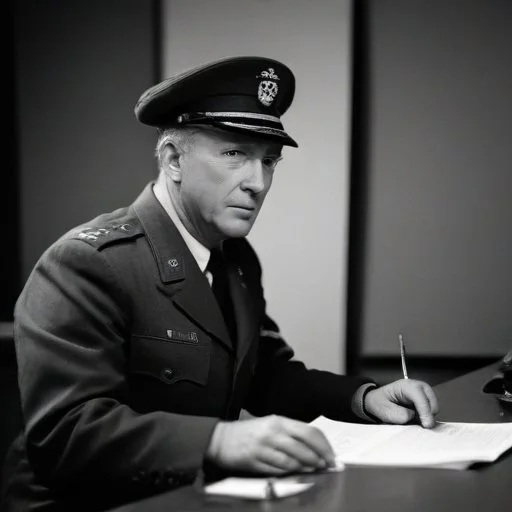
As the global conflict of World War II intensified, the United States found itself entrapped in a precarious position. The threat of Nazi Germany's potential acquisition of atomic capabilities loomed large, prompting the American government to action. In response, President Franklin D. Roosevelt sanctioned a comprehensive research and development program, designed to explore the feasibility of atomic energy for military applications.
The Manhattan Project's success hinged on the collective expertise of a diverse group of visionaries and scientists. Key figures such as J. Robert Oppenheimer, Enrico Fermi, and Ernest Lawrence played pivotal roles in shaping the project's trajectory. Their groundbreaking research and innovative approaches paved the way for the development of the atomic bomb.
The Manhattan Project's timeline was marked by a series of clandestine meetings, secret research facilities, and frantic efforts to stay ahead of the Nazi scientific community. Notable milestones included:
The Manhattan Project's reverberations were felt far beyond the boundaries of World War II. The successful development of the atomic bomb introduced a new era of warfare, where the threat of nuclear devastation would forever alter the global geopolitical landscape.
The project's implications extended beyond the realm of military strategy, as it also spawned a new generation of scientists, engineers, and policymakers. The Manhattan Project's legacy would continue to shape the course of international relations, scientific inquiry, and global security in the decades to come.
The Manhattan Project's secrecy shrouded the public in an air of mystique, fostering a sense of awe and trepidation. As news of the project's successes began to trickle out, the atomic age was born, and with it, a new cultural identity.
Films, literature, and art of the period began to grapple with the weight of nuclear responsibility, reflecting the societal anxiety and fascination with the destructive power of atomic energy.
"I am become Death, destroyer of worlds." – J. Robert Oppenheimer, upon witnessing the Trinity test
"The optimist thinks this is the best of all possible worlds. The pessimist fears it is true." – J. Robert Oppenheimer, on the implications of nuclear warfare
The Manhattan Project's significance can be gauged by comparing it to other pivotal scientific endeavors of the twentieth century. The project's scope, secrecy, and interdisciplinary approach set it apart from contemporaneous initiatives, such as the development of radar technology and code-breaking efforts.
In conclusion, the Manhattan Project's genesis, spearheaded by Major General Eugene Reybold's authorization, marked a turning point in human history. As we continue to navigate the complexities of the atomic age, the project's legacy serves as a poignant reminder of the dual nature of scientific progress – holding the power to both create and destroy.
Enrico Fermi: The Architect of the Nuclear Age
Enrico Fermi's involvement in the Manhattan Project was instrumental in shaping its success. An Italian-born physicist, Fermi's groundbreaking research in nuclear physics earned him a Nobel Prize in 1938. His expertise in neutron-induced radioactivity and nuclear chain reactions made him an invaluable asset to the project.
Fermi's leadership and scientific prowess were evident in his design of the Chicago Pile-1 experiment, which achieved the first controlled nuclear chain reaction in 1942. His work at the University of Chicago, Los Alamos, and Oak Ridge played a crucial role in the development of the atomic bomb.

The Early Years: The Formation of the S-1 Committee
In the spring of 1942, the Manhattan Project was still in its infancy. The S-1 Committee, comprising prominent scientists and government officials, was formed to discuss the project's objectives and feasibility. This secretive group, meeting for the first time in September 1942, laid the foundation for the project's subsequent success.
The committee's initial meetings took place in cramped, makeshift quarters in Washington, D.C. Attendees included J. Robert Oppenheimer, Ernest Lawrence, and Enrico Fermi, among others. These visionaries tackled the enormous task of harnessing atomic energy, paving the way for the development of the atomic bomb.
The Atomic Age in Popular Culture
The Manhattan Project's secrecy and mystique captivated the American public, inspiring a new wave of artistic expression. The atomic age permeated film, literature, and art, reflecting the nation's fascination and anxiety about the destructive power of atomic energy.
Classic films like The Day the Earth Stood Still (1951) and On the Beach (1959) grappled with the consequences of nuclear war, while authors like Ray Bradbury and Nevil Shute penned literary masterpieces that explored the human cost of atomic devastation. The atomic age had indelibly marked the cultural landscape of the 1950s and 1960s.

The Technological Legacy of the Manhattan Project
The Manhattan Project's innovations in nuclear physics and engineering paved the way for a new era of scientific discovery. The project's technological spin-offs had far-reaching implications, from the development of nuclear power plants to advancements in medicine and materials science.
The project's emphasis on interdisciplinary research and collaboration also spurred the growth of new fields, such as nuclear engineering and radiation biology. The Manhattan Project's technological legacy continues to shape the scientific community, inspiring breakthroughs in fields like nanotechnology and advanced materials.
Ripples of Change: The Manhattan Project's Social Impact
The Manhattan Project's existence and eventual success had a profound impact on American society. The project's secrecy and urgency led to unprecedented collaboration between government, industry, and academia, fostering a new era of public-private partnerships.
The project's emphasis on science and technology education also led to increased funding and support for STEM fields, shaping the trajectory of American education policy. Furthermore, the atomic age's emergence brought about a new awareness of the importance of international cooperation, paving the way for post-war diplomatic efforts and the establishment of the United Nations.