


The CBS television broadcast of the See It Now episode, A Report on Senator Joseph McCarthy, produced by Fred Friendly, is renowned for being the first major media outlet to openly question the authority of Senator Joseph McCarthy and his ruthless communist witchhunt. This groundbreaking broadcast, aired on March 9, 1954, marked a turning point in the Red Scare era, injecting a much-needed dose of critical journalism into the political landscape.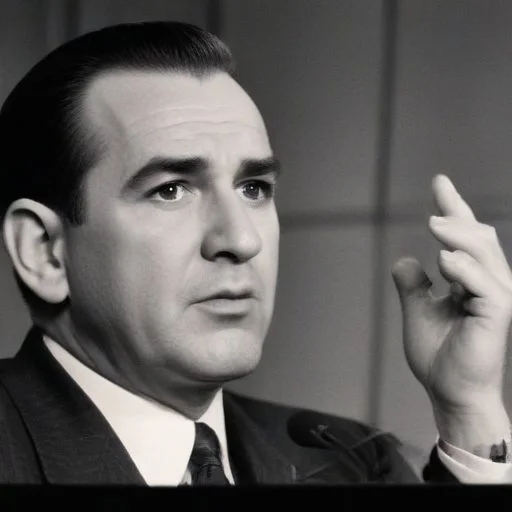
In the early 1950s, Senator Joseph McCarthy's accusations of communist infiltration in the US government and society had created a climate of fear and intimidation. McCarthy's tactics of guilt by association, public humiliation, and reckless accusations had silenced many, and his influence seemed unassailable.
Edward R. Murrow's See It Now episode, A Report on Senator Joseph McCarthy, boldly confronted the Senator's claims and tactics, asking piercing questions about the very fabric of American democracy. The broadcast's unflinching examination of McCarthy's methods and motivations ignited a firestorm of controversy, as Murrow and Friendly dared to challenge the Senator's authority.
The A Report on Senator Joseph McCarthy episode sparked a national debate, with many praising Murrow's courage and others condemning his perceived bias. The broadcast marked a shift in the media's approach to covering McCarthyism, as journalists began to take a more critical stance against the Senator's tactics.
McCarthy's popularity soon began to wane, and his influence eventually declined. The Senator's fall from grace was precipitated by his own arrogance and mistakes, but the See It Now episode played a significant role in exposing his abusive methods to a wider audience.
The broadcast's impact extended beyond the realm of politics, influencing the broader cultural and social landscape. The episode's bold questioning of authority resonated with a generation of Americans who were increasingly disillusioned with the Red Scare's Climate of Fear.
A Report on Senator Joseph McCarthy also inspired a new wave of investigative journalism, as reporters and anchors began to emulate Murrow's fearless approach to reporting. The episode's influence can be seen in the works of journalists like Walter Lippmann and I.F. Stone, who built upon Murrow's legacy.
The A Report on Senator Joseph McCarthy episode won a Peabody Award in 1954, with the committee praising the broadcast's "Courageous journalistic inquiry into the activities of Senator Joseph R. McCarthy."
In 2008, the Library of Congress added the episode to the National Recording Registry, deeming it "culturally, historically, or aesthetically significant."
A Report on Senator Joseph McCarthy serves as a powerful reminder of the importance of a free press in holding those in power accountable. This groundbreaking broadcast continues to inspire and educate, its impact still felt in the world of journalism today.
Edward R. Murrow was a pioneering journalist who embodied the spirit of fearless reporting. Born in Polecat Creek, North Carolina, Murrow began his career in radio broadcasting, covering some of the most significant events of the 20th century, including the rise of Nazi Germany and the Soviet Union.
Murrow's unwavering commitment to truth and his unrelenting pursuit of accountability made him the perfect anchor for See It Now. His iconic reporting style, characterized by his calm and authoritative tone, earned him the respect and trust of the American public.
Throughout his career, Murrow received numerous awards and accolades, including multiple Peabody Awards and an Emmy Award. His legacy continues to inspire generations of journalists, who strive to emulate his courage and integrity.
The early 1950s were marked by a heightened sense of paranoia and fear, fueled by the Cold War and the threat of communist infiltration. Senator Joseph McCarthy capitalized on this climate, using his influence to spread propaganda and silence dissenting voices.
The McCarthy era was characterized by a witch-hunt mentality, where accusations of communist sympathies were enough to ruin careers and reputations. This toxic environment stifled free speech and critical thinking, as many Americans were too afraid to speak out against the Senator's tactics.
The See It Now episode was a beacon of hope in this dark era, offering a much-needed critique of McCarthy's methods and motivations. By challenging the Senator's authority, Murrow and Friendly helped to shift the political narrative, paving the way for a more critical and nuanced approach to reporting on politics.
The See It Now episode had a profound impact on American culture, inspiring a new wave of critical thinking and intellectual curiosity. The broadcast's bold questioning of authority resonated with a generation of Americans who were increasingly disillusioned with the Red Scare's Climate of Fear.
The episode's influence can be seen in the works of artists, writers, and musicians who began to challenge the status quo and push the boundaries of creative expression. From the folk music of Bob Dylan to the literary works of Allen Ginsberg, the See It Now episode helped to fuel a cultural revolution that would shape the course of American history.
Today, the episode remains a powerful symbol of resistance against oppression and a testament to the transformative power of courageous journalism.

The Red Scare was not an isolated phenomenon, but rather a symptom of a larger global trend. The Cold War had created a state of sustained tension between the United States and the Soviet Union, with both superpowers engaging in a propaganda war that would shape public opinion and influence global events.
The rise of communist regimes in Eastern Europe and Asia further fueled American fears of communist infiltration, creating a sense of urgency and paranoia that Senator McCarthy was quick to exploit. The See It Now episode was a crucial intervention in this global conversation, offering a nuanced critique of McCarthy's methods and motivating Americans to think critically about the role of government in their lives.
Historians have long debated the significance of the See It Now episode, with some arguing that it marked a turning point in the Red Scare era and others seeing it as a symptom of a larger cultural shift.
For historian Ellen Schrecker, the episode represents a crucial moment in the development of American journalism, as it challenged the dominant narrative of the time and paved the way for a more critical approach to reporting.
Other historians, such as Robert Griffith, have argued that the episode was a key factor in the eventual decline of McCarthy's popularity, as it highlighted the Senator's tactics and motivated Americans to demand greater accountability from their leaders.