


The Mexican-American War was a pivotal conflict that shaped the course of North American history, and it all began with the Battle of Palo Alto. On May 8, 1846, American forces led by General Zachary Taylor clashed with a Mexican force north of the Rio Grande, marking the first major battle of the war. This decisive victory for the Americans set the tone for the conflict, showcasing their military prowess and resolve.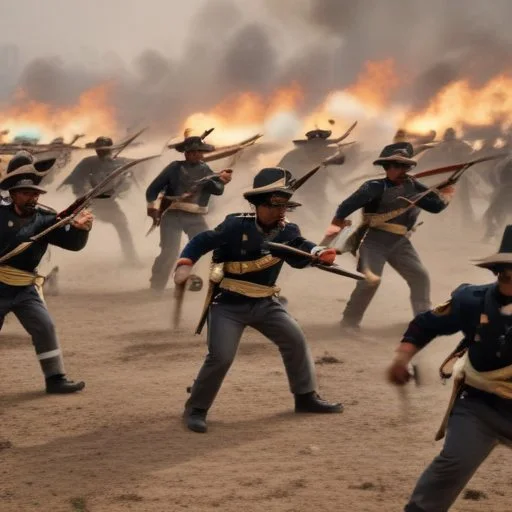
The circumstances leading up to the Battle of Palo Alto were complex and contentious. The United States had long coveted the territory that is now Texas, California, and parts of the Southwest, which was then part of Mexico. The annexation of Texas in 1845 sparked tensions between the two nations, and when Mexican forces moved north of the Rio Grande, the United States saw it as an opportunity to expand its territory.
May 3, 1846: Mexican forces cross the Rio Grande, prompting General Taylor to move north to confront them.
May 8, 1846: The Battle of Palo Alto takes place, with American forces emerging victorious.
May 9, 1846: The Battle of Resaca de la Palma occurs, further solidifying American control in the region.
The Battle of Palo Alto marked a decisive victory for the American forces, demonstrating their military strength and control over the disputed territory. The win boosted morale and paved the way for further American expansion, ultimately leading to the signing of the Treaty of Guadalupe Hidalgo in 1848, which ceded large swaths of land to the United States.
The Mexican-American War had a profound impact on the cultural and social fabric of both nations. The conflict sparked debates about slavery, expansion, and national identity, while also leading to the displacement and marginalization of indigenous peoples and Mexicans living in the newly acquired territories.
One notable account comes from Captain Mansfield, an American officer who wrote, "The Mexicans were repulsed at every point, and their artillery was silenced... The victory was complete, and the American army had gained a triumph that would be remembered for ages."
The Mexican-American War not only expanded American territory but also set a precedent for further westward expansion, contributing to the nation's growing sense of Manifest Destiny. The conflict also laid the groundwork for the American Civil War, as the newly acquired land sparked debates over slavery and regional identity.
In conclusion, the Battle of Palo Alto marked a pivotal moment in American history, showcasing the nation's military prowess and setting the stage for further expansion. The conflict's lasting impact on the cultural, social, and political landscape of North America continues to be felt to this day.
One of the most significant factors contributing to the American victory at Palo Alto was the superior artillery of the US army. The Mexican forces, largely equipped with outdated and cumbersome cannons, were no match for the American's state-of-the-art M1841 6-pounder field guns. These guns, designed by Thomas J. Rodman, were lighter, more maneuverable, and had a longer range than their Mexican counterparts, allowing the Americans to barrage the enemy from a safe distance.
The American artillery was also aided by the innovative use of "flying artillery" - light, mobile cannons that could be quickly repositioned on the battlefield to respond to changing circumstances. This tactic, developed by Captain Randolph, allowed the Americans to rapidly shift their artillery to exploit weaknesses in the Mexican lines, further demoralizing the enemy.

General Mariano Arista, the Mexican commander at Palo Alto, was a seasoned military veteran with a long history of service in the Mexican army. Born in 1802, Arista had fought in several conflicts, including the Mexican War of Independence and the Pastry War against France. Despite his experience, however, Arista was known for his cautious and conservative approach to battle, often prioritizing defense over offense.
Arista's decision to engage the Americans at Palo Alto has been criticized by some historians, who argue that he should have retreated to more defensible positions and waited for reinforcements. However, Arista believed that a show of strength was necessary to deter further American aggression, and that a decisive victory would bolster Mexican morale and assert their claim to the disputed territory.
The Mexican-American War had a profound impact on the cultural identity of both nations. For Mexico, the war marked a period of soul-searching and introspection, as the country struggled to come to terms with its defeat and the loss of nearly half its territory. The war also led to a resurgence of nationalism and anti-American sentiment, which would shape Mexican politics and identity for generations to come.
In the United States, the war sparked a wave of patriotic fervor, with many Americans seeing the conflict as a necessary step in the country's Manifest Destiny. The war also led to a renewed interest in American culture and identity, as the country sought to define itself in relation to its new territories and the diverse populations that inhabited them.
The Battle of Palo Alto took place against the backdrop of a rapidly shifting global geopolitical landscape. The 1840s were a time of colonial expansion and imperial rivalries, with European powers vying for influence and territory around the world. The United States, eager to establish itself as a major player on the global stage, saw the war with Mexico as an opportunity to expand its territory and secure access to the Pacific Ocean.
The war also had significant implications for the balance of power in North America. The defeat of Mexico marked the rise of the United States as a dominant military power, and paved the way for future American expansion into the western territories.
The Mexican-American War saw the introduction of several new technologies that would revolutionize modern warfare. One of the most significant innovations was the use of conical bullets, which replaced the earlier spherical bullets and allowed for greater accuracy and range.
The war also saw the first widespread use of the telegraph, which allowed for rapid communication between commanders and the transmission of military intelligence. This technology would become increasingly important in future conflicts, enabling commanders to respond quickly to changing circumstances and coordinate complex military operations.