


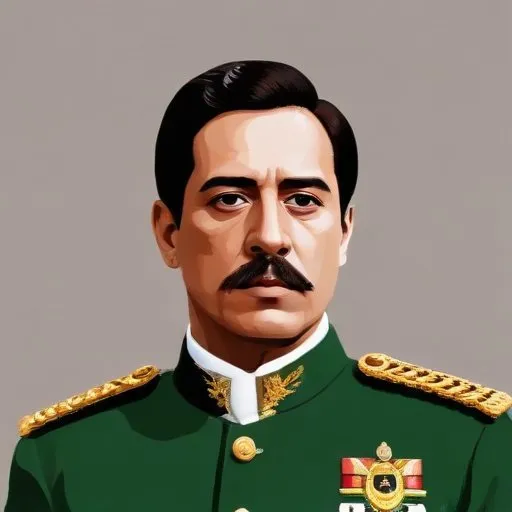
A 19th-century military leader and politician who served as President of Mexico, known for his efforts to modernize and stabilize the country during a tumultuous period. He's also remembered for his role in the Mexican-American War.
Mariano Arista, a renowned Mexican soldier and politician, is best known for his influential role in the Mexican-American War and his subsequent presidency of Mexico. As the commander of the Mexican forces during the Battle of Palo Alto and the Battle of Resaca de la Palma, Arista's military career was marked by both triumph and turmoil.
Arista's fascination with the military began at a young age. Born on July 26, 1802, he enlisted as a cadet in the regiment of provincials of Puebla in 1813. Throughout his career, he fought in various battles, including the Mexican War of Independence, where he initially sided with the Royalists. His exceptional bravery and leadership skills earned him promotions, and by 1821, he had become a lieutenant.
In 1851, Arista succeeded José Joaquín de Herrera as president of Mexico, marking the first peaceful transfer of power in Mexico since 1824. During his presidency, Arista implemented moderate policies, focused on economic growth, and maintained stability in the country. His administration was hailed as a golden era in Mexican history, with many regarding him as the greatest president Mexico had ever seen.
However, Arista's presidency was not without its challenges. In an effort to address Mexico's economic woes, he introduced sweeping budget cuts, which sparked widespread discontent. The ensuing unrest led to his eventual overthrow, and he was exiled by Antonio López de Santa Anna, who would go on to establish his final dictatorship.
Despite his tumultuous presidency, Arista's influence on Mexican history cannot be overstated. He played a pivotal role in shaping the country's military and politics, leaving behind a legacy of leadership and strategic thinking. His commitment to moderation and economic growth continues to inspire Mexican politicians to this day.
Arista's presidency was marked by controversy, with many criticizing his handling of the economy. His eventual overthrow and exile have been the subject of much debate among historians, with some viewing him as a martyr and others as an inept leader.
"The nation will prosper when its people are united and its leaders are just." - Mariano Arista
Arista's presidency occurred during a time of great turmoil in Mexico, following the devastating Mexican-American War. His efforts to rebuild and stabilize the country have been recognized by historians, who regard his term as a brief period of calm amidst the storm.
Mariano Arista's story serves as a testament to the complexities of Mexican history, a tale of leadership, strife, and the unrelenting pursuit of progress.
Born in 1832
Unconstitutional president of Mexico who briefly seized power in 1832, known for his short-lived and tumultuous reign.
Born in 1794
A charismatic and cunning leader who dominated Mexican politics for decades, known for his role in the Texas Revolution and multiple presidential terms.
Born in 1806
A champion of democracy and indigenous rights, he modernized Mexico, abolished slavery, and limited church power. He's revered as a national hero for his progressive reforms.
Born in 1830
A Mexican general and politician who ruled Mexico with an iron fist from 1876 to 1911, modernizing the country while suppressing dissent and opposition. He's infamous for his authoritarian regime and eventual exile.
Born in 1859
A Mexican revolutionary leader who served as president from 1917 to 1920, known for his role in the Mexican Revolution and drafting the country's 1917 constitution.
Born in 1880
Mexican general and politician who served as the 39th President of Mexico, known for his role in the Mexican Revolution and his efforts to modernize the country. He's also famous for losing his right arm in battle and continuing to serve as president.
Born in 1877
Mexican revolutionary leader who served as president from 1924 to 1928, known for implementing secular and anti-clerical policies, including restricting the Catholic Church's power. He also founded the National Revolutionary Party, which later became the dominant party in Mexico.
