


Boris Yeltsin's election as the President of Russia in 1991 marked a watershed moment in modern Russian history, as he became the country's first democratically elected president. This monumental event signaled a significant shift away from communist rule, ushering in a new era of democratic governance, economic reform, and increased freedom for the Russian people.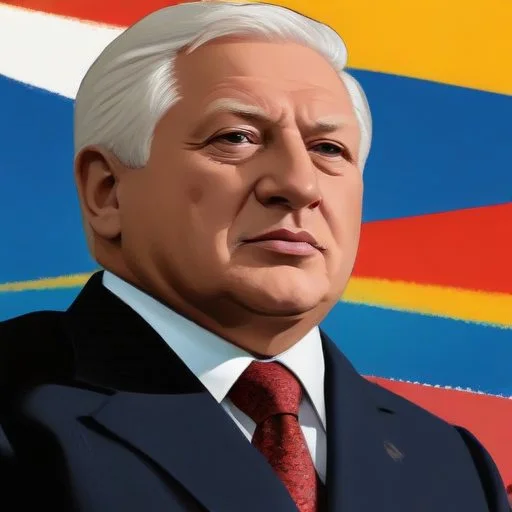
In the late 1980s, the Soviet Union was facing unprecedented economic and political challenges. The declining economy, Afghan War, and increasing nationalistic movements in the Baltic States and Caucasus region created a perfect storm that threatened the very foundations of the Soviet regime.
Against this backdrop, Mikhail Gorbachev's reforms, such as glasnost (openness) and perestroika (restructuring), aimed to revitalize the stagnant economy and increase transparency in governance. However, these reforms also created an environment that allowed for increased dissent and demands for democratic reforms.
Boris Yeltsin, a charismatic and reform-minded politician, emerged as a key figure in the democratization movement. As the Chairman of the Supreme Soviet of the Russian Soviet Federative Socialist Republic, Yeltsin became a vocal critic of the communist party's stranglehold on power.
Yeltsin's popularity grew rapidly, and he became a beacon of hope for those seeking democratic change. His ability to connect with the Russian people, combined with his willingness to challenge the status quo, made him an attractive candidate for the presidency.
The presidential election of 1991 was a historic event that marked a turning point in Russian politics. Held on June 12, 1991, the election saw Yeltsin running against five other candidates, including Nikolai Ryzhkov, the former Soviet Prime Minister.
The election campaign was marked by controversy, with Yeltsin facing resistance from the communist party and the Soviet government. However, his message of democratic reform and economic liberalization resonated with the Russian people, who saw him as a symbol of hope for a better future.
Yeltsin's victory in the 1991 election had far-reaching consequences for Russia and the world. Some of the key outcomes and impacts include:
Boris Yeltsin's legacy is complex and multifaceted. While his presidency was marked by controversy and challenges, he will always be remembered as the first democratically elected president of Russia, who played a pivotal role in shaping the country's transition from communism to democracy.
As Yeltsin himself said, "We don't have to fight for freedom, we just have to fight for the right to fight for freedom." His courage and determination to bring about democratic change to Russia will continue to inspire generations to come.
Boris Yeltsin's election as the President of Russia in 1991 was a momentous event that marked a significant turning point in modern Russian history. His victory paved the way for democratic reforms, economic liberalization, and increased individual freedoms, shaping the course of Russia's development in the post-Soviet era.
Boris Yeltsin's Early Life and Rise to Power
Born on February 1, 1931, in Butka, Russia, Boris Yeltsin grew up in a poor peasant family. Despite the humble beginnings, Yeltsin's strong work ethic and determination propelled him to study construction at the Urals Polytechnic Institute.
After completing his studies, Yeltsin worked his way up the ranks in the construction industry, becoming a member of the Communist Party in 1961. His Party connections led to his appointment as the First Secretary of the Sverdlovsk Regional Committee in 1976.
Yeltsin's reformist views and willingness to challenge the Party hierarchy caught the attention of Mikhail Gorbachev, who appointed him as the Chairman of the Supreme Soviet of the Russian Soviet Federative Socialist Republic in 1985.

The Geopolitical Context of the 1991 Election
The collapse of the Soviet Union created a power vacuum that led to the emergence of new global powers. The 1991 election took place amidst this shifting geopolitical landscape, with the United States and Europe watching with great interest.
The Soviet Union's fragmentation into independent states created new opportunities for international cooperation and competition. Yeltsin's victory was seen as a significant development in the post-Cold War era, with implications for global politics and economy.
Economic Reforms and the Russian Economy
Yeltsin's economic reforms aimed to transform Russia's command economy into a market-based economy. The introduction of privatization, price liberalization, and trade liberalization led to a significant increase in foreign investment and economic growth.
However, the reforms also led to a decline in industrial production, hyperinflation, and a widening wealth gap. The Russian economy struggled to adapt to the new market-oriented policies, leading to widespread poverty and unemployment.

The Cultural Impact of Yeltsin's Presidency
Yeltsin's presidency had a profound impact on Russian culture, as the country transitioned from a communist to a post-communist society. The introduction of democratic reforms and increased individual freedoms led to a flourishing of artistic expression and cultural diversity.
The emergence of new media outlets, independent newspapers, and cultural institutions created a more vibrant cultural scene, with artists, writers, and musicians exploring new themes and styles.
Yeltsin's Political Challenges and Controversies
Yeltsin's presidency was marked by several political challenges and controversies, including the conflict with the Russian parliament in 1993, the Chechen War, and allegations of corruption and cronyism.
Despite these challenges, Yeltsin remained a popular figure, using his charisma and political skills to navigate the complex web of Russian politics and maintain his position as a dominant force in Russian politics.