


The Battle of Trafalgar, fought on October 21, 1805, is renowned for being one of the most pivotal naval engagements in history, where a British fleet led by Vice-Admiral Horatio Nelson defeated a combined French and Spanish fleet under Admiral Pierre-Charles Villeneuve, cementing British dominance of the seas and altering the course of the Napoleonic Wars.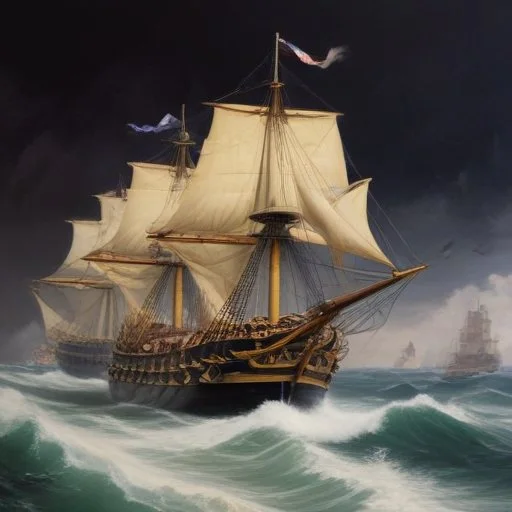
In the early 19th century, Napoleon Bonaparte's ambitions to conquer Europe had sparked a global conflict, with Britain emerging as a major obstacle to his plans. The British Navy, with its superior ships and tactics, had successfully blockaded French ports, crippling Napoleon's ability to wage war. In response, Napoleon devised a plan to break the blockade by combining the French and Spanish navies, thereby gaining control of the seas.
At the heart of the Battle of Trafalgar were two brilliant naval commanders: Vice-Admiral Horatio Nelson, a renowned British tactician, and Admiral Pierre-Charles Villeneuve, a seasoned French naval officer. Nelson, with his unwavering confidence and innovative tactics, led the British fleet with distinction, while Villeneuve, hampered by Napoleon's micromanaging and indecisive nature, struggled to effectively command the combined French and Spanish fleet.
The Battle of Trafalgar proved a crushing defeat for the French and Spanish navies, with the loss of thousands of men and ships. The British victory cemented their dominance of the seas, securing their ability to blockade French ports and disrupt Napoleon's supply lines. This, in turn, contributed to Napoleon's eventual defeat and exile.
The Battle of Trafalgar has had a profound impact on British culture, with Nelson's iconic signal, "England expects that every man will do his duty," becoming a rallying cry for patriotism and duty. The battle has also inspired numerous works of art, literature, and film, perpetuating its place in the popular imagination.
"England expects that every man will do his duty." - Vice-Admiral Horatio Nelson, October 21, 1805
"Thank God I have done my duty." - Vice-Admiral Horatio Nelson, as he lay dying on the HMS Victory, October 21, 1805
In the heat of battle, Nelson ordered his ships to fly a series of signals, including the famous "England expects..." message. According to legend, when the signal was hoisted, the crew of the HMS Victory cheered, knowing that their commander had given them a rallying cry that would inspire them to victory.
The Battle of Trafalgar's significance extends far beyond the Napoleonic Wars. It marked a turning point in the history of naval warfare, as it demonstrated the superiority of the British Navy's tactics and training. The battle also paved the way for the Pax Britannica, a period of British dominance that would last for over a century.
Vice-Admiral Horatio Nelson was posthumously honored with a state funeral and burial in St. Paul's Cathedral, London. Additionally, numerous monuments, memorials, and streets have been named in his honor, cementing his place as one of Britain's greatest heroes.
The HMS Victory, Nelson's flagship, is now a museum ship in Portsmouth, England, and remains one of the most popular tourist attractions in the UK.
The Battle of Trafalgar is often referred to as the "perfect battle," due to the British fleet's flawless execution of Nelson's tactics.
Admiral Pierre-Charles Villeneuve: The Reluctant Commander
Villeneuve, a seasoned French naval officer, was chosen by Napoleon to lead the combined French and Spanish fleet against the British. Despite his experience, Villeneuve was known for his cautious nature, which often led to indecisiveness in battle. His reluctance to engage the enemy was evident in the weeks leading up to the Battle of Trafalgar, where he hesitated to leave the safety of Cadiz harbor. This hesitation ultimately proved costly, as it gave Nelson's fleet an opportunity to prepare and intercept the enemy.
Villeneuve's leadership style was also marked by a lack of initiative and a tendency to follow orders from Napoleon, rather than trusting his own instincts. This made it difficult for him to adjust to changing circumstances during the battle, ultimately contributing to the defeat of the French and Spanish fleet.
The Egyptian Campaign and the Road to Trafalgar
In 1798, Napoleon's army invaded Egypt, hoping to disrupt British trade routes and expand French influence in the region. The French fleet, led by Admiral François-Paul Brueys, was stationed in Aboukir Bay, where it was blockaded by a British fleet under Admiral Horatio Nelson. On August 1, 1798, Nelson launched a surprise attack on the French fleet, sinking or capturing several ships and stranding Napoleon's army in Egypt.
This decisive victory cemented Nelson's reputation as a brilliant tactician and set the stage for his later success at Trafalgar. The Egyptian campaign also marked a turning point in the Napoleonic Wars, as it shifted the focus from land battles to naval engagements, highlighting the importance of sea power in the conflict.
The Battle of Trafalgar in Popular Culture
The Battle of Trafalgar has had a profound impact on British culture, inspiring countless works of art, literature, and film. From Turner's iconic painting of the battle to the numerous adaptations of The Hornblower series, Trafalgar has become a symbol of British courage and patriotism.
The battle has also inspired musical compositions, such as The Battle of Trafalgar by William Henry Bell, and has been referenced in popular literature, including The Napoleonic War by Bernard Cornwell.
The Tactical Innovations of the Battle of Trafalgar
The Battle of Trafalgar marked a significant shift in naval warfare, as Nelson's innovative tactics exploited the weaknesses of the traditional line-of-battle formation. By breaking through the enemy line and firing devastating broadsides, Nelson's ships were able to_sink or capture 19 enemy vessels without losing a single British ship.
The battle also showcased the importance of speed and maneuverability, as Nelson's ships were able to outpace and outmaneuver their slower and more cumbersome enemies. These tactical innovations would go on to influence naval warfare for generations to come.
The Global Consequences of the Battle of Trafalgar
The Battle of Trafalgar had far-reaching consequences, extending beyond the Napoleonic Wars to shape the global balance of power. The British victory cemented their dominance of the seas, securing their ability to blockade French ports and disrupt Napoleon's supply lines.
This, in turn, contributed to Napoleon's eventual defeat and exile, paving the way for the Congress of Vienna and the reorganization of Europe. The battle also marked the beginning of the Pax Britannica, a period of British dominance that would last for over a century, shaping global politics, trade, and culture.