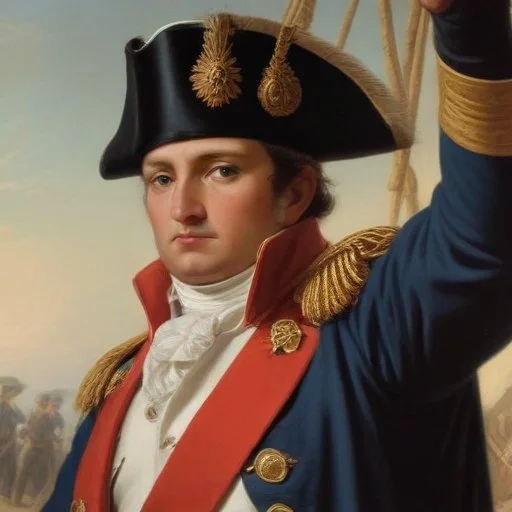
Napoleon Bonaparte surrenders to British on HMS Bellerophon.
Napoleon Bonaparte, the once-invincible French Emperor, stood on the quarterdeck of HMS Bellerophon, his proud eyes scanning the unfamiliar surroundings. He had worn the cloak of power for two decades, conquering much of Europe, but now he was surrendering to the British, his empire crumbling around him. As he handed over his sword to Captain Frederick Maitland, he knew his legend was about to be reduced to a footnote in history. The fate of Europe, indeed the world, hung in the balance, as the great Napoleon Bonaparte became a prisoner of war.
The Fall of the French Empire: Napoleon's Surrender Aboard HMS Bellerophon
The Fateful Encounter
Napoleon Bonaparte, the mastermind behind the Napoleonic Wars and the once-mighty French Empire, stood on the quarterdeck of HMS Bellerophon, marking the end of an era. On July 15, 1815, Napoleon's surrender to the British Navy signaled the defeat of French forces and the eventual collapse of his empire.
Historical Background
The Napoleonic Wars, which lasted from 1803 to 1815, were a series of conflicts fought during Napoleon's reign as Emperor of France. With his military prowess and strategic genius, Napoleon conquered much of Europe, expanding the French Empire to its greatest extent. However, his ambition and aggressive expansion led to the formation of the Sixth Coalition, a coalition of European powers determined to defeat him.
Key Figures Involved
- Napoleon Bonaparte: French Emperor and military strategist who dominated European politics for over a decade.
- Captain Frederick Maitland: British naval officer who commanding HMS Bellerophon and accepted Napoleon's surrender.
- Lord Liverpool: British Prime Minister who played a crucial role in the negotiations leading to Napoleon's surrender.
Timeline of Events
- June 18, 1815: Napoleon is defeated at the Battle of Waterloo, marking a turning point in the Napoleonic Wars.
- June 22, 1815: Napoleon abdicates the French throne for the second time.
- July 3, 1815: Napoleon requests asylum from the British government, hoping to escape to America or the British Isles.
- July 15, 1815: Napoleon surrenders to Captain Maitland aboard HMS Bellerophon off the coast of Rochefort, France.
Major Outcomes and Impacts
Napoleon's surrender had far-reaching consequences, shaping the course of European history and global politics.
- The Napoleonic Wars came to an end, and the French Empire began to dissolve.
- The Congress of Vienna (1815) redrew the European map, establishing a new balance of power and leading to the formation of the Concert of Europe.
- Napoleon was exiled to the island of Saint Helena, where he would remain until his death in 1821.
Cultural and Social Influences
Napoleon's surrender marked the end of an era, but his legacy continued to influence European culture and society.
- Napoleon's military reforms and innovations had a lasting impact on European armies.
- The Napoleonic Code, a set of civil laws, was adopted by many European countries and remained in effect for centuries.
- Napoleon's artistic and cultural patronage helped shape the French Renaissance and inspired a generation of European artists.
Quotes and Memorable Sayings
"I will not be a prisoner; I will be an Emperor even in captivity." - Napoleon Bonaparte
Comparative Analysis with Similar Events
Napoleon's surrender aboard HMS Bellerophon shares similarities with other historic surrenders, such as:
- General Robert E. Lee's surrender at Appomattox Courthouse (1865), marking the end of the American Civil War.
- Admiral Karl Dönitz's surrender of German forces in World War II (1945).
Personal Accounts and Anecdotes
Captain Maitland, the commander of HMS Bellerophon, wrote in his memoirs: "Napoleon's eyes were fixed on mine, and I could see the fire of his spirit still burning bright."
Impact on Future Events
Napoleon's surrender paved the way for a new era of European politics and global relations.
- The Congress of Vienna established the Concert of Europe, a system of diplomacy and collective security that maintained peace in Europe for decades.
- The rise of British naval power and the British Empire in the 19th century can be traced back to Napoleon's defeat.
Trivia and Fun Facts
- Napoleon's surrender was facilitated by a secret agreement between Lord Liverpool and the French Royalist, Comte de Chambord.
- HMS Bellerophon was nicknamed "Billy Ruffian" by the British sailors due to its reputation as a fast and formidable warship.
This marked the end of Napoleon's reign and the beginning of a new era in European history. The once-mighty French Empire crumbled, and the world was forever changed by the events that unfolded on that fateful day aboard HMS Bellerophon.
Supplemental Content
Napoleon's Strategic Retreat and the Fate of France
As Napoleon's forces suffered defeat at the Battle of Waterloo, the French Emperor was faced with a daunting decision: to flee or to fight. With his army in disarray and his allies deserting him, Napoleon chose to retreat to the French coast, where he hoped to regroup and reassess his options.
The French Navy's Loyalty was a crucial factor in Napoleon's plan, as he counted on its support to transport him to the United States or the British Isles. However, the French Navy's allegiance was wavering, and its top commanders were increasingly skeptical of Napoleon's ability to lead.
The Fate of France Hung in the Balance, as Napoleon's retreat sparked a power vacuum in Paris. The Directory, a provisional government, took control, but its legitimacy was tenuous at best. The stage was set for a dramatic showdown between Napoleon's loyalists and the forces of the Directory.

Supplemental Content
Captain Frederick Maitland: The Reluctant Hero
Captain Maitland, the commander of HMS Bellerophon, was an unlikely hero of the Napoleonic Wars. A veteran of several naval battles, Maitland was known for his bravery and tactical prowess, but he was also haunted by personal demons and struggled with the weight of responsibility.
Maitland's pivotal role in Napoleon's surrender was a turning point in his career, as he transitioned from a respected naval officer to a celebrated figure in British history. However, his fame came at a cost, as he was later criticized for his handling of Napoleon's exile and his perceived leniency towards the former Emperor.
A nuanced portrait of Captain Maitland reveals a complex and multidimensional individual, torn between duty and compassion, as he navigated the treacherous waters of Napoleonic politics.
Supplemental Content
The Letter of Surrender: A Historical Artifact
The original letter of surrender, penned by Napoleon on July 15, 1815, is a rare and precious artifact of the Napoleonic Wars. Housed in the Archives Nationales in Paris, the letter provides a unique glimpse into Napoleon's mindset in the hours leading up to his surrender.
The letter's significance extends beyond its historical importance, as it also offers insight into Napoleon's psychological state. The carefully worded phrases and hesitant language reveal a man grappling with the weight of defeat and the uncertainty of his future.
A Close Reading of the Letter reveals subtle nuances and tells a story of its own, as Napoleon's handwriting and syntax convey the tension and drama of the moment.

Supplemental Content
Napoleon's Surrender and the Dawn of Romanticism
Napoleon's surrender marked the end of an era, but it also heralded the beginning of a new cultural movement: Romanticism. As the Napoleonic Wars drew to a close, artists and writers began to reflect on the tumultuous events that had shaped their world.
The Imagery of Defeat became a dominant theme in Romantic art and literature, as creatives sought to capture the pathos and drama of Napoleon's downfall. From Delacroix's Liberty Leading the People to Byron's Ode to Napoleon, the artistic community responded to the news of Napoleon's surrender with a collective outpouring of emotion and creativity.
The End of the Enlightenment Era, Napoleon's surrender signaled the end of the Enlightenment era and the rise of a new artistic and cultural paradigm. Romanticism, with its emphasis on emotion, imagination, and the individual, would dominate the cultural landscape for generations to come.
Supplemental Content
The Economic Consequences of Napoleon's Defeat
Napoleon's surrender had far-reaching economic implications, as the French Empire's collapse sent shockwaves throughout Europe and beyond. The Continental System, Napoleon's ambitious economic project, was dismantled, and trade restrictions were lifted.
The British Economy Boomed, as the removal of trade barriers and the decline of French competition paved the way for British industries to flourish. The industrial Revolution, already underway in Britain, received a significant boost, as entrepreneurs and inventors seized the opportunities presented by the new economic landscape.
The Emergence of a New Global Order, Napoleon's defeat marked the beginning of a new era of globalization, as European powers began to carve out spheres of influence and establish colonial empires. The economic consequences of Napoleon's surrender would be felt for generations to come.


