


The day was June 24, 1812, and Napoleon Bonaparte's Grande Armée, the largest and most feared military force in Europe, stood poised on the banks of the Neman River, the natural border between Poland and Russia. This marked the beginning of a harrowing and ill-fated expedition that would change the course of history – Napoleon's invasion of Russia.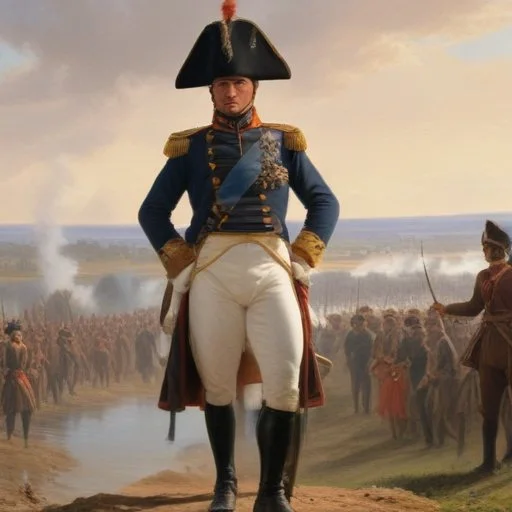
By 1812, Napoleon's empire was at its peak, with a vast portion of Europe under his control. However, his Continental System, aimed at weakening Britain by restricting trade, had pushed Russia into an alliance with the British. Napoleon, determined to bring Russia to its knees, assembled a colossal force, comprising over 680,000 soldiers from France and its allied nations.
The disastrous Russian campaign marked a turning point in Napoleon's fortunes. The French army suffered staggering losses, with estimates suggesting between 300,000 to 400,000 casualties. The failure of the campaign weakened Napoleon's grip on power, emboldened his European rivals, and paved the way for his eventual downfall.
The invasion of Russia had a profound impact on European culture and society. The experiences of the soldiers who fought in Russia inspired writings by authors such as Leo Tolstoy, who drew upon the war in his epic novel, War and Peace. The campaign also led to a surge in nationalistic sentiment in Russia, shaping the country's identity and politics for generations to come.
Napoleon's fateful decision to cross the Neman River into Russia marked a pivotal moment in the Napoleonic Wars, one that would ultimately contribute to his downfall and reshape the course of European history.
The winter of 1812-1813 was one of the harshest in Russian history, with temperatures plummeting to -30°C (-22°F) and below. Napoleon's army, ill-prepared for the extreme cold, suffered greatly, with many soldiers freezing to death or succumbing to hypothermia.
The Russians, familiar with the harsh climate, employed innovative tactics to utilize the winter to their advantage. They developed a network of intelligence gathering and communication, using sleds and horseback riders to relay information across the vast distances.
The Russian winter also played a significant role in the tactics employed by both armies. The French, accustomed to fighting in more temperate climates, struggled to adapt to the frozen terrain, whereas the Russians exploited their knowledge of the land to launch surprise attacks and ambushes.

While Napoleon Bonaparte led his army into Russia, his wife, Marie-Louise, remained in Paris, acting as regent and governing the empire in his absence. Born an Austrian princess, Marie-Louise brought a unique perspective to the French court, and her diplomatic skills helped maintain the fragile alliances with European powers.
As Napoleon's fortunes waned, Marie-Louise's influence grew, and she became a vital mediator between her husband and the European monarchs. Her letters to Napoleon, filled with concern and advice, provide a glimpse into the complexities of their relationship and the political machinations of the time.
The war had a profound impact on Russian culture, as the nation rallied around the war effort and the struggle against Napoleon. The war inspired a surge in patriotic sentiment, with poets and writers like Mikhail Lermontov and Alexander Griboedov penning works that celebrated Russian heroism and resilience.
The war also saw a resurgence of interest in Russian folklore and traditional music, as the nation sought to reconnect with its cultural heritage. The war became a catalyst for the development of Russian Romanticism, a movement that emphasized national identity and the importance of preserving cultural traditions.

Napoleon's Continental System, aimed at weakening Britain by restricting trade, had far-reaching consequences for European politics. The system created a complex web of alliances, with Russia, Prussia, and Austria caught in a delicate balance of power.
The British, determined to undermine Napoleon's empire, negotiated treaties and trade agreements with European powers, including Russia. The resulting web of alliances and rivalries ultimately led to Napoleon's downfall, as his European rivals slowly began to coalesce against him.
Napoleon's decision to invade Russia was, in part, a result of his failed diplomacy. The French Emperor had long sought to negotiate a trade agreement with Russia, but Tsar Alexander I's refusal to comply led Napoleon to believe that a military victory was necessary to achieve his goals.
The failure of Napoleon's diplomacy can be attributed, in part, to his own arrogance and stubbornness. He underestimated the Russian resolve to resist his demands and overestimated his own military prowess. The disastrous campaign that followed would ultimately seal Napoleon's fate as a military leader.