


New Hampshire's swaying 57 delegates, gathered within the historic walls of Concord's Old North Church, charted the course of American history on a fateful summer day. With a narrow 57-47 vote, they secured the crucial two-thirds majority needed for the Constitution's adoption, becoming the ninth state to ratify the United States Constitution.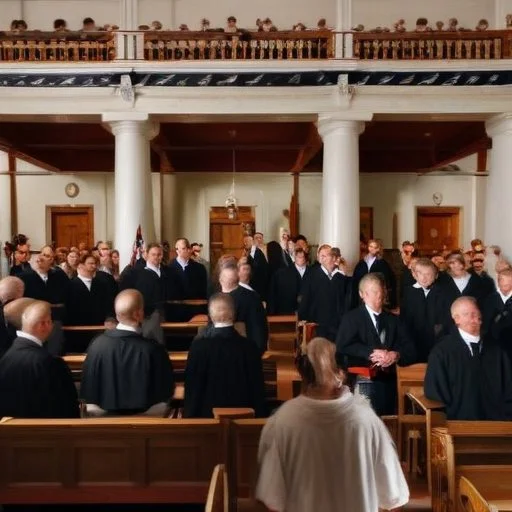
June 21, 1788, marked a turning point in the young nation's struggle for identity. The fate of the Constitution, and thereby the nation's very existence, hung precariously in the balance. Would the document, crafted by the Founding Fathers, become the foundation of a new nation, or would it falter, leaving the states to chart their own courses?
Among the assembly, notable figures such as John Langdon and Nicholas Gilman, ardent supporters of the Constitution, clashed with skeptical delegates like John Stark and Matthew Thornton, who feared the document's centralizing power. These individuals, driven by conviction and principle, shaped the outcome of the vote.
The Granite State's ratification sparked a chain reaction, as subsequent states followed suit, and the federal government began to take shape. The Constitution's adoption paved the way for the country's growth, westward expansion, and the development of a strong central government.
New Hampshire's decision resonated beyond the state's borders, as the young nation began to forge a unified identity. The Constitution's ratification symbolized a commitment to democracy, freedom, and the rule of law, setting a precedent for generations to come.
As Benjamin Franklin famously remarked, "A republic, if you can keep it." New Hampshire's decisive vote demonstrated the fledgling nation's ability to overcome its differences and strive for a common goal, fostering a sense of unity and purpose that would propel the United States forward.
New Hampshire's vital contribution to the Constitution's adoption cemented its place in American history, earning the state a revered position among the original 13 colonies. This milestone event continues to inspire generations, serving as a testament to the power of collective determination and compromise.
Nicholas Gilman, a stalwart supporter of the Constitution, played a pivotal role in swaying New Hampshire's delegates. As a federalist, Gilman believed that a strong central government was essential for the young nation's growth and prosperity. His persuasive arguments and diplomatic skills helped to win over skeptical delegates, ultimately securing the crucial two-thirds majority.
Gilman's commitment to the Constitution was rooted in his experiences during the American Revolution. Having served as a quartermaster general, he witnessed firsthand the inefficiencies of the Articles of Confederation. This firsthand knowledge informed his advocacy for a stronger federal government, which he believed would provide greater stability and unity.
Gilman's legacy extends beyond his role in New Hampshire's ratification. He went on to serve as a representative in the U.S. House of Representatives, where he continued to champion federalist ideals. His dedication to the Constitution and its principles cemented his place as a prominent figure in American history.

The debate surrounding the Constitution's ratification was characterized by a deepening rift between federalists and anti-federalists. Federalists, like Nicholas Gilman, believed in the importance of a strong central government, while anti-federalists, such as John Stark, feared the document's centralizing power and potential for abuse.
This ideological divide was rooted in fundamentally different visions for the young nation's future. Federalists saw the Constitution as a necessary step towards stability and growth, while anti-federalists believed that the document would lead to tyranny and the erosion of individual liberties. The clash between these two factions played out in the ratification debates, with New Hampshire's decision being a crucial turning point in the struggle.
The federalist-anti-federalist divide also reflected deeper social and economic cleavages. Federalists tended to be wealthier, more educated, and urban, while anti-federalists were often poorer, more rural, and skeptical of elite power. Understanding this divide is essential for grasping the complexities of the ratification process and its lasting impact on American politics.
New Hampshire's ratification of the Constitution marked a significant cultural shift in the young nation. The document's adoption symbolized a commitment to democracy, freedom, and the rule of law, values that would come to define American identity.
The Constitution's ratification also marked a turning point in the development of American literature and art. The document's emphasis on individual liberties and democratic principles inspired a new generation of writers, artists, and thinkers. From the patriotic odes of Philip Freneau to the stirring orations of Patrick Henry, the Constitution's ideals permeated the cultural landscape.

The Constitution's ratification took place against a backdrop of global upheaval. The French Revolution was in full swing, and European powers like Great Britain and Spain were vying for influence in the New World.
In this chaotic geopolitical environment, the Constitution's adoption was seen as a beacon of stability and a symbol of American independence. The document's emphasis on a strong federal government was, in part, a response to the perceived threats from European powers.
The Constitution's ratification also marked a significant shift in American foreign policy. By establishing a strong central government, the document paved the way for the United States to assert its influence on the global stage, setting the stage for westward expansion and eventual superpower status.
Historians have long debated the significance of the Constitution's ratification. While some have viewed the event as a triumph of democratic principles, others have argued that it marked a consolidation of elite power.
Recent scholarship has nuanced our understanding of the ratification process, highlighting the complex interplay of interests and ideologies at play. By examining the debates, letters, and diaries of the time, historians have uncovered a rich tapestry of motivations and perspectives.
Despite these differing interpretations, one thing is clear: the Constitution's ratification was a pivotal moment in American history, one that continues to shape the nation's identity and inform its political institutions.