


On the fateful night of June 30, 1934, Adolf Hitler unleashed a wave of terror on his own party members, eliminating any potential threats to his power and cementing his grip on Nazi Germany. The Night of the Long Knives, as it came to be known, was a brutal and calculated massacre that left hundreds dead, marking the beginning of Hitler's totalitarian regime.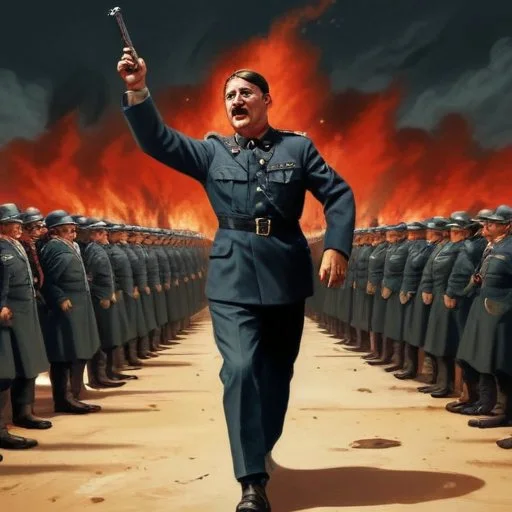
In the early 1930s, Hitler's Nazi Party was rapidly gaining popularity in Germany, and he had managed to manipulate the weak government into appointing him Chancellor. However, not everyone in the party was convinced of Hitler's leadership abilities, and a faction of high-ranking officials, led by Ernst Röhm, began to plot against him.
June 29, 1934: Hitler meets with Röhm and other high-ranking SA officials at a resort in Bad Wiessee, Germany, where he arrests them on trumped-up charges of treason.
June 30, 1934: Hitler unleashes his SS troops on the SA, massacring hundreds of Röhm's loyalists across Germany.
July 1, 1934: Hitler announces the purge to the German public, justifying the brutal act as necessary to protect the nation from treasonous elements.
The Night of the Long Knives marked the end of any internal opposition to Hitler's rule and the beginning of his totalitarian regime. The purge also led to the consolidation of power in the hands of the SS, which would go on to become the Nazi Party's paramilitary wing.
The purge sent shockwaves throughout Germany, with many citizens living in fear of the Nazi regime's brutal suppression of dissent. The Night of the Long Knives also marked a turning point in Hitler's leadership style, as he became increasingly paranoid and ruthless in his methods.
The international community was horrified by the brutality of the purge, and many countries condemned Hitler's actions. However, many Germans saw the purge as a necessary evil to maintain stability and order in the country.
"I was at a meeting with Hitler when he received the news that Röhm was planning to overthrow him," recalled Rudolf Hess, a high-ranking Nazi official. "Hitler's face turned red with rage, and he ordered us to take immediate action to eliminate the threat."
The Night of the Long Knives paved the way for Hitler's aggressive expansionist policies, including the annexation of Austria and the invasion of Poland, which would ultimately lead to World War II.
In conclusion, the Night of the Long Knives was a pivotal event in Hitler's rise to power, marking the beginning of his reign of terror and cementing his grip on Nazi Germany. The purge's brutal efficiency and ruthless elimination of opposition set the tone for the horrors that would follow, and its legacy continues to serve as a cautionary tale about the dangers of unchecked power and authoritarianism.
The Night of the Long Knives took place amidst a tumultuous time in European politics. The Treaty of Versailles had imposed harsh penalties on Germany, leading to widespread resentment and a sense of injustice among the German people. This created a fertile ground for extremist ideologies like Nazism to flourish. Hitler capitalized on these feelings, presenting himself as a strong leader who would restore German honor and pride.
The purge also occurred in the backdrop of rising tensions between European powers. The League of Nations had failed to prevent Japan's invasion of Manchuria, and the Italian aggression in Ethiopia had exposed the weaknesses of the international community. Hitler saw an opportunity to exploit these divisions and consolidate his power.
Hermann Göring, a high-ranking Nazi official, played a crucial role in the Night of the Long Knives. As the commander of the Luftwaffe, he provided aerial support to the SS troops during the purge. Göring's loyalty to Hitler was rewarded with the position of Minister-President of Prussia, making him one of the most powerful men in Nazi Germany.
Göring's flamboyant personality and extravagance often hid his ruthless nature. He was instrumental in convincing Hitler to eliminate Röhm and the SA leadership, and his involvement in the purge marked the beginning of his rise to the top of the Nazi hierarchy.
The Night of the Long Knives sent shockwaves throughout German society, as the brutal elimination of the SA leadership and its loyalists created an atmosphere of fear and intimidation. The purge marked a turning point in Hitler's leadership style, as he became increasingly paranoid and ruthless in his methods.
The event also had a profound impact on German culture, as the Nazi regime began to suppress any dissenting voices and impose its ideology on the population. The Night of the Long Knives paved the way for the creation of a police state, where the Gestapo and the SS became the instruments of terror and oppression.

Historians have offered various interpretations of the Night of the Long Knives, ranging from a necessary evil to a brutal and ruthless act of suppression. Some have seen it as a calculated move by Hitler to eliminate any potential threats to his power, while others have viewed it as a symptom of the inherent violence and instability of the Nazi regime.
Recent studies have highlighted the role of the Night of the Long Knives in the creation of a totalitarian state, where the boundaries between the party, state, and society became increasingly blurred. This event has been seen as a crucial moment in the descent of Germany into the abyss of World War II.
The Night of the Long Knives had significant economic implications for Germany. The elimination of the SA leadership and its loyalists led to a consolidation of power in the hands of the SS, which became the dominant force in the Nazi regime.
The purge also led to a shift in economic policy, as Hitler began to focus on rearmament and military expansion. This led to a massive increase in government spending, which helped to stimulate economic growth and reduce unemployment.