


The October Revolution, also known as the Great October Socialist Revolution, is one of the most pivotal events in modern history, marking the first successful socialist revolution in the world. Occurring on October 25, 1917, according to the Julian calendar, this revolution overthrew the provisional government and led to the establishment of the world's first socialist state.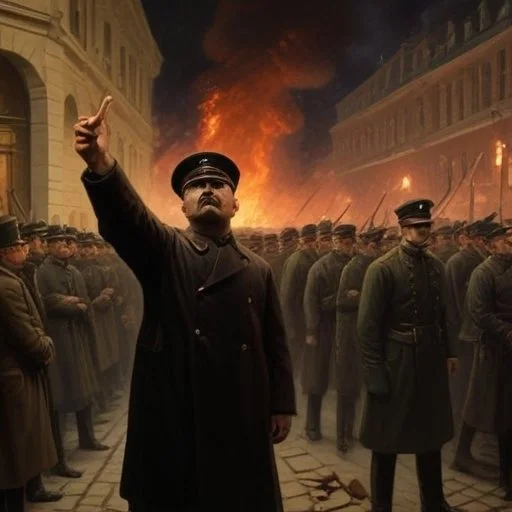
Russia had been embroiled in a state of turmoil since the February Revolution, which saw the abdication of Tsar Nicholas II. The provisional government, led by Alexander Kerensky, struggled to maintain control amidst economic crisis, food shortages, and wartime losses. Meanwhile, the Bolshevik Party, led by Vladimir Lenin, had been gaining popularity among the working class and peasants. Lenin's promise of "peace, land, and bread" resonated deeply with the Russian people, who were desperate for change.
The October Revolution marked a seismic shift in global politics, sending shockwaves across the world. The Bolsheviks' success inspired socialist and communist movements worldwide, and the Russian Revolution became a beacon of hope for the working class and oppressed peoples everywhere.
Domestically, the revolution led to the establishment of the Soviet Union, with Lenin as its first leader. The new government faced numerous challenges, including civil war, famine, and foreign intervention. However, the Soviet Union persisted, becoming a global superpower and shaping the course of modern history.
The October Revolution had a profound impact on Russian culture and society. The Bolsheviks promoted a new era of social equality, women's rights, and free education. Theaters, museums, and cultural institutions were nationalized, making art and culture accessible to the masses.
The revolution also inspired a new wave of artistic expression, with writers like Maxim Gorky and Vladimir Mayakovsky capturing the spirit of the revolution in their works. The constructivist movement in art, led by artists like Kazimir Malevich and Lyubov Popova, emerged as a direct result of the revolution.
The October Revolution remains a highly controversial event, with opinions about its significance and impact varying widely. While some view it as a beacon of hope for the working class and oppressed peoples, others see it as a brutal seizure of power and the start of a repressive regime.
Regardless of one's perspective, the October Revolution is an undeniable turning point in modern history, shaping the course of global politics, economics, and culture for generations to come.
“The oppressed are allowed once every few years to decide which particular representatives of the oppressing class are to represent and repress them.” - Vladimir Lenin
“The proletariat of Russia, having mastered the means of production, will put an end to the exploitation of man by man, and establish the reign of justice and equality.” - Leon Trotsky
The October Revolution may have taken place over a century ago, but its impact continues to be felt today. As we reflect on this pivotal event, we are reminded of the power of collective action, the importance of fighting for social justice, and the enduring legacy of those who dared to challenge the status quo.
Vladimir Lenin's early life had a profound impact on his later political views. Born in Simbirsk, Russia in 1870, Lenin was exposed to the harsh realities of poverty and inequality from a young age. His father, a dedicated public servant, was stripped of his noble title and exiled to Siberia, where he died under mysterious circumstances. This traumatic event shaped Lenin's worldview and fueled his desire for social justice.
Lenin's academic career was marked by his fascination with Marxism and his subsequent involvement in revolutionary activities. He was expelled from Kazan University for participating in a student protest and later arrested and exiled to Siberia for his involvement in a Marxist group.

The October Revolution had a profound impact on Russian literature and art. The Bolsheviks' emphasis on social equality and the proletariat's role in shaping society inspired a new wave of literary and artistic works. Writers like Maxim Gorky and Vladimir Mayakovsky captured the spirit of the revolution in their works, while artists like Kazimir Malevich and Lyubov Popova pioneered the constructivist movement.
The revolution also led to the establishment of new cultural institutions, such as the People's Commissariat for Education, which aimed to make education and culture accessible to the masses. Theaters, museums, and cultural centers were nationalized, and art was democratized, allowing ordinary people to engage with and appreciate cultural works.
The February Revolution, which took place in February 1917, laid the groundwork for the October Revolution. The provisional government, led by Alexander Kerensky, struggled to maintain control amidst economic crisis, food shortages, and wartime losses. The Bolsheviks, led by Vladimir Lenin, capitalized on the government's weaknesses and began to gain popularity among the working class and peasants.
The July Days, a series of spontaneous demonstrations and riots that took place in July 1917, further weakened the provisional government and paved the way for the Bolsheviks' seizure of power. The Kornilov Affair, a failed coup attempt by General Lavr Kornilov, also contributed to the government's instability and the eventual rise of the Bolsheviks.
The October Revolution marked a significant shift in global politics, as the world's first socialist state was established. The Bolsheviks' success inspired socialist and communist movements worldwide, and the Russian Revolution became a beacon of hope for the working class and oppressed peoples everywhere.
The revolution also led to the establishment of the Comintern, an international organization aimed at promoting communist revolutions worldwide. The Comintern played a crucial role in shaping global politics, as it Provided a platform for socialist and communist parties to coordinate their efforts and share their experiences.
The October Revolution had a profound impact on the Russian economy. The Bolsheviks' nationalization of key industries, such as banking and heavy industry, led to the establishment of a planned economy. The government introduced policies like War Communism, which aimed to rapidly industrialize the economy and achieve self-sufficiency.
The New Economic Policy (NEP), introduced in 1921, allowed for limited private enterprise and foreign investment, which helped to revitalize the economy. The Soviet government also established a vast network of state-owned enterprises, which played a crucial role in driving economic growth and development.