


The Ottoman Empire's decision to enter World War I on the side of the Central Powers is remembered as a catastrophic blunder that ultimately led to its downfall. On October 29, 1914, Ottoman warships bombarded Russian ports in the Black Sea, officially drawing the empire into the global conflict.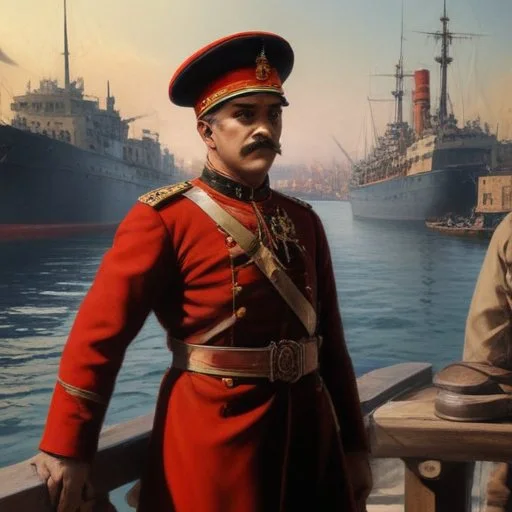
In the early 20th century, the Ottoman Empire was struggling to maintain its territorial integrity amidst the rising tide of nationalism in the Balkans and the Middle East. Meanwhile, the great powers of Europe were engaged in a complex web of alliances, with the Triple Entente (France, Britain, and Russia) pitted against the Central Powers (Germany, Austria-Hungary, and Italy). The Ottomans, sensing an opportunity to reclaim lost territories and protect their interests, cautiously navigated this treacherous landscape.
German Admiral Wilhelm Souchon, who had arrived in Constantinople in August 1914, played a crucial role in convincing the Ottoman government to join the war effort. Souchon's diplomatic prowess and promises of German military support proved persuasive, despite the reservations of the Ottoman Minister of War, Enver Pasha. Meanwhile, the Russian Empire, seeking to expand its influence in the region, had long been a thorn in the side of the Ottomans.
The Ottoman entry into World War I proved disastrous for the empire. The war effort drained its resources, led to widespread famine and poverty, and ultimately paved the way for the empire's collapse. The war also facilitated the Armenian Genocide, a dark chapter in human history that would scar the region for generations to come.
The war had a profound impact on the cultural and social fabric of the region. The displacement of millions of people, the destruction of infrastructure, and the rise of nationalist sentiment all contributed to a sense of chaos and upheaval. The war also marked the beginning of the end of the Ottoman Empire's multi-ethnic, multi-religious character, as nationalist ideologies began to take hold.
The Ottoman entry into World War I remains a topic of intense debate among historians and scholars. While some view the decision as a necessary response to the threat of Russian expansion, others see it as a reckless gamble that doomed the empire. The legacy of the war continues to shape public perception of the Ottoman Empire and its place in modern Turkish identity.
As the great Turkish poet, Nazım Hikmet, once wrote: "The great wars are the wars of the future, not of the past."
The Ottoman entry into World War I serves as a poignant reminder of the dangers of reckless ambition and the devastating consequences of war. As the world continues to grapple with the complexities of global politics and the rise of nationalist sentiment, the story of the Ottoman Empire's downfall serves as a powerful cautionary tale.
Historians have long debated the Ottoman Empire's role in World War I, with some viewing its entry into the war as a catastrophic blunder, while others see it as a necessary response to the threat of Russian expansion. This dichotomy reflects the complexities of the empire's motivations and the multifaceted nature of its war effort.
Some scholars argue that the Ottoman Empire's decision to enter the war was driven by a desire to reclaim lost territories and protect its interests in the face of rising nationalism. Others contend that the empire was drawn into the conflict by its dependence on German military support and the promise of territorial gains.
Recent historiographical trends have shifted the focus from the empire's military campaigns to the experiences of ordinary people during the war, highlighting the human cost of the conflict and the impact of war on civilians.

Wilhelm Souchon, the German Admiral who convinced the Ottoman government to enter World War I, was a charismatic and persuasive diplomat. Born in 1864, Souchon had a distinguished naval career before being dispatched to Constantinople in 1914 to negotiate an alliance with the Ottoman Empire.
Souchon's ability to build relationships with key Ottoman officials, including Enver Pasha, was instrumental in securing the empire's entry into the war. His diplomatic prowess was matched only by his military acumen, as he went on to command Ottoman warships in the Black Sea.
The Ottoman Empire's entry into World War I had a profound impact on its cultural landscape. The war effort drained the empire's resources, leading to widespread famine and poverty, and ultimately paved the way for the collapse of the empire's multi-ethnic, multi-religious character.
The war also facilitated the displacement of millions of people, leading to a sense of chaos and upheaval that would shape the cultural and social fabric of the region for generations to come. The destruction of infrastructure, including historic buildings and cultural artifacts, further eroded the empire's rich cultural heritage.

The Ottoman Empire's decision to enter World War I was a strategic miscalculation of monumental proportions. By aligning itself with the Central Powers, the empire exposed itself to the wrath of the Triple Entente, which possessed superior military might and economic resources.
The empire's failure to secure a decisive military victory in the early years of the war meant that it became increasingly dependent on German support, which only served to exacerbate its diplomatic isolation and military vulnerability.
The Ottoman Empire's entry into World War I was shaped by its precarious position in the global balance of power. The empire was caught between the rival interests of the great powers, with Russia seeking to expand its influence in the region and the Triple Entente intent on containing German and Austrian aggression.
In this complex geopolitical landscape, the Ottoman Empire was forced to navigate a delicate balancing act, seeking to maintain its territorial integrity while avoiding becoming a pawn in the game of great power rivalries.