


In 1493, Pope Alexander VI issued the papal bull Inter caetera, a decree that would shake the foundations of the colonial world. This single document divided the New World between Spain and Portugal, casting an imaginary line down the middle of the Atlantic, known as the Line of Demarcation.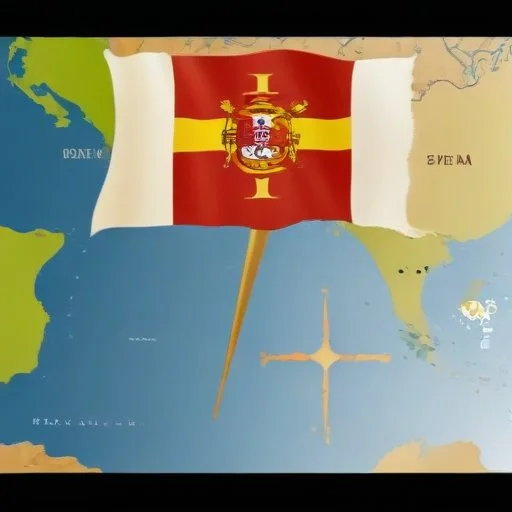
The late 15th century was a time of great exploration and discovery. The New World, with its untold riches and mysteries, had sparked a frenzy of interest among European powers. The Portuguese, led by John II, had been making steady inroads into West Africa and the Atlantic, while the Spanish, under the Catholic Monarchs, Ferdinand and Isabella, were eager to expand their empire.
Enter Pope Alexander VI, a Spanish-born pontiff with close ties to the Spanish monarchy. His papacy was marked by a complex web of alliances and rivalries, with the Portuguese and Spanish monarchies vying for influence and power.
The Inter caetera papal bull drew an imaginary line, running from the North Pole to the South Pole, approximately 370 leagues west of the Cape Verde Islands. This line divided the New World into two distinct zones: the western hemisphere, allocated to Spain, and the eastern hemisphere, allocated to Portugal.
In theory, this line granted Spain control over present-day Mexico, Central America, and South America, while Portugal received dominion over Brazil, West Africa, and parts of Asia. However, the Line of Demarcation was more a theoretical construct than a physical reality, often ignored or disputed by rival powers.
The Inter caetera papal bull had far-reaching cultural and social implications, shaping the trajectory of colonialism, imperialism, and globalization.
The Line of Demarcation marked the beginning of a long and complex process of cultural exchange, conflict, and synthesis, as European powers interacted with indigenous populations and other colonized peoples.
The Inter caetera papal bull has been criticized for its role in perpetuating colonialism, imperialism, and the subjugation of indigenous peoples.
Many have argued that the Line of Demarcation was an arbitrary and unjust division, ignoring the sovereignty of native peoples and the complexities of the New World.
"Alexander VI, the Spanish-born pontiff, drew an imaginary line down the middle of the Atlantic, creating the Line of Demarcation, and sparking a wave of exploration, conquest, and ultimately, the shaping of the modern world." - Historian, John R. Schmidt
"The Line of Demarcation was more than just a geographical construct; it was a symbol of colonial power struggles, and a testament to the enduring legacy of conquest and imperialism." - Scholar, Maria Rodriguez
| 1492 | Christopher Columbus returns from his first voyage to the New World |
| 1493 | Pope Alexander VI issues the Inter caetera papal bull, dividing the New World between Spain and Portugal |
| 1494 | The Treaty of Tordesillas modifies the Line of Demarcation, moving it further west, and allocating more territory to Spain |
The historiography of the Line of Demarcation is a complex and multifaceted field, with various interpretations and debates surrounding its significance and impact. One of the most influential historiographical perspectives on the Line of Demarcation is the "Atlantic turn," which emphasizes the transatlantic connections and exchange networks that shaped the modern world.
Another important perspective is the "postcolonial turn," which critiques the Eurocentric narratives that have dominated the study of the Line of Demarcation and highlights the agency and resistance of indigenous peoples and other colonized groups.
More recently, historians have also begun to examine the Line of Demarcation through the lens of environmental history, exploring the impact of European colonization on the natural environments of the Americas and the role of the Line of Demarcation in shaping the modern environmental crisis.

Pope Alexander VI, born Rodrigo Lanzol Borgia, was a Spanish-born pontiff who played a critical role in shaping the modern world. With his close ties to the Spanish monarchy, Alexander VI used his papal influence to further Spanish interests, most notably through the issuance of the Inter caetera papal bull.
Alexander VI's papacy was marked by a complex web of alliances and rivalries, with the Portuguese and Spanish monarchies vying for influence and power. Despite his Spanish roots, Alexander VI was a shrewd politician who navigated the treacherous waters of European diplomacy with ease.
Alexander VI's legacy is still debated among historians, with some viewing him as a cunning and ruthless operator who furthered the interests of his native Spain, while others see him as a visionary leader who helped to shape the modern world.
The cultural impact of the Line of Demarcation was profound, shaping the trajectory of art, literature, and culture in the Americas and beyond. The Encounter between European colonizers and indigenous peoples led to the creation of new cultural forms, such as the Mestizo arts of Mexico and the Baroque architecture of Brazil.
The Line of Demarcation also had a significant impact on language, with the imposition of European languages such as Spanish, Portuguese, and French on indigenous populations, leading to the suppression of native languages and cultural traditions.
In addition, the Line of Demarcation played a crucial role in shaping the modern concept of race, as European colonizers imposed their own racial categories on indigenous populations, leading to the creation of complex systems of racial hierarchy and segregation.

The geopolitical context of the Line of Demarcation was marked by a complex web of alliances and rivalries between European powers. The Treaty of Tordesillas, signed in 1494, modified the Line of Demarcation, moving it further west and allocating more territory to Spain.
The Line of Demarcation was also influenced by the Ottoman Empire, which was expanding its influence in the Mediterranean and posing a threat to European powers. In response, European powers began to explore and colonize the Americas, using the Line of Demarcation as a tool to divide and dominate the New World.
The Line of Demarcation also played a significant role in shaping the modern geopolitical landscape, influencing the boundaries and territories of nations in the Americas and beyond.
The Inter caetera papal bull, issued by Pope Alexander VI in 1493, is one of the most important historical documents of the Colonial Era. Written in Latin, the document is a testament to the complex web of alliances and rivalries between European powers.
The document itself is a remarkable artifact, with its ornate language and elaborate script reflecting the pomp and circumstance of the Renaissance papacy.The Treaty of Tordesillas, signed in 1494, is another critical document that sheds light on the Line of Demarcation. The treaty, written in Portuguese and Spanish, is a testament to the complex diplomatic maneuvering that shaped the modern world.