


The Wounded Knee Massacre, a brutal and avoidable tragedy, is remembered as one of the most egregious massacres of Native Americans in United States history, with over 300 Lakota Sioux lives lost at the hands of the United States 7th Cavalry Regiment.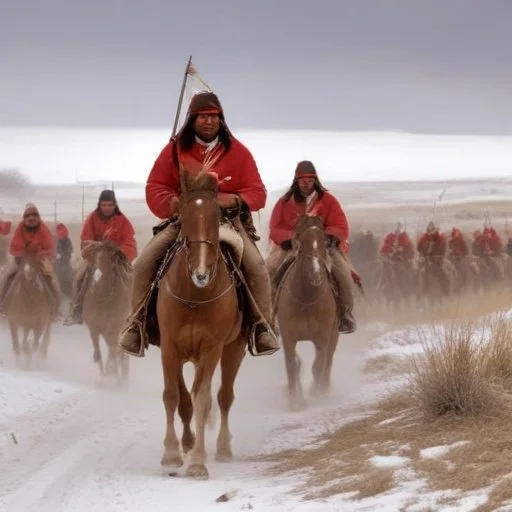
In the late 19th century, the United States government had forcibly relocated many Native American tribes, including the Lakota Sioux, to reservations. The Lakota Sioux, led by Chief Big Foot, had been struggling to maintain their cultural identity and traditional way of life in the face of encroaching American settlement and violence.
On a cold winter morning, Big Foot's band of Lakota Sioux, exhausted from days of travel and dwindling rations, stumbled upon the 7th Cavalry Regiment near Wounded Knee Creek on the Pine Ridge Indian Reservation in South Dakota. The Lakota, many of whom were women and children, were attempting to reach the safety of the nearby Red Cloud Agency.
The 7th Cavalry Regiment, still reeling from the defeat of Lt. Col. George Armstrong Custer at Little Bighorn in 1876, was determined to assert its dominance over the Native American population. Despite being vastly outnumbered, the Lakota were brutally attacked, with the cavalrymen firing indiscriminately into the crowd. The chaos that ensued was merciless, with Lakota women and children being slaughtered alongside their menfolk.
The massacre lasted for mere hours, but the consequences were devastating. Over 300 Lakota Sioux, including Chief Big Foot, lay dead or dying in the snow. The survivors, many of whom were left to wander the frozen landscape without food or shelter, were later taken into custody by the cavalry. The Wounded Knee Massacre marked the end of the Indian Wars and the final chapter in the forced relocation of Native American tribes.
The Wounded Knee Massacre has had a profound impact on Native American culture and identity, with many regarding it as a symbol of the trauma and suffering endured by their ancestors. The massacre has also inspired numerous artistic and literary works, including Dee Brown's acclaimed book "Bury My Heart at Wounded Knee."
The Wounded Knee Massacre remains a contentious issue, with many arguing that it was a deliberate attempt to exterminate the Native American population. Others have criticized the United States government for its failure to provide adequate reparations or acknowledge the full extent of its culpability.
"A people's memory is its collective consciousness, and our collective consciousness is our history. The Wounded Knee Massacre is a part of our collective consciousness, and we must never forget it." - Oglala Lakota elder, Leonard Little Finger
The Wounded Knee Massacre bears striking similarities to other brutal episodes in Native American history, including the Sand Creek Massacre and the Battle of Little Bighorn. These events, while distinct, share a common thread of violence, trauma, and marginalization inflicted upon Native American communities.
Survivors of the Wounded Knee Massacre, including Dewey Beard and Louise Weasel Bear, have shared harrowing accounts of the massacre, providing invaluable insights into the trauma and devastation inflicted upon the Lakota people.
The Wounded Knee Massacre has had a lasting impact on Native American activism, inspiring generations of leaders and advocates to fight for their rights and dignity. It has also influenced American policy towards Native American communities, with many recognizing the need for greater understanding, respect, and reconciliation.
The Wounded Knee Massacre serves as a poignant reminder of the resilience and strength of Native American communities, who have endured centuries of trauma, marginalization, and oppression. It is a testament to their courage, determination, and unwavering commitment to preserving their cultural identity and heritage.
The Wounded Knee Massacre is a stain on American history, a painful reminder of the atrocities committed against Native American communities. Yet, it is also a powerful symbol of the human spirit's capacity for perseverance, forgiveness, and hope.
The Wounded Knee Massacre was part of a larger pattern of violence and intimidation employed by the US government to assert its dominance over Native American tribes. In the years leading up to the massacre, the Lakota Sioux had been subject to forced relocation, land seizures, and cultural suppression.
One of the most significant events that contributed to the tensions leading up to Wounded Knee was the Dawes Act of 1887, which allowed the US government to divide Native American land into individual allotments that could be sold to non-Natives. This led to a significant loss of land and autonomy for the Lakota Sioux, and created resentment towards the US government.

Chief Big Foot, also known as Spotted Elk, was a respected leader of the Miniconjou Lakota Sioux tribe. He was known for his wisdom, compassion, and commitment to preserving the traditional way of life of his people.
Big Foot was a key figure in the events leading up to Wounded Knee, as he had been working to maintain peace and unity among the Lakota Sioux tribes in the face of increasing US government pressure. Despite his efforts, he was brutally killed during the massacre, along with many of his followers.
The Wounded Knee Massacre had a profound impact on Native American art, literature, and music. The traumatic event inspired a range of creative works, including paintings, sculptures, poetry, and music that reflected the sorrow, anger, and resilience of Native American communities.
One notable example is the work of the Native American painter and sculptor, Helen Hardin, who created powerful and moving works that reflected the trauma and pain of the Wounded Knee Massacre. Her work has been celebrated for its raw emotion and powerful storytelling.
The Wounded Knee Massacre bears striking similarities to other brutal episodes in Native American history, including the Sand Creek Massacre and the Trail of Tears. These events, while distinct, share a common thread of violence, trauma, and marginalization inflicted upon Native American communities.
However, the Wounded Knee Massacre stands out for its particularly brutal and indiscriminate nature, as well as its significance as a symbol of the US government's failure to honor its treaties and commitments to Native American tribes.
The Wounded Knee Massacre took place against the backdrop of significant geopolitical tensions and rivalries. The US government was engaged in a series of imperialist wars and expansionist projects, including the Spanish-American War and the annexation of Hawaii, which further solidified its dominance over Native American lands.
In this context, the massacre can be seen as part of a broader pattern of US aggression and expansion, which was justified by ideologies of Manifest Destiny and white supremacy.