


In a groundbreaking move, President Dwight D. Eisenhower sent the 101st Airborne Division to Little Rock, Arkansas, in 1957 to enforce desegregation, marking a pivotal moment in the Civil Rights Movement. This bold decision ensured the safe passage of nine African American students, known as the Little Rock Nine, into Little Rock Central High School, despite fierce opposition from white protesters and Arkansas Governor Orval Faubus.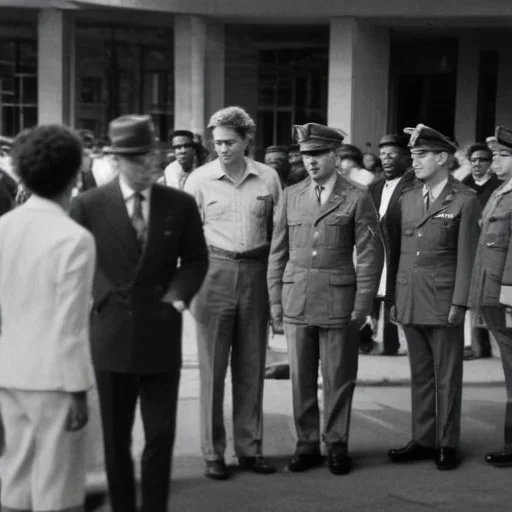
The landmark Supreme Court case, Brown v. Board of Education (1954), declared segregation in public schools unconstitutional. However, many Southern states, including Arkansas, refused to comply, sparking widespread protests and violent clashes. Against this backdrop, the Little Rock Nine, comprising Melba Pattillo, Elizabeth Eckford, Ernest Green, Thelma Mothershed, Gloria Ray, Carlotta Walls, Terrence Roberts, Jefferson Thomas, and Minnijean Brown, sought to integrate Little Rock Central High School.
On September 2, 1957, Governor Orval Faubus deployed the Arkansas National Guard to prevent the Little Rock Nine from entering the school, citing concerns for their safety. This move was deemed unconstitutional by the federal court, which ordered the desegregation of Little Rock Central High School. Nevertheless, Faubus persisted in his defiance, sparking a national crisis.
Faced with the impasse, President Eisenhower took swift action, federalizing the Arkansas National Guard and ordering the 101st Airborne Division to Little Rock. On September 24, 1957, the troops arrived, ensuring the safe passage of the Little Rock Nine into the school. This move sent a powerful message: the federal government would no longer tolerate defiance of its laws and would protect the rights of all citizens.
The Little Rock Crisis, as it came to be known, had far-reaching cultural and social implications. It exposed the deep-seated racial tensions in America, prompting a national conversation about civil rights and social justice. The event also galvanized the Civil Rights Movement, with key figures like Daisy Bates, a prominent activist and newspaper publisher, playing crucial roles in supporting the Little Rock Nine.
"We will not make a joke of our Constitution by permitting the States to disregard willfully the mandate of the Supreme Court." - President Dwight D. Eisenhower
Melba Pattillo, one of the Little Rock Nine, recalled the terror and uncertainty she felt as she walked into the school, surrounded by soldiers and hostile crowds. "I was scared, but I knew I had to do it," she said in a later interview. "I had to show them that we were not going to be intimidated."
The Little Rock Crisis paved the way for the Civil Rights Act of 1964 and the Voting Rights Act of 1965, landmark legislation that further solidified the gains made during the movement. The event also inspired a new wave of civil rights activism, as seen in the Freedom Rides and the March on Washington for Jobs and Freedom.
The Little Rock Nine's bravery and determination inspired generations of students, educators, and civil rights activists. Their story has been immortalized in books, films, and documentaries, serving as a powerful reminder of the importance of standing up for what is right in the face of adversity.
In recognition of their bravery, the Little Rock Nine were awarded the Congressional Gold Medal in 1999. Today, their legacy continues to inspire, with their story a testament to the power of courage, perseverance, and the unwavering pursuit of justice.
Elizabeth Eckford, one of the Little Rock Nine, was only 15 years old when she faced the wrath of white protesters and segregationists. Born in 1942, Eckford was an exemplary student and an avid reader, who dreamed of attending Little Rock Central High School. Despite the threats and intimidation, Eckford remained resolute, inspired by the words of her mother: "If you turn back, you'll never be able to hold your head up again." Eckford's courage and determination paved the way for future generations of African American students.

The Little Rock Crisis marked a significant turning point in American cultural history. The event exposed the deep-seated racial tensions and forced a national conversation about civil rights and social justice. The crisis also galvanized the Civil Rights Movement, inspiring artists, writers, and musicians to create works that reflected the struggles and triumphs of African Americans. From music to literature, the Little Rock Crisis left an indelible mark on American culture.
President Dwight D. Eisenhower's decision to deploy the 101st Airborne Division to Little Rock was a calculated risk that had far-reaching political implications. By taking a firm stance against segregation, Eisenhower sent a powerful message to Southern governors and legislators, while also appeasing the growing civil rights movement. The move strengthened Eisenhower's reputation as a leader, while also setting a precedent for future presidential interventions in civil rights cases.

The historiography of the Little Rock Crisis reflects the evolving narratives of the Civil Rights Movement. Early interpretations of the event framed it as a triumph of federal authority over state sovereignty. Later historians, however, emphasized the agency and activism of the Little Rock Nine, highlighting their bravery and resilience in the face of adversity. More recent scholarship has focused on the intersectionality of race, class, and gender in the Civil Rights Movement, revealing a more complex and nuanced understanding of the Little Rock Crisis.
The Little Rock Crisis unfolded against the backdrop of the Cold War, a period of intense ideological rivalry between the United States and the Soviet Union. The event was closely watched by international observers, who saw it as a litmus test of American democracy and commitment to human rights. The crisis forced the Eisenhower administration to confront the contradictions between its domestic and foreign policies, ultimately leading to a more robust defense of civil rights and liberties.