


On October 7, 1963, President John F. Kennedy made a historic move towards global peace and security by signing the ratification of the Partial Nuclear Test Ban Treaty, banning nuclear tests in the atmosphere, outer space, and underwater. This monumental agreement marked a significant milestone in the quest for nuclear disarmament, reverberating across the globe with a message of hope and cooperation.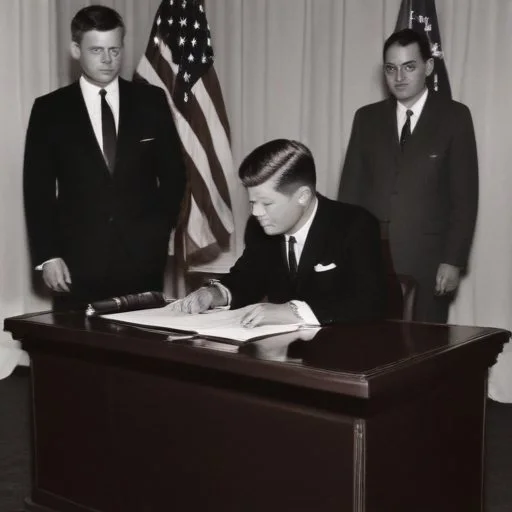
The Partial Nuclear Test Ban Treaty was the culmination of years of diplomatic efforts to curb the nuclear arms race. In the aftermath of the Cuban Missile Crisis, Kennedy and Soviet Premier Nikita Khrushchev sought to reduce tensions and limit the spread of nuclear weapons. After months of negotiations, the treaty was signed on July 25, 1963, by the United States, the Soviet Union, and the United Kingdom.
Kennedy's leadership played a crucial role in the treaty's ratification. His commitment to disarmament and international cooperation was evident in his address to the United Nations General Assembly, where he declared, "Today, every inhabitant of this planet must contemplate the day when this planet may no longer be habitable. Every man, woman, and child lives under a nuclear sword of Damocles, hanging by the slender thread of fate." His words resonated globally, inspiring a new era of diplomacy and cooperation.
The Partial Nuclear Test Ban Treaty prohibited nuclear tests in three environments:
These provisions marked a significant step towards reducing the risks associated with nuclear testing, paving the way for further disarmament efforts.
The treaty's signing had far-reaching consequences, including:
Kennedy's vision for a nuclear-free world continues to inspire generations, serving as a beacon of hope in the pursuit of global peace and security.
"The world is very different now. For man holds in his mortal hands the power to abolish all forms of human poverty and all forms of human life." - John F. Kennedy
Kennedy's leadership and commitment to disarmament left an indelible mark on the world. As we continue to strive for a safer, more peaceful world, the Partial Nuclear Test Ban Treaty serves as a powerful reminder of the importance of international cooperation and diplomacy.
As the world teetered on the brink of nuclear war during the Cuban Missile Crisis, Kennedy's leadership played a pivotal role in easing tensions between the United States and the Soviet Union. The crisis, which lasted for 13 days in October 1962, saw both nations engaging in a high-stakes game of brinksmanship that brought humanity closer to the precipice of nuclear annihilation than ever before. Kennedy's restraint and diplomatic efforts eventually led to a resolution, but the experience left an indelible mark on him, imbuing him with a sense of urgency to address the threat of nuclear weapons.
In the aftermath of the crisis, Kennedy became increasingly vocal about the need for nuclear disarmament, famously declaring in a speech at American University, "Some say that it is useless to speak of disarmament... until the leaders of the Soviet Union adopt a more enlightened attitude. I hope they do. I believe we can help them do it." His words sparked a wave of interest in disarmament efforts, paving the way for the Partial Nuclear Test Ban Treaty.

Nikita Khrushchev, the Soviet Premier, was a complex figure who played a crucial role in the Partial Nuclear Test Ban Treaty. A Communist ideologue with a reputation for bombast and bluster, Khrushchev was also a shrewd politician who recognized the need for diplomacy. His correspondence with Kennedy during the Cuban Missile Crisis revealed a more nuanced personality, one who was willing to compromise and seek peace.
Khrushchev's commitment to disarmament was driven, in part, by a growing awareness of the devastating consequences of nuclear war. He had witnessed the horrors of nuclear testing firsthand, and was deeply troubled by the prospect of a nuclear conflict. His partnership with Kennedy on the Partial Nuclear Test Ban Treaty marked a significant shift in Soviet policy, one that acknowledged the need for international cooperation in the pursuit of peace.
The Partial Nuclear Test Ban Treaty marked a significant departure from previous disarmament efforts, which had focused primarily on stockpile reduction. By banning nuclear tests in the atmosphere, outer space, and underwater, the treaty addressed the environmental and health consequences of nuclear testing, rather than solely focusing on the number of weapons.
In contrast to the Comprehensive Nuclear-Test-Ban Treaty, which would come later, the Partial Nuclear Test Ban Treaty was a more limited agreement that reflected the political realities of the time. While it did not achieve a complete ban on nuclear testing, it marked an important step towards reducing the risks associated with nuclear weapons, and paved the way for future disarmament efforts.

The environmental consequences of nuclear testing were a key driver of the Partial Nuclear Test Ban Treaty. The atmospheric tests conducted by the United States and the Soviet Union in the 1950s and early 1960s had released massive amounts of radioactive fallout into the atmosphere, contaminating large areas of land and water.
The treaty's ban on atmospheric testing was a direct response to the growing concern about nuclear fallout, and the devastating impact it had on the environment and human health. By prohibiting these tests, the treaty helped to reduce the amount of radioactive material released into the environment, and paved the way for further efforts to address the environmental consequences of nuclear testing.
The Partial Nuclear Test Ban Treaty was signed against the backdrop of a rapidly changing geopolitical landscape. The Cold War was in full swing, with the United States and the Soviet Union engaging in a proxy war in Vietnam, and competing for influence in the developing world.
The treaty marked a rare instance of cooperation between the two superpowers, and reflected a growing recognition that the nuclear arms race was unsustainable. By working together on disarmament, Kennedy and Khrushchev hoped to create a new framework for international relations, one that emphasized cooperation and diplomacy over confrontation and competition.