The 1900 Presidential Election: A Landslide Victory for McKinley and Roosevelt
A Dominant Display of Republican Power
The 1900 presidential election is famously remembered as a resounding triumph for President
William McKinley and his running mate, Governor
Theodore Roosevelt of New York. This election marked a watershed moment in American political history, as the Republican Party secured a crushing victory, capturing 292 electoral votes to their opponents' 155.
Historical Context: A Nation in Transition
In the late 19th century, the United States was undergoing a period of rapid industrialization, urbanization, and immigration. The economy was booming, and the country was grappling with the challenges of a rapidly changing society. Against this backdrop, the 1900 presidential election took place, with the incumbent President McKinley and his new running mate, Governor Roosevelt, facing off against the Democratic ticket of
William Jennings Bryan and Adlai E. Stevenson.
The McKinley-Roosevelt Ticket: A Winning Combination
The selection of Theodore Roosevelt as McKinley's running mate proved to be a shrewd move. Roosevelt's charisma, energy, and reputation as a trust-busting governor of New York brought a new level of enthusiasm to the Republican campaign. McKinley, meanwhile, was a seasoned politician with a strong track record of leadership during the Spanish-American War. Together, they formed a formidable ticket that appealed to a broad swath of the American electorate.
Campaign Issues and Strategies
The 1900 campaign revolved around several key issues, including imperialism, tariffs, and the gold standard. McKinley and Roosevelt enthusiastically supported the annexation of Hawaii and the expansion of American influence abroad, while Bryan and Stevenson advocated for a more isolationist approach. The Republicans also campaigned on their support for high tariffs, which they argued would protect American industries and workers. The Democrats, on the other hand, pushed for lower tariffs and free trade.
The Election: A Republican Sweep
On November 6, 1900, the American people went to the polls and delivered a crushing victory to the Republican ticket. McKinley and Roosevelt won 292 electoral votes to Bryan and Stevenson's 155, with the Republicans also securing increased majorities in both the Senate and the House of Representatives.
Key Figures Involved
- William McKinley: The incumbent President of the United States and leader of the Republican Party.
- Theodore Roosevelt: The Governor of New York and McKinley's running mate.
- William Jennings Bryan: The Democratic nominee for President and a populist leader.
- Adlai E. Stevenson: Bryan's running mate and a former Vice President of the United States.
Major Outcomes and Impacts
The 1900 presidential election had significant consequences for American politics and society. The Republican victory cemented the party's dominance in national politics, while the Democrats were left to regroup and reassess their strategy. The election also marked a turning point in the career of Theodore Roosevelt, who would go on to become one of the most influential Presidents in American history.
Cultural and Social Influences
The election of 1900 reflected the shifting cultural and social landscape of the United States. The rise of industrialization and urbanization had created new social tensions and cleavages, and the election campaign addressed these issues in various ways. The Republican Party's emphasis on imperialism and tariffs, for example, resonated with the emerging industrial and business classes, while the Democrats' focus on free trade and populism appealed to farmers and laborers.
Controversies and Public Perception
The 1900 election was not without its controversies. The campaign was marked by bitter rhetoric and personal attacks, with Bryan and Stevenson accusing McKinley and Roosevelt of being beholden to corporate interests. The election also raised questions about the role of big money in politics, as the Republicans outspent the Democrats by a significant margin.
Quote and Memorable Saying
"The duties of the President are not to make legislation, but to execute the laws. It is the duty of the Congress to make the laws." - William McKinley
Impact on Future Events
The 1900 presidential election set the stage for a new era of Republican dominance in American politics. Theodore Roosevelt's rise to national prominence paved the way for his future presidency, during which he would implement a series of far-reaching reforms and assert American leadership on the global stage. The election also marked a turning point in the country's approach to international relations, as the United States began to assume a more assertive role in global affairs.
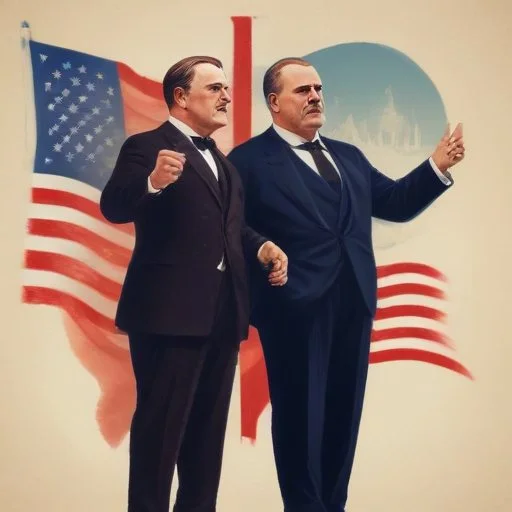
Rich Character Description
Theodore Roosevelt: The Energetic Governor
Theodore Roosevelt, also known as Teddy Roosevelt, was a prominent figure in American politics during the late 19th and early 20th centuries. Born on October 27, 1858, in New York City, Roosevelt was a man of many talents and passions. He was a naturalist, writer, and historian, but it was his career in politics that brought him to the forefront of American life.
Roosevelt's rise to prominence began with his role as the Governor of New York, a position he held from 1899 to 1900. During this time, he made a name for himself as a trust-busting governor, taking on corrupt businesses and monopolies. His energetic and charismatic personality won him many admirers, and it was this reputation that led to his selection as William McKinley's running mate in the 1900 presidential election.
Roosevelt's dynamism and leadership skills were instrumental in the Republican ticket's landslide victory. After the election, he continued to play a crucial role in American politics, eventually becoming the 26th President of the United States after McKinley's assassination in 1901.
Side-by-Side Comparison
A Tale of Two Campaigns: McKinley and Bryan
The 1900 presidential election was a study in contrasts, with two vastly different campaigns waged by the Republican and Democratic parties. On one hand, the McKinley-Roosevelt ticket presented a united front, with a strong incumbent president and a charismatic running mate.
In contrast, the Bryan-Stevenson ticket was marked by internal divisions and a lack of cohesion. Bryan, a populist leader, struggled to reconcile his message of economic reform with Stevenson's more conservative approach to politics.
This contrast in campaign styles was reflected in their respective strategies. The Republicans focused on a positive message of growth and expansion, while the Democrats relied on a more negative approach, criticizing the Republicans' perceived weaknesses.
Ultimately, the Republican campaign's emphasis on unity and optimism resonated with the American people, securing a crushing victory for McKinley and Roosevelt.
Comprehensive Cultural Examination
The Election of 1900: A Reflection of America's Cultural Landscape
The 1900 presidential election was a cultural touchstone, reflecting the shifting values and attitudes of the American people. The campaign's emphasis on imperialism, tariffs, and the gold standard spoke to the concerns of a nation in the midst of rapid industrialization and urbanization.
The Republican Party's focus on expansion and growth resonated with the emerging industrial and business classes, who saw America's future as a global leader. In contrast, the Democratic Party's emphasis on populism and free trade appealed to farmers and laborers, who were wary of the economic changes sweeping the nation.
The election of 1900 marked a turning point in American cultural history, as the country began to assert its influence on the global stage. The campaign's themes of progress, prosperity, and patriotism captured the imagination of the American people, setting the stage for a new era of American dominance.

Full Political Examination
The Republican Party's Strategic Triumph
The 1900 presidential election was a testament to the Republican Party's strategic prowess. The selection of Theodore Roosevelt as William McKinley's running mate proved a masterstroke, bringing a new level of energy and enthusiasm to the campaign.
The Republicans' emphasis on imperialism and tariffs played to their strengths, allowing them to capitalize on the nation's growing economic power. By contrast, the Democratic Party's focus on populism and free trade limited their appeal to a narrower segment of the electorate.
The McKinley-Roosevelt ticket's landslide victory marked a significant turning point in American politics, solidifying the Republican Party's dominance for years to come. Their strategic triumph was a testament to their ability to adapt to changing circumstances and capitalize on emerging trends.
Geopolitical Dynamics Review
The Global Context of the 1900 Election
The 1900 presidential election took place against the backdrop of a rapidly changing global landscape. The Spanish-American War had recently ended, and the United States was emerging as a major world power.
The election's focus on imperialism and tariffs reflected the nation's growing interest in international affairs. The Republicans' support for annexation and expansion resonated with a nation eager to assert its influence on the global stage.
In contrast, the Democrats' isolationist stance seemed out of step with the times, and their defeat marked a significant shift in American foreign policy. The election of 1900 set the stage for the United States' emergence as a global leader, with far-reaching consequences for the nation and the world.


