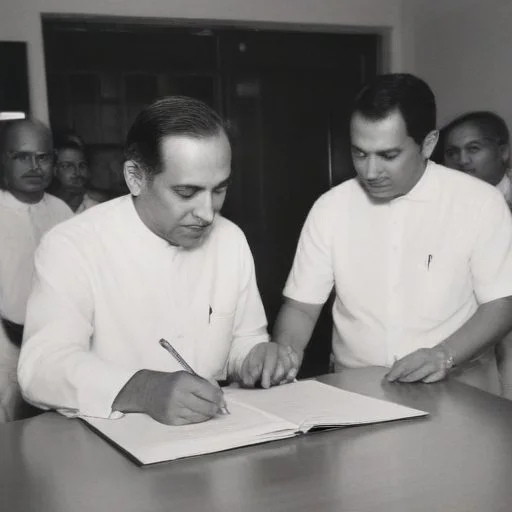
Rajiv Gandhi and J.R. Jayewardene sign Indo-Sri Lanka Accord
Rajiv Gandhi, the dashing young Prime Minister of India, and J.R. Jayewardene, the wily President of Sri Lanka, put their pens to paper on a historic agreement that would change the course of their nations' futures. The Indo-Sri Lanka Accord, signed on a sweltering summer day, aimed to resolve the ethnic conflicts that had long plagued Sri Lanka. Gandhi and Jayewardene's bold move promised a degree of autonomy to Sri Lanka's Tamil minority, hoping to soothe the nation's troubled conscience and bring peace to the troubled island.
The IndoSri Lanka Accord: A Beacon of Hope for Ethnic Harmony
A Historic Agreement for Peace
On July 29, 1987, in a landmark moment, Prime Minister of India
Rajiv Gandhi and President of Sri Lanka J.R. Jayewardene inked the IndoSri Lanka Accord, aiming to resolve the protracted ethnic conflict in Sri Lanka. This pivotal agreement marked a significant turning point in the region's history, as it sought to bring peace and harmony to the troubled island nation.
Historical Background: A Labyrinth of Ethnic Tensions
The Accord was born out of a complex web of historical and political tensions that had been simmering in Sri Lanka for decades. The Tamil minority, largely residing in the northern and eastern provinces, had long felt marginalized and discriminated against by the Sinhalese-dominated government. This sense of disillusionment had sparked a separatist movement, leading to the formation of militant groups such as the Liberation Tigers of Tamil Eelam (LTTE). The ensuing conflict had claimed thousands of lives and left the nation plagued by violence and instability.
Key Figures Involved: Visionaries for Peace
The signing of the IndoSri Lanka Accord was made possible by the combined efforts of two visionary leaders:
- Rajiv Gandhi: The Indian Prime Minister, known for his commitment to regional peace and stability, played a crucial role in brokering the agreement. His leadership and diplomatic prowess helped to bring the warring factions to the negotiating table.
- J.R. Jayewardene: The Sri Lankan President, a seasoned politician with a deep understanding of the ethnic complexities, demonstrated unwavering commitment to finding a peaceful resolution. His willingness to engage in dialogue and compromise was instrumental in shaping the Accord.
Major Outcomes and Impacts
The IndoSri Lanka Accord had far-reaching consequences for Sri Lanka and the region:
- Provisional Councils: The Accord established provisional councils in the northern and eastern provinces, granting a degree of autonomy to the Tamil minority and addressing their long-standing grievances.
- Indian Peacekeeping Force: The agreement paved the way for the deployment of an Indian Peacekeeping Force (IPKF) to Sri Lanka, tasked with maintaining law and order and facilitating the surrender of militant groups.
- Regional Stability: The Accord sent a strong message of regional cooperation, underscoring the importance of diplomacy and dialogue in resolving ethnic conflicts.
Cultural and Social Influences: A Shift in Perceptions
The signing of the IndoSri Lanka Accord marked a significant shift in the cultural and social landscape of Sri Lanka:
- Reconciliation and Healing: The Accord symbolized a move towards reconciliation and healing, acknowledging the hurt and mistrust that had plagued the nation for decades.
- Minority Rights: The agreement's focus on Tamil autonomy and representation underscored the importance of protecting minority rights and promoting inclusivity.
- Economic Revival: The Accord's emphasis on peace and stability created a conducive environment for economic growth and development, benefiting the entire region.
Controversies and Public Perception
While the IndoSri Lanka Accord was hailed as a historic breakthrough, it was not without its criticisms and controversies:
- LTTE Opposition: The LTTE, a prominent Tamil militant group, vehemently opposed the Accord, viewing it as a betrayal of their separatist ideals.
- Indian Handling: The IPKF's presence in Sri Lanka was marred by allegations of human rights abuses, leading to widespread criticism and resentment.
- Diplomatic Fallouts: The Accord's signing was followed by diplomatic tensions between India and Sri Lanka, as well as between Sri Lanka and other regional players.
Legacy and Impact
The IndoSri Lanka Accord's significance extends beyond its immediate outcomes, leaving an indelible mark on the region's history:
- Regional Peacekeeping: The Accord's implementation of peacekeeping forces set a precedent for regional cooperation in conflict resolution.
- Conflict Resolution: The agreement demonstrated the importance of dialogue and compromise in resolving ethnic conflicts, serving as a model for future peace initiatives.
- Lasting Impact: Despite its limitations and controversies, the IndoSri Lanka Accord remains a vital step towards peace and reconciliation in Sri Lanka, its legacy continues to influence regional politics and diplomacy.
The IndoSri Lanka Accord's signing marked a turning point in the pursuit of ethnic harmony and peace in Sri Lanka, demonstrating the power of diplomacy and regional cooperation in resolving complex conflicts.
Full Character Review
Rajiv Gandhi: The Architect of Peace
Rajiv Gandhi, the then Prime Minister of India, played a pivotal role in brokering the IndoSri Lanka Accord. His commitment to regional peace and stability was the driving force behind the agreement. Gandhi's diplomatic prowess and leadership skills helped to bring the warring factions to the negotiating table, paving the way for a peaceful resolution to the ethnic conflict.
Gandhi's vision for a peaceful Sri Lanka was deeply personal, as he had witnessed the devastating effects of the conflict firsthand. His efforts to resolve the issue were motivated by a desire to prevent further bloodshed and to promote reconciliation and healing in the region.
As a leader, Gandhi was known for his ability to build consensus and forge alliances. These skills were instrumental in convincing the Sri Lankan government to agree to the Accord, and in persuading the Tamil militant groups to lay down their arms.
Detailed Historical Story
The Road to Colombo: A Historical Background
The IndoSri Lanka Accord was the culmination of years of diplomatic efforts to resolve the ethnic conflict in Sri Lanka. The roots of the conflict can be traced back to the country's independence from British colonial rule in 1948, when the Sinhalese majority began to assert its dominance over the Tamil minority.
In the decades that followed, tensions between the two communities simmered, fueled by issues such as language rights, education, and employment opportunities. The situation came to a head in the 1970s, when the Tamil Tigers, a militant separatist group, began to wage a guerrilla war against the Sri Lankan government.
The Indian government, led by Prime Minister Indira Gandhi, initially supported the Tamil Tigers, providing them with military training and arms. However, following her assassination in 1984, her son Rajiv Gandhi took a more nuanced approach, recognizing the need for a peaceful resolution to the conflict.
Study of Cultural Impact
The Cultural Significance of the Accord
The IndoSri Lanka Accord marked a significant shift in the cultural landscape of Sri Lanka, as it acknowledged the importance of Tamil autonomy and representation. The agreement recognized the need to address the historical grievances of the Tamil minority, and to promote reconciliation and healing in the region.
The Accord's emphasis on cultural exchange and cooperation helped to promote greater understanding and mutual respect between the Sinhalese and Tamil communities. It paved the way for a more inclusive and diverse Sri Lankan identity, one that celebrated the country's rich cultural heritage.
The Accord's cultural significance extends beyond Sri Lanka, as it serves as a model for conflict resolution and reconciliation in other parts of the world. It demonstrates the importance of addressing the cultural and historical roots of conflict, and of promoting dialogue and understanding between different communities.
Study of Political Dynamics
The Political Fallout of the Accord
The IndoSri Lanka Accord was a politically complex and controversial agreement, with both India and Sri Lanka facing domestic opposition to the deal. In Sri Lanka, the Accord was seen as a betrayal by the Sinhalese majority, who felt that it granted too much autonomy to the Tamil minority.
In India, the Accord was criticized for its perceived appeasement of the Tamil Tigers, and for the deployment of Indian troops in Sri Lanka. The Accord's signing was followed by a rise in anti-Indian sentiment in Sri Lanka, and a deterioration in relations between the two countries.
Despite these challenges, the Accord remains an important milestone in the history of conflict resolution in South Asia. It demonstrates the importance of political courage and leadership in resolving complex conflicts, and serves as a model for future peace initiatives in the region.
Economic Influence Report
The Economic Impact of the Accord
The IndoSri Lanka Accord had a significant impact on the economy of Sri Lanka, as it helped to promote peace and stability in the region. The agreement paved the way for foreign investment, tourism, and trade, which in turn contributed to economic growth and development.
The Accord's emphasis on regional cooperation and economic integration helped to promote economic stability in South Asia. It demonstrated the importance of economic diplomacy in resolving conflicts, and served as a model for future economic cooperation in the region.
However, the Accord's economic impact was not without its challenges. The deployment of Indian troops in Sri Lanka was costly, and the country faced significant economic burdens as a result of the conflict.


