


On this fateful day, the Emerald Isle took a drastic leap towards self-governance, as the Republic of Ireland Act officially came into force, marking Ireland's formal severance from the British Commonwealth. This monumental moment in Irish history declared Ireland a republic, freeing it from the shackles of centuries-long colonial rule.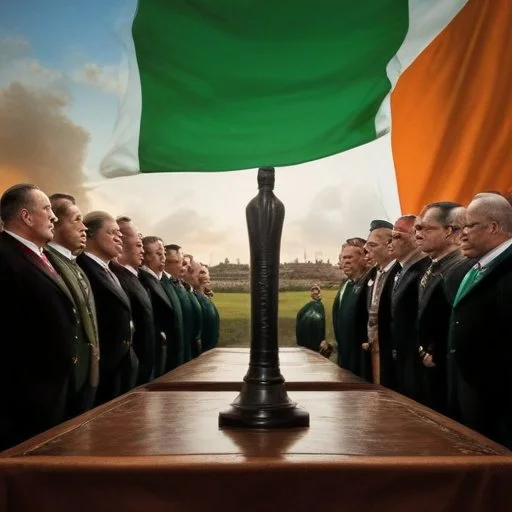
Ireland's struggle for independence was a long and arduous one, with Irish patriots like Éamon de Valera and Seán MacBride fighting tirelessly to break free from British domination. The road to independence was paved with sacrifice, bloodshed, and determination, as the Irish people refused to be bound by the chains of colonialism.
Behind this historic moment were visionary leaders who dared to dream of a free Ireland. Éamon de Valera, a towering figure in Irish politics, played a crucial role in shaping the nation's destiny. His unwavering commitment to the cause of independence inspired a generation of Irish patriots.
The declaration of Ireland as a republic marked a new chapter in the nation's history. As the Irish tricolor waved proudly, the Irish people embarked on a journey of self-discovery, cultural revival, and economic growth. The era of colonial domination was relegated to the past, as Ireland forged its own path, free from the influences of British rule.
The declaration of Ireland as a republic had a profound impact on the nation's cultural landscape. The Irish language, once suppressed by British rule, experienced a resurgence, as the Irish people sought to reclaim their cultural heritage. The nation's rich literary and musical traditions were revitalized, as Irish artists and writers drew inspiration from their newfound freedom.
As Ireland looked to the future, it did so with a sense of pride, purpose, and belonging. The declaration of Ireland as a republic marked a triumphant moment in the nation's history, as the Irish people finally achieved the independence they had fought so hard to attain.
Today, as we look back on this momentous occasion, we are reminded of the power of determination, resilience, and courage. The Republic of Ireland Act's coming into force serves as a testament to the indomitable spirit of the Irish people, who refused to be bound by the shackles of colonialism, and instead, forged their own path towards freedom and self-governance.
Éamon de Valera, a charismatic figure in Irish politics, played a pivotal role in shaping the nation's destiny. Born in the United States to an Irish mother, de Valera was raised in Ireland and educated by the Christian Brothers. He became involved in the Irish independence movement in the early 1900s, eventually rising to become one of the leaders of the Easter Rising in 1916.
De Valera's unwavering commitment to the cause of independence inspired a generation of Irish patriots. He was a skilled politician and strategist, able to navigate the complexities of Irish politics and forge alliances with other independence leaders. Despite being imprisoned and later escaping, de Valera continued to fight for Irish independence, eventually becoming the third President of Ireland and contributing to the drafting of the Irish Constitution.
De Valera's legacy is complex and multifaceted. While he is revered as a national hero, his leadership style was often autocratic, and his decision to launch the Easter Rising without consulting other leaders has been criticized. Nevertheless, his unwavering commitment to Irish independence and self-governance has earned him a place in the pantheon of Irish heroes.
The Republic of Ireland Act, signed into law in 1948, is a crucial document in Irish history. This historic document not only marked Ireland's formal separation from the British Commonwealth but also cemented the country's status as a sovereign nation.
The Act's preamble sets the tone for Ireland's newfound independence, stating that the Irish people are a "sovereign independent and democratic state" and that the Act is intended to "proclaim the establishment of the Republic of Ireland."
The Act's provisions are far-reaching, outlining the structure and powers of the Irish government, as well as the relationship between the state and the Catholic Church. The document also includes provisions for the protection of individual rights and freedoms, solidifying Ireland's commitment to democratic values.
The declaration of Ireland as a republic had a profound impact on the nation's cultural landscape. The Irish language, once suppressed by British rule, experienced a resurgence as the Irish people sought to reclaim their cultural heritage.
The nation's rich literary and musical traditions were revitalized, with Irish artists and writers drawing inspiration from their newfound freedom. Authors such as Flann O'Brien and Samuel Beckett explored themes of identity, nationalism, and the search for meaning in a post-colonial Ireland.
The cultural revival also extended to the visual arts, with Irish artists such as Jack B. Yeats and Paul Henry capturing the essence of the Irish landscape and people. The establishment of the Irish Film Industry in the 1950s further cemented Ireland's cultural independence, providing a platform for Irish storytellers to share their vision with the world.
The Republic of Ireland Act marked a significant shift in Ireland's political landscape, cementing the country's transition from a dominion of the British Empire to a fully independent republic.
The Act's provisions for a presidential system of government, in which the President serves as head of state, reflected a desire to distance Ireland from the British monarchical system.
The establishment of the Republic also led to a reconfiguration of Ireland's international relationships, as the country began to forge its own path on the global stage. Ireland's decision to remain neutral during the Cold War, for example, demonstrated its commitment to independence and self-determination.
The historiography of Ireland's declaration of independence is complex and multifaceted, with different interpretations and perspectives emerging over time.
Early histories of the period, such as those written by Éamon de Valera himself, tended to emphasize the heroic struggle for independence and the triumphant achievement of self-governance.
Later historians, such as J.J. Lee and Ronan Fanning, have adopted a more nuanced approach, highlighting the complexities and challenges of the independence movement and the consolidation of power in the new Irish state.
Recent scholarship has shifted the focus to the experiences of ordinary people during this period, highlighting the diverse perspectives and experiences of women, workers, and other marginalized groups.